
TKO Group's Valuation and Growth Prospects After Seaport Downgrade: A Strategic Investment Analysis
The recent downgrade of TKO Group HoldingsTKO-- (TKO) by SeaportSEG-- Global from "Buy" to "Neutral" has sparked debate among investors about the stock's valuation and growth trajectory. While the move signals reduced short-term optimism, a deeper analysis of TKO's financial performance, strategic initiatives, and market positioning suggests that the downgrade may present a buying opportunity for long-term investors willing to navigate near-term volatility.
The Downgrade: A Cautionary Signal or Overreaction?
Seaport's downgrade, which removed its $200 price target and shifted the rating to "Neutral," reflects concerns about TKO's near-term profitability and valuation. The firm cited a Q4 2025 earnings per share (EPS) estimate downgrade to a $0.33 loss from a $0.08 loss, highlighting deteriorating market conditions[1]. However, this contrasts with a raised Q2 2026 EPS forecast of $1.39 (up from $1.31), indicating some confidence in the company's long-term earnings potential[2]. The downgrade appears to balance skepticism about immediate challenges—such as rising debt servicing costs and margin pressures—with recognition of TKO's structural strengths.
Earnings Momentum and Revenue Diversification: A Foundation for Growth
TKO's Q2 2025 results underscore its resilience. Consolidated revenue hit $1.308 billion, a 10% year-over-year increase, driven by 22% growth in WWE revenue ($556 million) and 5% growth in UFC revenue ($416 million)[3]. These figures outperformed expectations and prompted an upward revision of full-year guidance to $3.005 billion–$3.75 billion in core revenue and $1.49 billion–$1.53 billion in adjusted EBITDA[3].
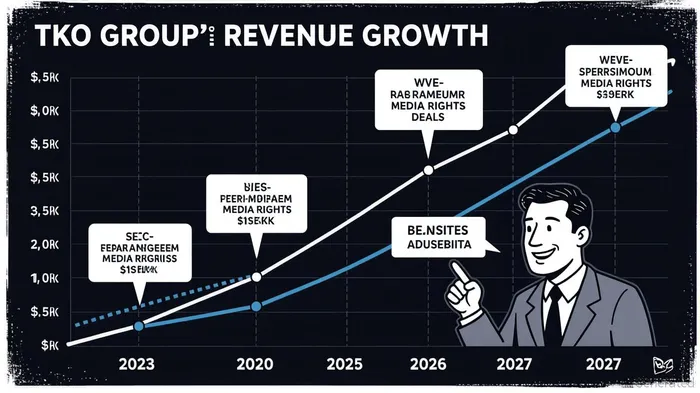
The company's recent media rights deals are pivotal. The UFC's seven-year, $7.7 billion agreement with Paramount, which shifts content to streaming and simulcasts on CBS, is projected to generate $1.1 billion annually[4]. Similarly, WWE's $1.6 billion ESPN deal ensures steady revenue from premium live events[3]. These contracts not only stabilize cash flows but also expand TKO's reach, particularly in international markets. For instance, WWE's NetflixNFLX-- partnership has driven "Raw" to global top-10 rankings in 37 countries[3], diversifying revenue beyond traditional pay-per-view models.
Strategic Expansion and Shareholder Returns
TKO's acquisition of IMG, On Location, and PBR has further diversified its portfolio, enabling cross-synergy opportunities. The "TKO Takeover" event in Kansas City, which unified WWE and UFC under a single live event, demonstrated strong fan engagement and operational coordination[3]. Meanwhile, the company's foray into boxing via a joint venture with Saudi-based Sela—a $10 million management fee upfront—positions it to capitalize on high-profile "super fights" in 2026[3].
Shareholder returns also bolster the investment case. TKOTKO-- doubled its quarterly dividend to $0.76 per share and announced a $2 billion share repurchase program[4]. These moves signal confidence in the company's cash flow generation, even as Seaport highlights concerns about Endeavor Group Holdings' $5.4 billion debt load[5].
The UFC White House Event: Symbolic Catalyst or Financial Driver?
The UFC White House event in July 2026, while unlikely to directly boost revenue, serves as a powerful branding tool. Aligned with the 250th anniversary of U.S. independence, the event enhances TKO's visibility and reinforces its status as a global sports entertainment leader[4]. More importantly, the Paramount deal—already a $7.7 billion windfall—ensures long-term revenue growth by expanding UFC's accessibility to streaming audiences[4]. Analysts project 2026 revenue to hit $4.7 billion, a 67.5% increase from 2025, with further gains expected in 2027[4].
Risks and Considerations
Seaport's downgrade to "Sell" for Endeavor Group Holdings underscores risks, including weak profitability (negative EPS in 2023) and declining gross margins (46% in Q3 2024 vs. 59% in FY2023)[5]. The company's debt burden, while reduced from a peak debt-to-equity ratio of 30.6 in 2020 to 2.05 in 2023, remains a concern in a high-interest-rate environment[5]. Additionally, TKO's stock trades at a 27% premium to its takeover price, reflecting speculative bets on M&A activity rather than current fundamentals[5].
Conclusion: A Buy or a Warning Sign?
The Seaport downgrade is a cautionary signal but not a definitive sell. TKO's structural strengths—landmark media deals, diversified revenue streams, and aggressive shareholder returns—position it to outperform in the long term. While near-term challenges like debt servicing and margin pressures persist, the company's strategic initiatives and earnings momentum suggest that the market may be overreacting to short-term risks. For investors with a 12–18 month horizon, the current valuation offers an opportunity to capitalize on TKO's growth trajectory, provided they monitor debt management and execution risks.





Comentarios
Aún no hay comentarios