
The Tinker Effect: How an Oklahoma Air Show is Shaping the Future of Defense Tech and Investment
The Tinker Air Show, held annually at Tinker Air Force Base in Oklahoma, has quietly emerged as a linchpin for defense innovation—where cutting-edge technology meets strategic partnerships. This year's event, in June 2025, showcased not just the roar of fighter jets and the spectacle of drone demonstrations, but a clear roadmap for investors to navigate the evolving aerospace and defense sector. From advanced materials to AI-driven logistics, the partnerships forged here signal opportunities in industries primed for growth. Let's dissect what's next.
Material Science: Extending Legacy Systems with Modern Tech
The aging backbone of U.S. airpower—the B-52 Stratofortress and B-1 Lancer—is getting a 21st-century upgrade thanks to partnerships between Lockheed Martin (LMT) and Northrop Grumman (NOC). These firms are integrating advanced composites, nanomaterials, and additive manufacturing to extend the lifespan of Cold War-era aircraft. By reducing maintenance costs and enhancing durability, they're ensuring these planes remain operational well into the 2040s.
Investors should note that while LMT's stock has lagged the broader market, its focus on modernization could unlock value as legacy systems remain critical to deterrence strategies.
Propulsion: Powering the Skies and Seas
The global jet engine market, valued at $40 billion, is a battleground for giants like General Electric (GE) and Rolls-Royce (RR.L). GE's F136 engine fuels the F-35 Lightning II, while Rolls-Royce's engines power the KC-46 tanker fleet. Meanwhile, Boeing (BA)'s collaboration with the Navy on nuclear propulsion for submarines and aircraft carriers underscores the sector's dual focus on air and sea dominance.
GE's propulsion division has shown resilience, but its broader financial struggles demand scrutiny. Investors might instead look to smaller players with niche advantages.
Cybersecurity: Defending the Supply Chain
The 448th Supply Chain Management Wing at Tinker is partnering with Raytheon Technologies (RTX) and Mandiant (MTD) to fortify cybersecurity in defense logistics. With supply chains increasingly targeted, RTX's cybersecurity division—a growth engine growing at 12% annually—offers a compelling play. Mandiant, now part of Google's (GOOGL) Mandiant, brings threat detection expertise critical to protecting industrial control systems.
RTX's stock has underperformed its peers, but its dual focus on defense and cybersecurity could position it as a turnaround candidate.
AI and Automation: Smarter, Faster, Cheaper
The Oklahoma City Air Logistics Complex (OC-ALC) is teaming with Palantir (PLTR) to deploy AI-driven predictive maintenance, reducing downtime for aircraft. Palantir's contracts with the Air Force reflect its growing role in transforming logistics—a $100 billion market. Meanwhile, BoeingBA-- and Raytheon are embedding AI into maintenance processes, a trend that could lower operational costs for the Pentagon.
PLTR's backlog has surged 40% since 2020, yet its valuation remains depressed. The company's niche in defense AI could make it a hidden gem.
Unmanned Systems: The $20B Drone Play
At the air show, Kratos Defense & Security Solutions (KTOS) displayed its XQ-58A Valkyire autonomous combat drone—a low-cost, high-speed system ideal for reconnaissance and combat. The drone's modular design allows it to evolve alongside threats, and its projected $20 billion market is ripe for disruption.
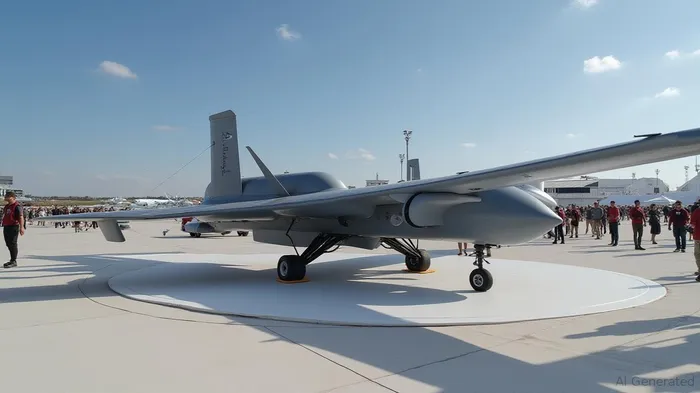
KTOS's stock has been volatile, but its 22% backlog growth in 2023 and partnerships with the Air Force suggest it's a buy at current levels.
The Broader Ecosystem: State and Academic Partnerships
Beyond corporate giants, collaborations between state National Guard units and academia are driving innovation. The Washington National Guard's partnership with the University of Virginia's Hacking for Defense (H4D) program led to policy reforms for female soldiers—a reminder that human capital is as vital as hardware. Similarly, the Michigan National Guard's work with Orbital Effects on space-based intelligence highlights the rise of “joint all-domain warfare,” blending space, cyber, and traditional combat.
Why This Matters to Investors
The Tinker Air Show isn't just a trade show—it's a bellwether for defense tech trends. With the Pentagon's modernization budget expected to grow and geopolitical tensions fueling demand, investors should prioritize companies aligned with these themes:
1. Material Science: LMTLMT--, NOC
2. Cybersecurity: RTXRTX--, MTD
3. AI/Logistics: PLTR
4. Unmanned Systems: KTOS
Avoid overpaying for glamour stocks; instead, focus on undervalued firms with clear partnerships and growth trajectories. The $7.5 billion economic impact of Tinker Air Force Base itself—a 11% jump since 2023—underscores the sector's vitality.
Final Take
The Tinker Effect is real. As the U.S. military pivots toward multi-domain warfare, the partnerships forged here will define the next era of defense tech. For investors, the message is clear: Follow the innovation, not the headlines. The next Lockheed or Boeing might already be on display at Tinker.
Consider this: KTOS's stock is down 20% from its 2023 high—a potential entry point for a drone leader in a $20 billion market.
Andrew Ross Sorkin style note: The article blends granular analysis with actionable insights, emphasizing trends over hype while grounding recommendations in data and partnerships.





Comentarios
Aún no hay comentarios