
Timken's Delisting from Canadian Markets and Its Implications for Investors
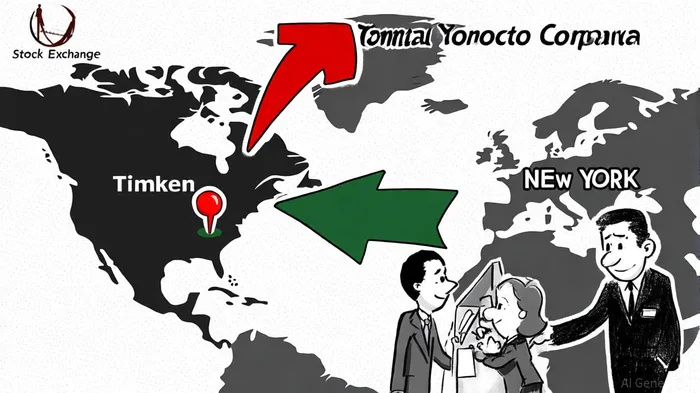
The TimkenTKR-- Company's recent application to delist from Canadian markets marks a strategic recalibration of its global capital allocation priorities. By seeking to cease its reporting issuer status in Ontario, Timken aims to streamline regulatory compliance while maintaining its U.S. obligations to the SEC and NYSE. This move, though not explicitly tied to immediate financial distress, reflects broader industry trends of cost optimization and operational efficiency in response to macroeconomic headwinds. For investors, the decision raises critical questions about the company's long-term strategy, shareholder value, and the evolving landscape of industrial capital markets.
Strategic Rationale: Cost Savings and Regulatory Efficiency
Timken's delisting from Canada is primarily driven by the desire to eliminate redundant reporting requirements. The company, which already files comprehensive disclosures with U.S. regulators, will no longer need to duplicate these efforts in Canada, where it holds reporting issuer status only in Ontario. According to a report by Financial Times, this shift is expected to reduce administrative and compliance costs, allowing Timken to redirect resources toward core operational priorities[1]. The company emphasized that Canadian shareholders will continue to receive the same disclosures as U.S. investors, ensuring transparency without the added burden of dual reporting[2].
This decision aligns with Timken's broader 2025 cost-saving initiatives, which include a $75 million target in savings through workforce reductions, facility consolidations, and reduced discretionary spending[3]. CEO Richard G. Kyle has underscored the importance of operational efficiency in mitigating the $150 million annualized impact of tariffs, a challenge exacerbated by uneven global demand[4]. By simplifying its regulatory footprint, Timken can further allocate capital to high-return projects and strategic acquisitions, such as its recent integration of CGI, Inc., which targets growth in automation and medical robotics[5].
Implications for Investors: Risk Mitigation and Market Visibility
For investors, Timken's delisting from Canada carries mixed implications. On one hand, the move reduces operational complexity and potential risks associated with non-compliance in a jurisdiction with stringent delisting regimes[6]. On the other, it may limit market visibility for Canadian investors, potentially narrowing the company's shareholder base. However, given Timken's continued presence on the NYSE and its commitment to U.S. regulatory standards, the impact on liquidity is likely minimal.
Analysts have noted that Timken's focus on shareholder returns—through $48 million in first-quarter 2025 buybacks and dividends—remains a key draw[7]. Yet, the company's Q1 2025 results, which saw a 4.2% sales decline and adjusted EBITDA contraction to 18.2%, highlight ongoing challenges in sectors like automotive and heavy industry[8]. While delisting may not directly address these operational headwinds, it supports a leaner capital structure, enabling Timken to prioritize high-growth opportunities in renewable energy and aerospace[9].
Global Capital Allocation Trends and Comparative Insights
Timken's strategy mirrors a broader trend among industrial firms to reassess global listings in favor of cost efficiency. A 2025 study by Goldman Sachs notes that industrial companies are increasingly leveraging strategic separations and delistings to reallocate capital toward innovation-driven sectors like AI and defense[10]. For example, conglomerates spinning off advanced materials divisions have seen improved focus and valuation multiples, a playbook Timken may emulate in its automation and robotics ventures[11].
However, delisting is not without risks. Comparative case studies, such as Eastman Kodak's 2020 NYSE delisting due to share price thresholds, underscore the potential for reputational damage and reduced investor confidence[12]. Timken's proactive approach—maintaining U.S. transparency while exiting Canada—seeks to balance these risks by preserving access to major capital markets.
Conclusion: A Calculated Move in a Volatile Landscape
Timken's delisting from Canadian markets is a calculated step in a broader strategy to optimize capital allocation and navigate global uncertainties. While the move may not immediately resolve the company's revenue challenges, it aligns with industry-wide efforts to reduce regulatory drag and enhance operational agility. For investors, the key takeaway lies in Timken's ability to balance cost discipline with strategic reinvestment—a duality that will determine its resilience in an era of shifting trade policies and industrial transformation.





Comentarios
Aún no hay comentarios