
Why Timing the Market is a Losing Game: The Case for Consistent Investing
The age-old debate between market timing and disciplined investing has never been more relevant. As investors grapple with volatility, geopolitical risks, and economic uncertainty, the question remains: Is it better to try to outsmart the market or simply stay invested? A groundbreaking study by Charles SchwabSCHW--, analyzing 20 years of S&P 500 returns, provides a clear answer. Its findings, rooted in historical data and behavioral finance insights, reveal that even poor timing in equities trumps procrastination—and that perfection is far less important than persistence.
The Myth of Perfect Timing
The Schwab study simulated five hypothetical investors with starkly different strategies. Peter Perfect, who perfectly timed the market by investing at the lowest point each year, ended with $138,044 after 20 years. Yet his “perfection” brought only a marginal advantage: just $10,537 more than Ashley Action, who invested immediately at the start of each year. Even Matthew Monthly, who used dollar-cost averaging by dividing investments equally each month, finished third with $124,248—still 81% of Peter's gains.
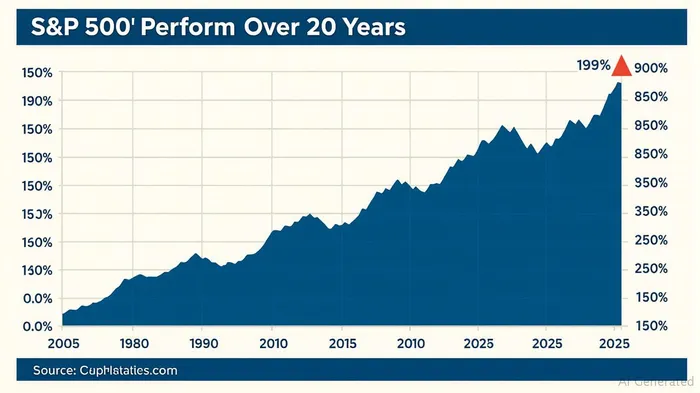
The most striking result, however, involved Rosie Rotten, who invested at the S&P 500's annual peak. Despite this “poor timing,” she still earned $112,292—more than Larry Linger, who kept his money in cash (Treasuries), which yielded only $43,948. The lesson? Missing market swings hurts, but staying out of stocks entirely is far worse. Over the past two decades, the S&P 500's annualized return averaged 8.5%, versus 2.8% for cash—highlighting the cost of inaction.
Behavioral Finance and the Cost of Regret
Market timing's allure stems from human psychology. Overconfidence tricks investors into believing they can predict turning points, while fear of losses drives procrastination. Yet history shows that even professionals struggle to time the market consistently. The Schwab study found that over 78 rolling 20-year periods since 1926, perfect timing ranked first only 68 times—meaning even flawless execution couldn't guarantee dominance. More damning: during weak equity markets (e.g., 1962–1981), immediate investors sometimes underperformed cash—a stark reminder that timing risks are real.
But the greatest cost lies in missed opportunities. Consider that the S&P 500's best days often follow its worst. Missing just the 10 best days in a 20-year period would reduce cumulative returns by nearly 25%. For the average investor, this means selling during downturns (like early 2020) and sitting out recoveries (as seen in late 2020's rebound) can erase decades of gains. Dollar-cost averaging, by contrast, removes emotion from the equation—steadily buying more shares when prices are low and fewer when they're high.
Time Horizon: The Investor's Secret Weapon
The study underscores that time, not timing, is the true catalyst for wealth. A $10,000 investment in the S&P 500 in 2005 would have grown to over $40,000 by 2025—regardless of when it was deployed, provided it stayed invested. This reflects the power of compounding, which even poor timing (Rosie's $112k vs. Larry's $44k) cannot suppress.
For long-term goals like retirement, this means prioritizing consistency over precision. A 30-year-old investing $500 monthly in the S&P 500 (vs. a 25-year-old who delays five years) would amass $680k by age 65—$140k less than the early starter. The math is unforgiving: procrastination is a tax on future wealth.
Practical Strategies for the Disciplined Investor
- Invest Immediately: Unless you're certain of an imminent crash (a rare feat), deploy capital as soon as possible.
- Dollar-Cost Average: For those spooked by volatility, spread investments over time to smooth entry prices.
- Avoid Procrastination: Even small, regular contributions beat waiting for “the right time.”
- Diversify: The study focused on stocks, but real-world portfolios need bonds, commodities, and international exposure to weather downturns.
Caveats and Context
The Schwab study's reliance on the S&P 500 may understate risks in global or emerging markets. Nor does it account for fees or taxes, which can erode returns. Backtesting also assumes flawless execution—something real investors rarely achieve. Yet its core message holds: markets reward patience.
Conclusion
The allure of market timing is a siren song. It promises mastery over chaos but delivers little more than regret. The Schwab study's data is unequivocal: consistent investing, paired with a long-term horizon, is the surest path to wealth. As the old adage goes, “Time in the market beats timing the market”—a truth that 20 years of S&P 500 data has now quantified in cold, hard numbers.







Comentarios
Aún no hay comentarios