
The Timeline and Implications of Scaling Venezuelan Oil Production in 2025
Venezuela's oil sector in 2025 remains a paradox: a country with the world's largest proven oil reserves--struggles to scale production amid geopolitical tensions, operational decay, and economic mismanagement. As of December 2025, , , driven by system failures and uncertainty over U.S. military involvement. This analysis examines the timeline and feasibility of scaling production, emphasizing the interplay of geopolitical constraints and operational bottlenecks.
Geopolitical Restraints: Sanctions and Political Uncertainty
The U.S. embargo on Venezuelan oil, in place since 2019, has crippled the country's ability to access global markets. By December 2025, , with most shipments funneled to China via shadow fleets at discounted prices according to analysis. While the Trump administration recently announced plans to open Venezuela's oil sector to U.S. companies, this initiative hinges on the overthrow of President Nicolás Maduro-a politically uncertain scenario. Even if U.S. firms return, Chevron's current operations.
 International partnerships, such as through 2040, and China's , offer partial lifelines. However, these relationships lack the scale or urgency required to rebuild infrastructure. Analysts caution that meaningful production growth will require not only sanctions relief but also a stable political transition to attract sustained investment.
Operational Challenges: Infrastructure and Efficiency
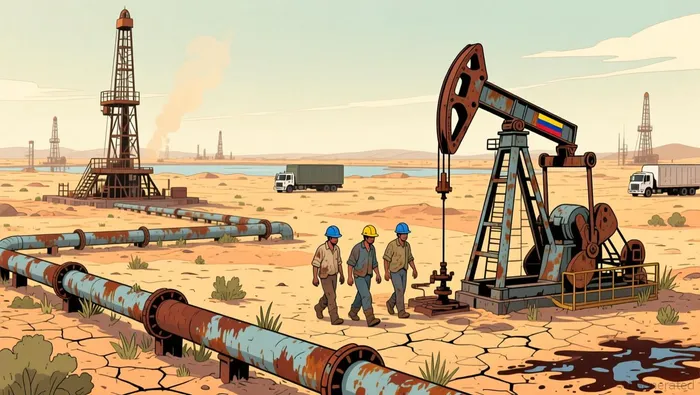
Venezuela's oil infrastructure has deteriorated due to years of underinvestment. The Orinoco Belt, its primary producing region, , reflecting aging facilities and a lack of maintenance. according to data.
Scaling production would necessitate modernizing heavy crude processing facilities and upgrading operational efficiency. However, PDVSA's debt-laden balance sheet and reliance on state subsidies make such investments improbable without foreign capital. Even under optimistic scenarios, experts estimate a return to pre-sanction levels .
The Path Forward: A Decade-Long Timeline
A realistic timeline for scaling production hinges on three interdependent factors:
1. : A shift in governance to stabilize policy and align with international partners.
2. Sanctions Relief: Lifting U.S. and EU restrictions to enable access to global markets and financing.
3. Infrastructure Investment: Billions in capital to repair aging facilities and adopt advanced extraction technologies.
Without these, Venezuela's oil sector will remain trapped in a cycle of decline. Even with favorable conditions, production growth is likely to be modest, with incremental gains over 5–10 years.
Conclusion
Venezuela's oil potential is undeniable, but its realization in 2025 is constrained by geopolitical and operational realities. While international partnerships and U.S. policy shifts offer glimmers of hope, the path to scaling production remains fraught with uncertainty. Investors must weigh the long-term horizon against the risks of political instability and infrastructure decay. For now, Venezuela's oil sector remains a case study in the interplay of resource wealth and systemic collapse.







Comentarios
Aún no hay comentarios