
Timbercreek Financial's Resilience Amid Macroeconomic Uncertainty
Strategic Multi-Family Exposure: A Pillar of Stability
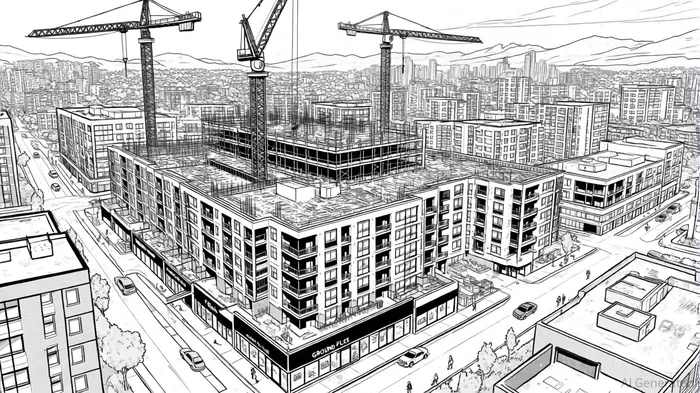
Timbercreek's emphasis on multi-family residential real estate has proven to be a cornerstone of its resilience. As of Q3 2025, multi-family assets accounted for 56.5% of the company's portfolio, a deliberate shift that aligns with long-term demographic trends and housing demand, as reported in Timbercreek's Q3 2025 results. This sector's inherent stability-driven by inelastic demand for rental housing-has shielded Timbercreek from the sharper downturns seen in commercial real estate segments like retail and office.
A notable example is the company's Vancouver retail portfolio, which recorded an expected credit loss (ECL) of $5.9 million in Q3 2025, including $2.1 million tied to a redevelopment project into multi-family units, according to the Q3 2025 results. While this loss reflects near-term challenges, it underscores Timbercreek's proactive approach to repositioning underperforming assets. By converting retail spaces into multi-family housing, the company is future-proofing its portfolio against structural shifts in urban land use and consumer behavior.
Variable-Rate Loan Floors: A Hedge Against Rate Volatility
Timbercreek's variable-rate loan portfolio has been another critical buffer against macroeconomic shocks. As of September 30, 2025, 85.8% of these loans featured rate floors-a significant increase from 77.9% in Q3 2024, as shown in the Q3 2025 results. This structural adjustment has insulated the company from the Bank of Canada's 175-basis-point prime rate decline over the past year. Notably, 92.7% of these loans were already at their floor rates, stabilizing the weighted average interest rate (WAIR) on the portfolio and limiting margin compression, per the Q3 2025 results.
This strategy contrasts sharply with peers relying on fixed-rate debt, which becomes increasingly costly in a rising rate environment. By locking in floors, Timbercreek has created a "floor-to-ceiling" flexibility, allowing it to benefit from rate hikes while capping downside risk during potential rate cuts. The result? A WAIR decline of just 100 bps year-over-year, far outperforming the broader market's volatility reported in Timbercreek's announcement.
Balancing Near-Term Pressures with Long-Term Vision
Despite these strengths, Timbercreek faces near-term headwinds. The $82.9 million repayment in September 2025 reduced its net mortgage investment portfolio, temporarily impacting liquidity, as detailed in the Q3 2025 results. However, the company's robust Q4 2025 transaction pipeline-exceeding $200 million in funded and committed deals-demonstrates its ability to scale operations while maintaining disciplined risk management, according to the same report. CEO Blair Tamblyn's emphasis on "resilience" and "pipeline strength" signals confidence in navigating macroeconomic cycles without compromising growth, per the company's disclosures.
Conclusion: A Model for Defensive Investing
Timbercreek Financial's Q3 2025 results highlight the strategic value of multi-family real estate and variable-rate loan floors as tools for macroeconomic resilience. By prioritizing sectors with structural demand and structuring debt to hedge against rate volatility, the company has positioned itself to outperform in both rising and falling rate environments. For investors, this underscores the importance of aligning asset allocation with long-term trends while maintaining flexibility to adapt to short-term shocks.







Comentarios
Aún no hay comentarios