
TikTok's Geopolitical Crossroads and Investment Implications
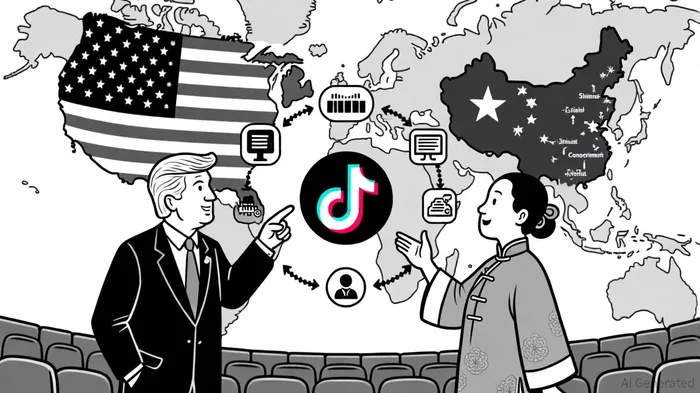
In the volatile landscape of U.S.-China tech tensions, TikTok stands as a microcosm of the broader struggle for digital sovereignty and economic leverage. As of September 2025, the app's future in the U.S. remains suspended in a legal and political limbo, with profound implications for investors. The interplay of regulatory pressure, corporate strategy, and geopolitical calculus has created a high-stakes arena where strategic asset positioning is critical.
Regulatory Developments: A Legal Tightrope
The U.S. Supreme Court's upholding of the Protecting Americans from Foreign Adversary Controlled Applications Act (PAFACA) in January 2025 has forced ByteDance into a precarious position: divest or face a nationwide ban [2]. President Donald Trump's repeated extensions of the divestiture deadline—most recently to December 16, 2025—reflect the administration's dual priorities of addressing national security concerns and preserving TikTok's commercial viability [5]. This delay has bought time for a proposed framework deal, which would see a U.S.-led consortium, including OracleORCL--, Silver Lake, and Andreessen Horowitz, acquire 80% of TikTok's U.S. operations, with ByteDance retaining a minority stake [3].
The deal, if finalized, would align with the 2024 U.S. law capping Chinese ownership at 20%. Oracle's role in managing U.S. user data at its Texas facilities and the establishment of an American-dominated board with a government-designated member aim to mitigate data security risks [1]. However, the final approval hinges on U.S.-China diplomatic coordination, with Trump set to discuss the terms with Chinese President Xi Jinping on September 19, 2025 [5].
Corporate Strategies: Lobbying and Technological Isolation
ByteDance has pursued a dual strategy to navigate the regulatory quagmire. First, it has invested heavily in lobbying efforts, spending over $6 million in the first half of 2025 to influence legislation on data security and platform liability [1]. Second, the company has developed a U.S.-only version of TikTok, codenamed “M2,” with a separate algorithm and infrastructure to isolate American user data from its global operations [5]. This technical pivot underscores ByteDance's attempt to comply with U.S. demands while preserving its core business model.
Despite these efforts, TikTok has resisted a forced sale, maintaining that the PAFACA law is unconstitutional. The company's defiance has kept the app operational, but the looming deadline creates a binary outcome: either a successful divestiture or a catastrophic market disruption [3]. Rival platforms like Instagram Reels and YouTube Shorts are already positioning themselves to capitalize on any user exodus, adding another layer of competitive risk [3].
Investment Implications: Risks and Opportunities
For investors, TikTok's geopolitical crossroads present both risks and opportunities. On the risk side, a failed deal or a ban could trigger a 30-40% drop in TikTok's valuation, with cascading effects on its parent company, ByteDance. The app's 170 million U.S. users represent a critical revenue stream, and its loss could destabilize ByteDance's global advertising and e-commerce ecosystems [4]. Additionally, a ban would create regulatory uncertainty for other Chinese tech firms operating in the U.S., amplifying sector-wide volatility.
Conversely, the proposed consortium deal offers a unique opportunity. Oracle's involvement, in particular, could enhance investor confidence by leveraging its cloud infrastructure expertise to address data security concerns. The 80% stake in TikTok's U.S. operations would also grant the consortium access to a platform with unparalleled youth engagement metrics, potentially boosting their ad-tech and AI capabilities [3]. For long-term investors, the deal could serve as a bridge between U.S. and Chinese markets, mitigating geopolitical friction while securing a stake in a high-growth asset.
Strategic Positioning for Investors
Given the binary nature of TikTok's regulatory outcome, investors must adopt a hedged approach. Short-term traders should monitor the December 16 deadline and the September 19 diplomatic talks, as either event could trigger sharp market movements. Long-term investors, however, may find value in the consortium's proposed structure, which balances U.S. security interests with commercial sustainability.
Moreover, the deal's success hinges on broader U.S.-China trade relations. A deterioration in bilateral ties could scuttle the agreement, while a resolution could set a precedent for managing cross-border tech investments. Investors should also consider the ripple effects on rival platforms and the potential for regulatory overreach in other sectors.
In conclusion, TikTok's journey through the U.S.-China tech tensions exemplifies the complexities of global asset management in a polarized world. For those willing to navigate the uncertainty, the app's geopolitical crossroads offer a rare opportunity to align with both regulatory trends and market dynamics.





Comentarios
Aún no hay comentarios