
The Threshold of Influence: XRP Ownership and Network Power Dynamics
The XRPXRP-- Ledger (XRPL) has long been a subject of debate in the cryptocurrency space, not least because of its unique supply dynamics and the outsized influence of its largest holders. As of December 2025, the distribution of XRP remains highly concentrated, with Ripple Labs-the company behind the asset- controlling 42% of the total supply through escrow accounts. This dominance, combined with the top 100 wallets holding 68% of the circulating supply, raises critical questions about market power, liquidity, and the potential for manipulation. For investors, understanding the thresholds at which XRP ownership can meaningfully influence the ecosystem is essential to navigating the asset's risks and opportunities.
Ownership Concentration and the Ripple Effect
Ripple's control over XRP is both a stabilizing and destabilizing force. By locking 34.48 billion XRP in escrow and releasing tokens at a predictable monthly rate, the company has created a mechanism to avoid sudden supply shocks. This approach has been praised for fostering transparency but criticized for maintaining Ripple's outsized influence. For instance, Ripple occupies eight of the top ten XRP wallet positions, with its holdings dwarfing those of other major players like Binance and Bithumb. Such concentration means that even minor shifts in Ripple's strategy-such as accelerating or slowing token releases-could ripple through the market.
The top 10 XRP holders collectively control 18.56% of the total supply, but the real power lies in the top 100 wallets, which hold 68% of the circulating supply. This suggests that while no single entity (other than Ripple) wields absolute control, a coordinated effort among large holders could sway price action. For example, a 30% increase in Bithumb's XRP holdings in 2025-replacing Uphold as a top holder-demonstrates how institutional or exchange-level movements can signal broader market sentiment.
The Threshold for Market Influence
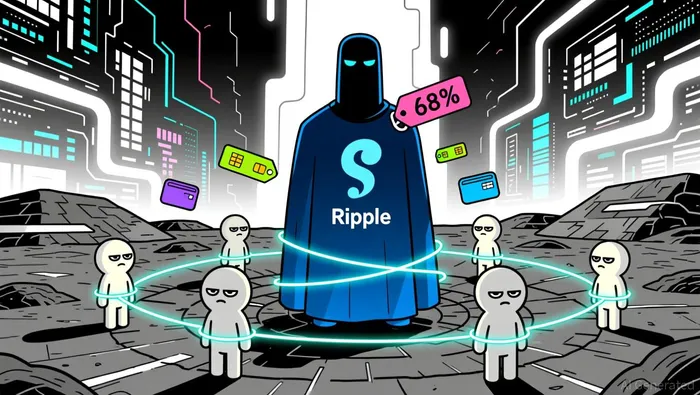
To determine the ownership threshold for meaningful influence, we must consider both quantitative and qualitative factors. Quantitatively, data from XRPSCAN and wallet distribution analyses indicate that holding at least 300,000 XRP places an entity in the top 0.1% of holders. This threshold is significant because it represents a level of ownership that could impact liquidity, especially in lower-volume trading environments. For even greater influence, the top 0.01% requires holding 3.65 million XRP or more, a level achieved by just 743 wallets.
Qualitatively, the impact of large holders is amplified by the XRP Ledger's design. Unlike proof-of-work or proof-of-stake systems, XRPL does not rely on consensus mechanisms that inherently limit the power of large stakeholders. Instead, the network's reliance on a fixed supply and escrowed tokens means that movements by top holders-whether through selling, staking, or strategic partnerships-can directly affect market dynamics. For instance, Ripple's acquisition of Hidden Road and rebranding it as Ripple Prime-a move to become a crypto-owned global prime brokerage-has already expanded XRP's institutional accessibility. Such actions not only increase demand but also signal broader adoption, indirectly influencing smaller investors.
Historical Precedents and Institutional Signals
Historical data underscores the correlation between whale activity and price volatility. In January 2026, XRP whale transactions surged to a three-month high, with large-value transactions (over $100,000) spiking by 29% in 24 hours. While these transactions do not always indicate buying or selling, they often precede inflection points in price trends. Similarly, Ripple's legal victory over the SEC in 2025 triggered an 11% price rally, illustrating how institutional confidence and regulatory clarity can catalyze market sentiment.
Expert analysis further highlights the importance of liquidity and infrastructure. XRP Tundra's adoption of Meteora's DAMM V2 liquidity system, for example, aims to reduce early-stage volatility and stabilize trading behavior. Such innovations suggest that institutional players are increasingly focused on mitigating risks associated with concentrated ownership, rather than exploiting them.
The Path Forward: Institutional Adoption and Price Projections
Looking ahead, the threshold for XRP to achieve broader institutional adoption hinges on its market capitalization and utility. Analysts project that XRP could reach $2.50–$3.20 in 2026 under a conservative scenario, with bullish forecasts extending to $5–$10 by 2030. These projections assume continued regulatory clarity, mass adoption of Ripple's ODL solution, and tokenization of real-world assets on the XRP Ledger. However, the $2.75 level remains a critical resistance point; breaking through it could trigger sustained momentum toward $3.00.
For investors, the key takeaway is that XRP's value proposition is inextricably tied to its ownership structure. While Ripple's control ensures a degree of stability, it also creates a dependency that could be both a strength and a vulnerability. The emergence of secondary players like Binance and Bithumb as top holders suggests a gradual decentralization of influence, but the top 100 wallets still hold the majority of the circulating supply. This dynamic means that any meaningful price movement will likely be driven by coordinated actions among large stakeholders, rather than organic retail demand.
Conclusion
The XRP ecosystem operates at a delicate intersection of control and decentralization. Ripple's escrow mechanism and the concentration of holdings among the top 100 wallets create a unique power dynamic where even minor shifts can reverberate through the market. For investors, understanding these thresholds-whether 300,000 XRP for top-tier status or Ripple's 42% dominance-is crucial to assessing risk and opportunity. As institutional adoption accelerates and liquidity models evolve, the balance of power may shift further, but for now, the threshold of influence remains firmly in the hands of a few.






Comentarios
Aún no hay comentarios