
ThredUp's Strategic Edge: Scaling the Secondhand E-Commerce Boom in 2025
Market Positioning: Dominance Through Differentiation
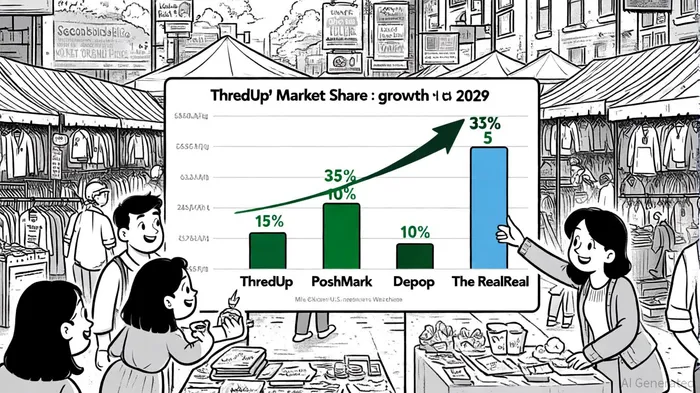
ThredUp's dominance in the secondhand apparel market is underpinned by its RaaS platform, which has onboarded 52 major brands, including J.Crew and Kate Spade, enabling seamless integration of pre-owned inventory into traditional retail ecosystems, as highlighted in ThredUp's SWOT analysis. This model differentiates ThredUp from peers like Poshmark and Depop, which rely on community-driven, peer-to-peer transactions. By handling the entire resale process-from authentication and photography to listing and shipping-ThredUp ensures quality control and convenience, critical factors for scaling in a market where 47% of younger consumers now purchase secondhand directly from brands, according to ThredUp's 2024 Resale Report.
The company's focus on automation and AI further strengthens its position. In Q2 2025, ThredUp reported a 74% year-over-year surge in new buyer acquisition, driven by AI-powered tools like visual search and chat-based recommendations, which boosted conversion efficiency by 18%, per the ThredUp Q2 2025 earnings. These innovations have not only enhanced user experience but also expanded gross margins to 79.5%, reflecting operational discipline in a sector often plagued by low-margin logistics-details shown in the Q1 2025 financial slides.
Scalability: Logistics, Technology, and Margin Expansion
ThredUp's scalability hinges on its ability to optimize logistics and reduce costs. The company has invested heavily in AI-driven automation, aiming to cut item processing costs by 20% and fulfillment expenses by 150 basis points through network optimization, as outlined in ThredUp's 2025-Q4 OKR Plan. These initiatives are critical for maintaining profitability as the market expands. For instance, ThredUp's Q1 2025 adjusted EBITDA margin reached 5.3%, a testament to its cost-control measures and premium inventory mix, according to ThredUp's 2025 rally.
Competitors like eBay and Poshmark face steeper challenges in this regard. eBay's complex fee structure and reliance on third-party logistics limit its agility, while Poshmark's community-centric model, though effective for engagement, lacks the end-to-end infrastructure that ThredUp has built, per a Poshmark vs. ThredUp comparison. Depop, despite its Gen Z appeal, struggles with scalability due to its 10% commission model, which incentivizes small-scale sellers but limits volume growth, as discussed in an analysis of Depop's commission model.
Strategic Execution: Partnerships and Global Ambitions
ThredUp's strategic execution is equally compelling. The company's RaaS model is projected to generate 50% more revenue in 2025 compared to 2024, with 163 brands now offering resale shops through its platform (ThredUp's RaaS expansion in 2025). This expansion is not just quantitative but qualitative: partnerships with luxury and mid-tier brands are diversifying its inventory and attracting higher-margin customers. Additionally, ThredUp's exit from European operations to focus on the U.S. market has streamlined cash flow and accelerated growth, a move analysts view as a catalyst for long-term profitability, according to ThredUp's strategic U.S. focus.
Looking ahead, ThredUp's plans to enter international markets, particularly in Europe, signal ambition beyond its current footprint. With the global secondhand market expected to reach $64 billion by 2033, the company's RaaS model offers a replicable framework for scaling into new regions (second-hand e-commerce growth projections).
Conclusion: A Resale Leader in a Booming Market
ThredUp's combination of technological innovation, strategic partnerships, and operational efficiency positions it as a prime beneficiary of the secondhand e-commerce boom. As the company prepares for its Q3 2025 earnings report, key metrics-such as RaaS revenue growth, AI-driven cost reductions, and EBITDA expansion-will be critical for assessing its trajectory. With the market favoring platforms that balance scalability with sustainability, ThredUp's execution could determine whether it maintains its leadership or faces disruption from emerging rivals.
For investors, the stakes are high. The secondhand apparel market is not just a niche trend but a $74 billion inevitability. ThredUp's ability to navigate this shift with agility and innovation will define its role in shaping the future of fashion.
Historical context from past earnings events offers additional nuance. A backtest of ThredUp's stock performance around earnings releases from 2022 to 2025 reveals mixed short-term signals but a notable medium-term trend: while average returns within the first five trading days were negative and statistically insignificant, cumulative returns turned positive by day 10, reaching approximately 12.5% by day 30-outperforming the benchmark by 4.3 percentage points. Furthermore, the proportion of positive post-earnings moves rose from 40% (day 1) to 80% (day 15–30), suggesting that patience may reward investors despite initial volatility, according to a backtest of ThredUp's earnings. However, these findings are based on only five events, limiting statistical confidence; see the backtest methodology for details.





Comentarios
Aún no hay comentarios