
The Threat to Fed Independence: Implications for Global Markets and Safe-Haven Assets
The Federal Reserve's independence has long been a cornerstone of U.S. economic policy, ensuring that monetary decisions are guided by data and long-term stability rather than short-term political agendas. However, recent developments from 2023 to 2025 have raised alarming questions about the erosion of this independence, with significant implications for global markets and safe-haven assets. As political pressures intensify and legislative proposals challenge the Fed's autonomy, investors must reassess their strategies to navigate a landscape where monetary policy risks becoming a tool of partisan influence.
Political Pressures and Legislative Threats
The Trump administration's repeated attempts to undermine the Fed's independence have drawn widespread criticism. From threats to fire Fed Chair Jerome Powell to the appointment of individuals with overtly political agendas-such as Stephen Miran, who retained his White House role while serving at the Fed- these actions signal a troubling trend of politicization. Miran's dual roles have raised concerns about conflicts of interest, with experts warning that such arrangements could compromise the Fed's ability to act objectively.
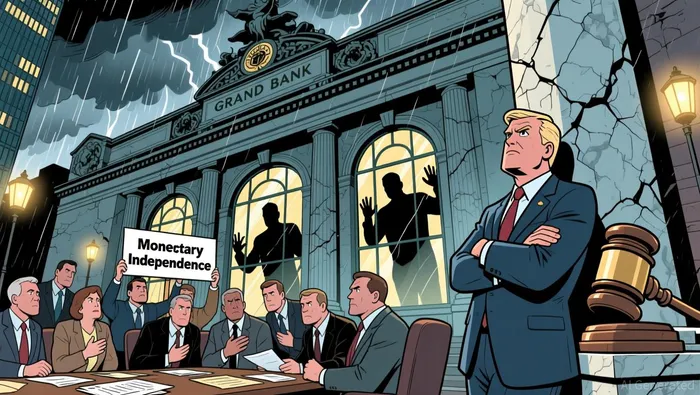 Legislative proposals further exacerbate these risks. H.R.24, the Federal Reserve Transparency Act of 2025, mandates a Government Accountability Office audit of the Fed's operations, reflecting growing congressional demands for accountability. Meanwhile, the Heritage Foundation's Project 2025 advocates for a radical overhaul, including a return to the gold standard and the elimination of the Fed's discretionary power over monetary policy. These proposals, if enacted, could destabilize the Fed's ability to respond flexibly to economic shocks, undermining its core mandate of price stability and maximum employment.
International Reactions and Global Implications
The politicization of the Fed has not gone unnoticed by global counterparts. European Central Bank (ECB) President Christine Lagarde has warned that political interference in the Fed's operations poses a "very serious danger" to both the U.S. and global economies. Similarly, Bank of England Governor Andrew Bailey has described Trump's actions as "very dangerous", emphasizing that the Fed's reputation for independence is critical to maintaining investor confidence. Germany's Deutsche Bundesbank head, Joachim Nagel, has called for stronger European support for the Fed, framing the issue as a defense of shared democratic and economic principles.
The dollar's global dominance is also at stake. As the world's primary reserve currency, the dollar's strength relies on the Fed's credibility as an independent institution. A loss of independence could trigger a shift in capital flows, with investors seeking alternatives to the dollar in a scenario of heightened inflation or policy unpredictability. Deutsche Bank's survey underscores this risk, with 41% of investors viewing a loss of Fed independence as "somewhat likely" and 21% as "very likely." Such sentiment is already reflected in gold's recent surge, as investors hedge against the potential misallocation of capital and a weaker dollar.
Strategic Risks and Opportunities for Investors
The politicization of monetary policy introduces significant risks for global markets. Historically, political interference-such as Nixon's pressure on the Fed in the 1970s-has led to entrenched inflation and economic instability. If the Fed's focus shifts from economic fundamentals to political goals, it could exacerbate inflationary pressures, particularly in a context of extended tax cuts and accommodative fiscal policies. This scenario would likely widen yield curves, increase volatility in equity markets, and erode the purchasing power of fixed-income investments.
However, these risks also create opportunities for investors to position portfolios defensively. Safe-haven assets such as gold, real assets (e.g., infrastructure and commodities), and high-quality equities are likely to outperform in a politicized environment. Morgan Stanley advises reducing exposure to speculative assets and prioritizing "quality large-cap stocks" to mitigate the risks of policy-driven uncertainty. Additionally, investors may benefit from diversifying into currencies and assets less tied to the dollar, such as the euro or Swiss franc, as central banks globally recalibrate their strategies in response to U.S. policy shifts.
Conclusion
The Federal Reserve's independence is not merely a domestic issue but a linchpin of global economic stability. As political pressures and legislative proposals threaten to erode this independence, investors must remain vigilant. The potential consequences-ranging from inflationary surges to a diminished dollar-demand a strategic rebalancing toward resilience and diversification. While the road ahead is uncertain, those who anticipate the risks and adapt accordingly will be better positioned to navigate the turbulence of a politicized monetary policy environment.







Comentarios
Aún no hay comentarios