
The Threat to Fed Independence and Its Implications for Financial Markets
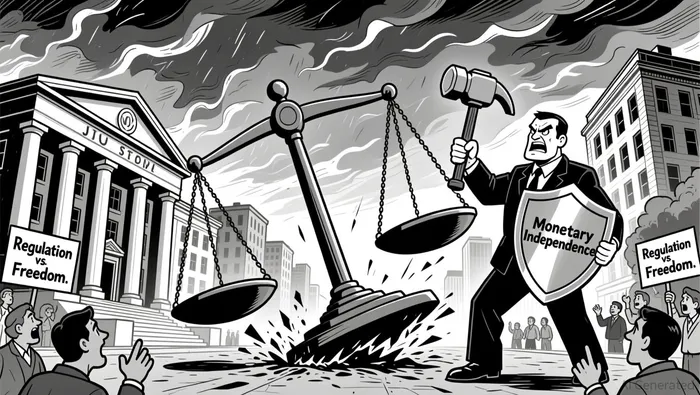
The Federal Reserve's independence has long been a cornerstone of U.S. economic policy, ensuring that monetary decisions are guided by data and long-term stability rather than short-term political agendas. However, recent developments-including a Department of Justice (DOJ) investigation into Federal Reserve Chair Jerome Powell and escalating political pressure from the Trump administration-threaten to erode this independence. These dynamics raise critical questions about the credibility of monetary policy, the trajectory of inflation expectations, and the broader implications for global financial markets.
The DOJ Probe and Political Pressure: A Direct Challenge to Fed Autonomy
The DOJ's criminal investigation into Powell, centered on his testimony about the $2.5 billion renovation of the Fed's headquarters, has been widely interpreted as an attempt to coerce the central bank into aligning with Trump's demands for lower interest rates. Powell has explicitly framed the probe as a "pretext" to undermine the Fed's independence, emphasizing that monetary policy should be based on economic evidence, not political pressure. This conflict has drawn rare bipartisan criticism, with Republican senators like Thom Tillis and Lisa Murkowski condemning the DOJ's actions as a threat to institutional credibility.
Historical parallels to the 1970s loom large. During that era, political interference-such as Nixon's pressure on the Fed to cut rates before the 1972 election- led to the Great Inflation, a period of volatile price increases that destabilized the economy. The current situation mirrors this risk, as political actors seek to prioritize short-term economic goals over long-term stability. If the Fed's independence is compromised, the 2% inflation target-a key anchor for global markets- could lose its credibility, triggering a resurgence of inflationary expectations.
Investor Confidence and Market Reactions
The erosion of Fed independence has already begun to ripple through financial markets. Safe-haven assets like gold have surged, while the U.S. dollar has weakened, reflecting investor uncertainty about the Fed's ability to manage inflation and interest rates effectively. A report by the Atlantic Council notes that the Trump-Powell clash has prompted a "sell America" sentiment, with investors divesting U.S. assets in favor of markets with stronger central bank independence.
This shift is not merely speculative. A 50-year study of 155 central banks found that institutional reforms increasing independence have a measurable positive effect on price stability, particularly in democratic countries with flexible exchange rate regimes. Conversely, political interference risks destabilizing inflation expectations and undermining the Fed's ability to anchor them.
Strategic Investment Considerations for 2026 and Beyond
Given these risks, investors must adopt a hedging strategy to navigate the uncertainty. Here are three key considerations:
- Inflation Hedges: Assets like gold, Treasury Inflation-Protected Securities (TIPS), and commodities (e.g., energy, agriculture) should remain core holdings. The 1970s demonstrated that inflationary environments disproportionately benefit these assets, and current dynamics suggest a similar trajectory.
Diversification into Global Markets: Investors should consider diversifying into international equities and bonds, particularly in countries with independent central banks (e.g., Germany, Japan). These markets are less vulnerable to political interference and offer more predictable monetary policy frameworks.
Equity Sector Rotation: Sectors that thrive during inflationary periods-such as energy, materials, and industrials-deserve increased exposure. Conversely, sectors reliant on low-interest-rate environments (e.g., technology) may face headwinds if the Fed's credibility is further eroded.
Conclusion: A Pivotal Moment for Monetary Policy
The DOJ probe and political pressures on the Fed represent a pivotal moment for U.S. monetary policy. If the Fed's independence is compromised, the consequences could mirror the 1970s: a breakdown in inflation expectations, volatile interest rates, and a loss of global confidence in the U.S. dollar. Investors must act proactively, prioritizing resilience over short-term gains. As former Fed chairs have warned, the stakes extend beyond the U.S. economy-they threaten the stability of the global financial system.







Comentarios
Aún no hay comentarios