
Thermo Fisher's AI Lab Bet: Assessing the Infrastructure Play
Thermo Fisher's announcement of a strategic collaboration with NvidiaNVDA-- is a clear bet on becoming the infrastructure layer for the next scientific paradigm. This is not about incremental tool upgrades; it's a foundational move to build the digital and AI backbone for autonomous laboratories. The partnership aims to connect instruments and data through Nvidia's AI platform, creating a seamless computing fabric from the lab bench to the cloud for high-throughput experiment management. The goal is to provide a seamless computing fabric from the laboratory edge to the cloud for high-throughput experiment management.
Viewed through the lens of technological adoption, this positions Thermo FisherTMO-- at the critical intersection of AI and scientific instrumentation. The company is targeting a paradigm shift from today's manual, step-by-step workflows to automated, AI-assisted processes. The collaboration between Thermo Fisher and NVIDIA will meaningfully contribute to modernizing these processes. By pairing its deep expertise in lab hardware and software with Nvidia's AI infrastructure-including the DGX Spark desktop supercomputer-Thermo Fisher seeks to evolve instruments into intelligent systems that can interact with scientists and continuously learn from each experiment. Starting with NVIDIA DGX Spark as a benchtop AI supercomputer, Thermo and NVIDIA easily build and employ quality control and analytics agents to help scientists interpret data as it's generated.
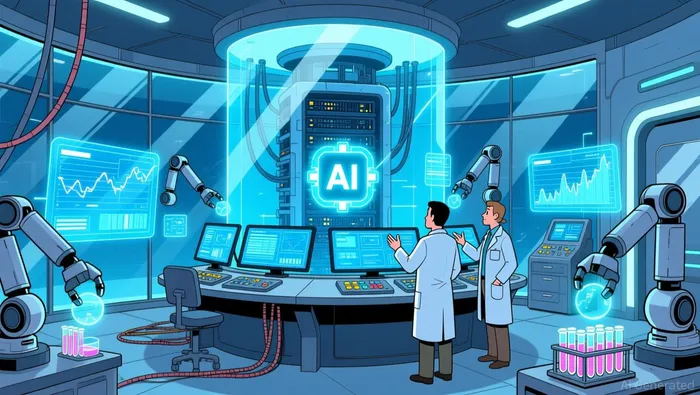
The strategic intent is direct and high-value. The collaboration's focus on joint efforts to bring integrated solutions to customers across biopharmaceutical R&D and manufacturing signals a targeted attack on a market defined by capital intensity and long development cycles. This is where the exponential curve of AI-driven discovery could yield the highest returns. For ThermoTMO-- Fisher, success here would redefine its growth trajectory from a supplier of discrete instruments to the provider of the fundamental rails for industrial-scale scientific advancement. The bet is on becoming the essential infrastructure layer for the "lab-in-the-loop" era.
Financial Impact and Execution Risks
The financial calculus for Thermo Fisher's AI bet is stark. On one side, the company faces a clear margin compression trend that challenges its pricing power and cost discipline. Adjusted gross margins fell to 42.2%, a significant drop from 46.4% in 2019, and the broader adjusted EBIT margin has declined sharply over recent years. This sets a high bar for any new investment to generate returns that can offset or reverse this pressure.
On the other side, the growth runway for the core business may need to accelerate to justify the capital required for this paradigm shift. While the forecast for revenue from lab products and services calls for a 5.4% compound annual growth rate over the next three years, that pace is modest against the backdrop of a capital-intensive AI build-out. The historical growth rate from 2019 to 2024 was stronger at 16.9%, suggesting the current forecast may be conservative or that the company is navigating a more mature phase. For the AI infrastructure play to be a net positive, Thermo Fisher will likely need to demonstrate that this new layer can not only be profitable but also catalyze faster growth across its entire portfolio.
The financial terms of the Nvidia collaboration remain undisclosed, but the investment required to build and deploy a platform based on technologies like the Nvidia DGX Spark desktop supercomputer represents a significant capital allocation decision. This is a classic infrastructure bet: the upfront cost is high, but the payoff is the creation of a proprietary, sticky ecosystem that could redefine the company's competitive moat. The risk is that the margin headwinds and moderate growth forecast leave less financial flexibility to fund this bet without straining the balance sheet or delaying other strategic initiatives. The company must execute flawlessly to turn this potential upside into a tangible financial advantage.
Competitive Landscape and the Closed-Loop System
The partnership with Nvidia creates a powerful, integrated system that could redefine the competitive landscape. Nvidia's role is to provide the essential compute layer-the "seamless computing fabric from the laboratory edge to the cloud". This positions the chipmaker not just as a supplier of hardware, but as the foundational infrastructure for Thermo Fisher's physical lab ecosystem. The collaboration starts with the Nvidia DGX Spark desktop supercomputer, embedding AI directly at the bench and creating a continuous data stream from instrument to cloud.
This setup enables a potential closed-loop system. Nvidia's advanced AI models, like those being developed with partners such as Eli Lilly, can directly optimize Thermo Fisher's instrument workflows. The Lilly-Nvidia lab aims to build a "continuous learning system" that connects wet labs with computational dry labs. In practice, this means AI agents can flag anomalies in real-time, recommend experiment adjustments, and validate results before the next run. Each experiment feeds back into the model, creating a feedback cycle that accelerates discovery. For Thermo Fisher, this transforms its instruments from static tools into dynamic, learning components of a larger AI-driven system.
Competitors are also building lab automation infrastructure, but Thermo Fisher's scale combined with Nvidia's compute partnership may create a formidable, integrated alternative. Companies like LabVantage and PerkinElmer focus on software and integrated platforms, but they lack this direct, high-performance compute partnership. Thermo Fisher's advantage lies in its deep penetration into biopharma R&D and manufacturing, giving it a vast installed base of instruments to connect. By anchoring its physical infrastructure to Nvidia's AI fabric, the company risks creating a proprietary ecosystem that is difficult for rivals to replicate. The competitive dynamic shifts from selling standalone instruments or software to selling a complete, AI-optimized workflow platform. The winner in this race will be the one that builds the most seamless, high-performance loop between physical experiments and computational intelligence.
Catalysts, Scenarios, and What to Watch
The strategic thesis for Thermo Fisher's AI bet now hinges on a series of forward-looking milestones. The primary catalyst is the successful deployment of the Nvidia DGX Spark desktop supercomputer and the integration of AI agents into real-world lab workflows at select biopharma partners. This is the first tangible step from announcement to execution. The goal is to move beyond theoretical benefits and demonstrate a working "autonomous lab" where AI agents can flag anomalies, validate results, and recommend adjustments in real-time, making each experiment smarter than the last. Starting with NVIDIA DGX Spark as a benchtop AI supercomputer, Thermo and NVIDIA easily build and employ quality control and analytics agents to help scientists interpret data as it's generated.
Investors should watch for concrete evidence of reduced experiment cycle times and increased data accuracy in pilot programs. These metrics are the clearest validation of the promised value proposition. If the closed-loop system can demonstrably accelerate discovery timelines or improve the reliability of results, it would prove the exponential potential of the infrastructure layer. The collaboration with Eli Lilly, which aims to build a "continuous learning system" for drug discovery, provides a high-profile benchmark. Early results from such partnerships will be critical for building credibility and attracting broader adoption.
At the same time, the financial execution risk remains. Thermo Fisher must maintain or improve its margin profile while funding this strategic initiative. The company's adjusted gross margin fell to 42.2%, and its adjusted EBIT margin has declined sharply, creating a high bar for any new investment to generate returns. The capital required to build and deploy a platform based on technologies like the DGX Spark represents a significant allocation. Sustaining investor confidence will depend on the company's ability to show that this infrastructure bet can eventually offset or reverse these margin pressures, rather than exacerbate them. The path forward is a race between exponential adoption of the new AI workflows and the persistent cost discipline needed to fund the build-out.





Comentarios
Aún no hay comentarios