
Thailand's Surprising Export Growth: A Strategic Buying Opportunity in Key Sectors
Thailand's export-driven economy has defied global headwinds in 2025, with a 12.7% year-over-year surge in total exports, driven by strategic industrial policies and foreign investment inflows. While many analysts focused on traditional manufacturing, the country's pivot toward high-value sectors like electronics, electric vehicles (EVs), and sustainable agriculture has unlocked new equity opportunities. For investors, this represents a rare confluence of government incentives, supply chain repositioning, and global demand shifts.
Electronics: The Semiconductor and Optoelectronics Boom
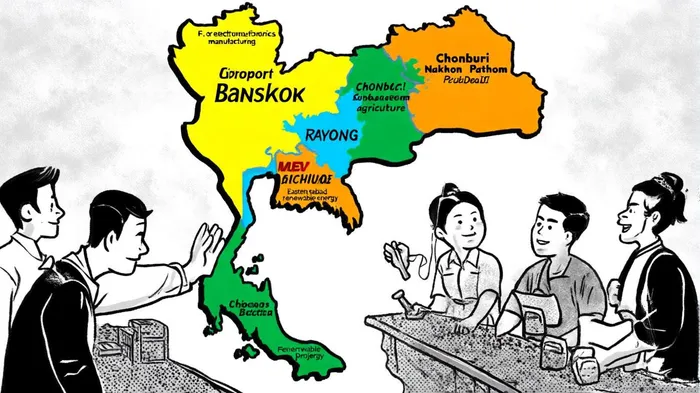
Thailand's electronics sector remains a cornerstone of its export success, with integrated circuits and office machine parts accounting for USD 31.5 billion in Q3 2025 exports, according to Thailand import statistics. The government's aggressive incentives-such as 13-year corporate income tax exemptions for semiconductor fabrication projects exceeding THB 1.5 billion in machinery investment-have attracted firms specializing in next-generation optoelectronics and advanced components, as outlined in BOI incentives.
Chinese tech giants and regional partners are capitalizing on these incentives. For instance, a THB 50 billion investment by a multinational semiconductor firm in Bangkok's Eastern Economic Corridor (EEC) is projected to create a 10,000-job ecosystem by 2026, leveraging Thailand's low-cost labor and proximity to ASEAN markets, according to a Thaiger report. Investors in local suppliers, such as firms producing printed circuit boards or optical sensors, stand to benefit from rising demand for 5G infrastructure and AI-driven manufacturing.
Electric Vehicles: A 30@30 Strategy with Global Partnerships
Thailand's "30@30" EV strategy-aiming for 30% zero-emission vehicle production by 2030-has transformed the country into Southeast Asia's EV manufacturing hub. By Q3 2025, EV exports had already reached 12,500 units, with Chinese automakers like BYD and CATL leading the charge. CATL's USD 100 million battery assembly plant in Rayong, for example, is set to supply 50,000 EVs annually, leveraging Thailand's 8-year tax exemption and 100% foreign ownership policies, according to BOI EV incentives.
The Board of Investment (BOI) has further sweetened the deal for EV manufacturers. Projects meeting 40% local content requirements for battery electric vehicles (BEVs) qualify for import duty waivers on critical components like lithium-ion cells, per a Tractus-Asia report. This has spurred vertical integration, with Thai firms now producing EV charging stations and lightweight materials. For equity investors, this ecosystem offers exposure to both manufacturing and infrastructure plays, particularly in firms like Siam Cement Group (SCG), which is pivoting into EV battery recycling.
Agriculture: From Traditional Exports to Agri-Tech Innovation
While rubber and durian exports remain staples, Thailand's agricultural sector is undergoing a quiet revolution. The government's 5-year tax exemptions for agri-tech projects have accelerated investments in precision farming and alternative proteins. For example, a THB 3 billion smart greenhouse project in Chonburi is using AI-driven irrigation to boost cassava yields by 30%, with exports projected to hit USD 4.2 billion by 2026, according to the Tractus-Asia report.
The rise of plant-based proteins also presents a compelling angle. With Thailand's future food sector growing at 9.52% annually, firms like Thai Good Crops are scaling up production of pea protein and mycoprotein, targeting the $100 billion global alternative protein market, as noted by the same Tractus-Asia analysis. Investors in agri-tech startups or logistics firms serving these exports could capitalize on Thailand's first-mover advantage in Southeast Asia.
Renewable Energy and Digital Economy: The Next Frontier
Thailand's renewable energy targets-30% of total energy from renewables by 2037-are creating tailwinds for solar and wind projects. The BOI's 5-year tax holidays for solar panel manufacturers have already drawn investments from South Korean and Chinese firms, with grid modernization contracts expected to exceed USD 2 billion in 2025, per Tractus-Asia.
Meanwhile, the Thailand 4.0 digital economy strategy is fueling demand for data centers and cloud infrastructure. A THB 20 billion data center project in Nakhon Ratchasima, backed by a 10-year tax exemption, is set to serve ASEAN's growing e-commerce and fintech sectors, according to a Chambers article. This positions Thailand as a regional hub for digital services, with equity opportunities in firms like True Digital, which is expanding its 5G and AI capabilities.
Conclusion: Equity Positioning in a High-Growth Ecosystem
Thailand's export growth is no accident-it's the result of a calculated industrial strategy, foreign partnerships, and investor-friendly policies. For equity buyers, the most compelling opportunities lie in sectors where government incentives align with global demand trends:
- Electronics: Semiconductor suppliers and optoelectronics firms.
- EVs: Battery manufacturers, charging infrastructure, and recycling startups.
- Agriculture: Agri-tech platforms and alternative protein producers.
- Renewables: Solar panel makers and grid modernization contractors.
As Thailand's export value chain continues to evolve, early-stage investors who align with these strategic sectors stand to reap outsized returns. The key is to act before global capital catches up to this Southeast Asian success story.







Comentarios
Aún no hay comentarios