
Thailand's Strategic Attraction for Chinese Manufacturing Investment: Regulatory Momentum and Long-Term Returns
Thailand has emerged as a pivotal destination for Chinese manufacturing investment, particularly in the electric vehicle (EV) sector, driven by a combination of regulatory reforms, strategic incentives, and long-term economic vision. As global supply chains diversify and U.S.-China trade tensions persist, Thailand's proactive policies are reshaping its industrial landscape, offering Chinese firms a gateway to regional and global markets. This analysis examines Thailand's regulatory momentum, the economic returns of Chinese investments, and its competitive positioning against Vietnam and Indonesia.
Regulatory Momentum: A Policy-Driven Transformation
Thailand's regulatory environment has undergone significant modernization to attract foreign capital. The Board of Investment (BOI) has introduced incentives tailored to Chinese EV manufacturers, including up to 8 years of corporate income tax exemptions and 100% foreign ownership in EV production under the BOI's EV incentives. These measures align with Thailand's 30@30 policy, aiming for 30% zero-emission vehicle production by 2030, as reflected in the BOI EV 3.5 policy. To qualify for additional benefits, manufacturers must meet local content requirements-40% for Battery Electric Vehicles (BEVs) and 45% for Plug-in Hybrid Electric Vehicles (PHEVs)-further incentivizing supply chain localization, according to the BOI incentives.
The 2025 Foreign Business Act (FBA) amendments have further streamlined foreign ownership rules, eliminating restrictive practices like nominee shareholding and easing equity caps in restricted industries, as noted in a Thai Examiner analysis. These reforms, coupled with streamlined visa processes for foreign executives, position Thailand as a business-friendly hub for multinational corporations. Additionally, the BOI's EV 3.5 policy mandates a 1:1 import-to-local production ratio in 2024 and 1:1.5 in 2025, compelling Chinese automakers to scale domestic assembly, according to a Thai Times report.
Economic Impact: Chinese Investments and Localization Gains
Chinese EV manufacturers, including BYD, MG, and GWM, have poured $1.44 billion into Thailand's EV sector since 2023, creating over 9,600 local jobs and sourcing 40–60% of components domestically, as reported by The Diplomat. These investments have spurred upstream supply chain development, with battery giants like CATL and Gotion High-tech establishing assembly plants in collaboration with Thai partners, a trend The Diplomat also highlights. The government's cash subsidies and tax breaks have accelerated EV adoption, with exports surging 300% in 2023 to markets like Singapore, Laos, and Cambodia, per The Diplomat.
Long-term returns are bolstered by Thailand's strategic location and infrastructure. The Eastern Economic Corridor (EEC), a $50 billion development project, is being transformed into a high-tech manufacturing hub with dedicated EV clusters. By 2030, the government projects 290,000 BEV sales annually, supported by a target of 12,000 DC fast chargers, according to a KPMG outlook. Chinese automakers are also incentivized to increase local content to 90% by 2030, ensuring sustained value creation, as noted by The Diplomat.
Comparative Analysis: Thailand vs. Vietnam and Indonesia
While Vietnam and Indonesia remain competitive, Thailand's regulatory stability and high-tech focus offer unique advantages. Vietnam's 2020 Law on Investment and Land Law 2025 have reduced bureaucratic hurdles, but its lower labor costs and younger workforce make it more attractive for low-cost manufacturing, according to a Thailand Business News piece. Indonesia, meanwhile, has leveraged its critical mineral resources (e.g., nickel) to attract Chinese investments in battery production, with projects like BYD's smelters and CATL's joint ventures, as analyzed by the Lowy Institute. However, Indonesia's regulatory complexity and infrastructure gaps in non-urban areas pose challenges, as observed by Thailand Business News.
Thailand's edge lies in its established automotive supply chain, skilled workforce, and pro-business policies. Unlike Vietnam's focus on HMLV (high-mix, low-volume) production, Thailand's EV 3.5 policy prioritizes large-scale manufacturing and export readiness, a point emphasized by The Diplomat. Indonesia's downstreaming policies (e.g., export bans on raw materials) create dependency on Chinese processing expertise, whereas Thailand's local content requirements foster self-sufficiency, per the Lowy Institute.
Challenges and Sustainability
Thailand faces headwinds, including political instability and sluggish local demand for EVs. The decline of the internal combustion engine (ICE) industry-now at its lowest sales in 14 years-has led to 100 factory closures monthly since 2021, underscoring the need for workforce reskilling, as reported by Thai Examiner. However, the government's Bio-Circular-Green (BCG) model and 50% renewable energy target by 2037 align with global sustainability trends, according to an EIU analysis. Chinese investors benefit from Thailand's MiT (Made in Thailand) certification, which enhances export competitiveness, per the BOI incentives.
Vietnam's Green Industrial Push and Indonesia's IFRS S1/S2 sustainability reporting standards highlight regional competition in ESG compliance, as noted in a Broadsheet piece. Yet, Thailand's EV 3.5 policy and local content incentives ensure that Chinese investments contribute to both economic and environmental goals.
Conclusion: A Strategic Hub for Long-Term Returns
Thailand's regulatory momentum and strategic incentives make it a compelling destination for Chinese manufacturing investment. While Vietnam and Indonesia offer cost advantages, Thailand's focus on high-tech, sustainable industries and regulatory clarity ensures long-term value creation. As Chinese automakers scale local production and supply chains, Thailand's EV sector is poised to become a regional export hub, delivering robust returns for investors and reinforcing its role in the global green economy.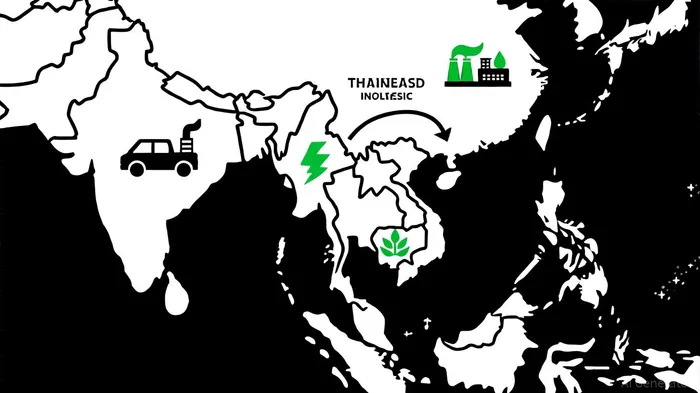







Comentarios
Aún no hay comentarios