
Thailand's Political Uncertainty and Election Outlook: Geopolitical Risk and Market Volatility in Southeast Asia
Thailand's political landscape in 2025 remains a focal point of concern for investors and policymakers alike. With the 2026 general election looming, the country faces a confluence of domestic and global risks that threaten to amplify market volatility across Southeast Asia. The National Economic and Social Development Council (NESDC) has flagged four critical risk signals-U.S. reciprocal tariffs, a slowing global economy, high private-sector debt, and pre-election political uncertainty-as potential catalysts for economic instability. These factors, compounded by historical patterns of political upheaval, underscore the fragility of Thailand's investment climate and its ripple effects on regional markets.
The NESDC's Four Risk Signals: A Looming Perfect Storm
The U.S. imposition of a 19% tariff on Thai imports in August 2025 has already disrupted key export sectors, including rubber products, gems and jewelry, and electrical appliances. This move, coupled with broader U.S.-China trade tensions, threatens to erode Thailand's export competitiveness and industrial production. Meanwhile, a global economic slowdown and rising protectionism are exacerbating supply chain vulnerabilities, particularly in sectors like rare earth minerals and vehicles.
 High private-sector debt remains another critical constraint. Household debt in Thailand reached 86.8% of GDP in Q2 2025, a level that stifles domestic demand and economic recovery. Political uncertainty further compounds these challenges. The Business Sentiment Index has historically shown volatility during government transitions, and the anticipated dissolution of the House of Representatives by early 2026 could delay fiscal planning for the FY2027 budget, compounding economic fragility.
Historical Precedents: Political Instability and Market Reactions
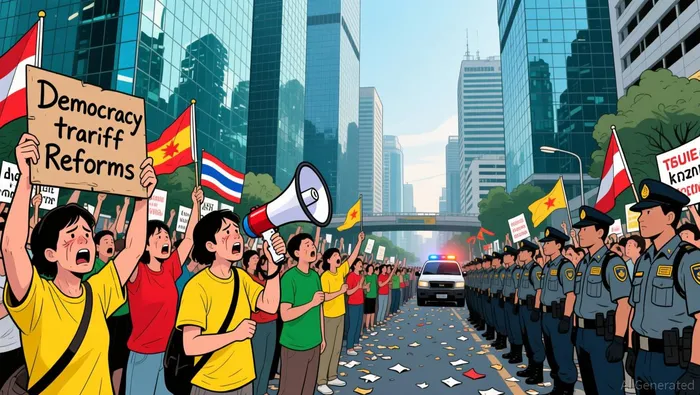
Thailand's history of political instability offers a cautionary tale. The 2014 military coup, while initially perceived as a stabilizing force, failed to address structural economic issues and eroded long-term investor confidence. Similarly, the 2019 election, which returned democratic governance, did not resolve deep-seated political divisions. In 2025, renewed protests and leaked communications between the Prime Minister and Cambodian officials triggered a $2.3 billion exodus of foreign capital from the Thai equity market, with the SET Index falling to its lowest point in over three years.
These episodes highlight a recurring pattern: political uncertainty in Thailand often leads to sharp declines in investor confidence, currency depreciation, and sector-specific volatility. For instance, tourism and healthcare stocks fell over 15% in 2025 due to waning consumer confidence, while banks and retail firms fared better due to their domestic focus.
Regional Implications: Thailand's Role in Southeast Asian Markets
Thailand's economic performance is a bellwether for Southeast Asia. In Q3 2025, the country lagged behind regional peers like Vietnam and Malaysia, which demonstrated stronger growth amid global headwinds. The Philippines and Thailand both experienced their weakest growth since 2021, underscoring the uneven impact of external shocks such as U.S. tariffs.
Investor behavior in 2025 reflects a recalibration of regional strategies. While Thailand's political turmoil has driven capital outflows, it has paradoxically attracted inflows from more volatile markets like Indonesia, where fiscal uncertainty and a sudden change in the finance ministry have spooked investors. This divergence underscores the growing importance of political stability in Southeast Asia's investment calculus.
Navigating the Risks: Strategies for Investors
For investors, the path forward requires a nuanced approach. The Thai government's 157-billion-baht stimulus package and targeted incentives for high-growth sectors like advanced manufacturing and digital technology aim to mitigate risks. However, these measures may not fully offset the impact of U.S. tariffs or political instability.
Historical data suggests that sectors with strong domestic demand-such as infrastructure and fintech-are more resilient during periods of uncertainty. Additionally, hedging against currency fluctuations and diversifying regional exposure could help mitigate risks. As one analyst notes, "Thailand's long-term appeal lies in projects like the Eastern Economic Corridor (EEC), but short-term volatility will persist until the election's outcome provides clarity."
Conclusion
Thailand's 2026 election represents a pivotal moment for Southeast Asia's economic trajectory. The interplay of domestic political uncertainty, global trade tensions, and structural debt challenges creates a high-risk environment for investors. While the country's strategic initiatives and regional trade integration offer long-term potential, the immediate outlook remains fraught with volatility. Investors must balance caution with strategic opportunities, prioritizing resilience over short-term gains in an increasingly unpredictable landscape.







Comentarios
Aún no hay comentarios