
Thailand's Monetary Policy Challenges and Structural Reforms: Assessing Long-Term Investment Resilience Amid Shifting Central Bank Priorities and Economic Fragility
Thailand's economic trajectory in the post-pandemic era has been shaped by a delicate balancing act between inflation control, growth support, and structural transformation. As the Bank of Thailand (BOT) navigates a shifting global landscape marked by trade tensions, domestic debt burdens, and uneven recovery, its monetary policy decisions and the government's structural reforms will determine the nation's long-term investment resilience.
Monetary Policy: A Tightrope Between Inflation and Growth
The BOT has maintained a medium-term inflation target of 1.0–3.0% since 2023, a range designed to balance price stability with sustainable growth. However, the central bank's recent actions reveal a growing emphasis on growth support. In December 2025, the Monetary Policy Committee (MPC) cut the policy rate by 0.25 percentage points to 1.25%, a move aimed at mitigating deflationary pressures and stimulating economic activity amid slowing growth. This shift reflects the MPC's prioritization of vulnerable groups and small and medium enterprises (SMEs), even as it remains vigilant about external risks such as U.S. trade tariffs and domestic demand weakness.
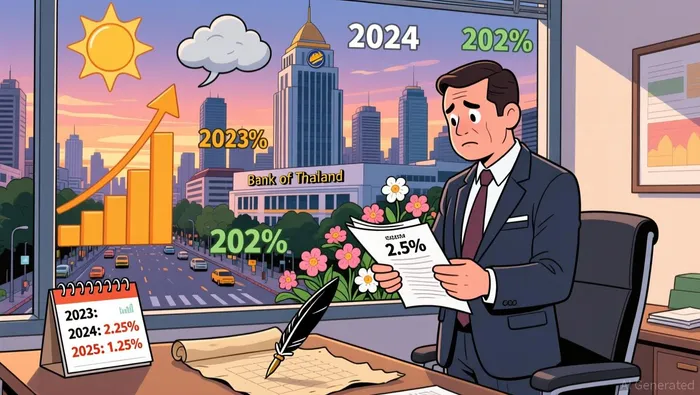
The central bank's accommodative stance is further underscored by its history of gradual adjustments. For instance, in 2023, the policy rate was raised to 2.5% to curb temporary inflationary pressures, but by 2024, it was reduced to 2.25% to foster sustainable growth. This flexibility highlights the BOT's commitment to avoiding rigid policy frameworks, a strategy that has helped Thailand's economy grow from 1.9% in 2023 to 2.4% in 2024. Yet, the central bank faces a critical test in 2026, when growth projections are expected to slow to 1.6% amid global headwinds.
Structural Reforms: A Path to Resilience or a Work in Progress?
While monetary policy provides short-term stability, Thailand's long-term investment resilience hinges on structural reforms. The OECD has emphasized the need for reforms to boost productivity, including simplifying trade regulations, reducing bureaucracy, and attracting foreign investment. However, progress has been uneven. For example, the labor market remains plagued by informality, which limits productivity and social protection access. Similarly, regional development disparities-exemplified by Bangkok's dominance- continue to stifle balanced growth.
The government has introduced targeted measures, such as the "digital wallet" fiscal stimulus, which is projected to boost growth by 0.5–1 percentage point over 2024–2025. Yet, these efforts have come at a cost: public debt now stands at 65% of GDP, raising concerns about fiscal sustainability. The IMF has urged Thailand to adopt a "credible medium-term consolidation strategy" to address this imbalance while preserving fiscal space for growth-enhancing investments.
Foreign Investment and the Risks of Global Shocks
Thailand's economic recovery has been bolstered by a surge in foreign direct investment, particularly in high-value sectors like electric vehicles and advanced electronics. In 2025 alone, FDI applications reached THB 1.37 trillion (USD 42.2 billion), a 94% year-on-year increase. However, these inflows are not without risks. The high import content of many projects exposes Thailand to U.S. transshipment tariffs, while political uncertainty has delayed budget preparations and eroded investor confidence.
The BOT's rate cuts and the government's "Thailand 4.0" agenda-focusing on innovation-driven industries- aim to mitigate these risks. Yet, structural challenges persist. For instance, the lack of high-skilled labor in digital and green technologies threatens to limit the spillover benefits of FDI. Without targeted vocational training and SME support, Thailand risks creating a two-tier economy where foreign firms dominate technological frontiers while domestic firms lag according to analysis.
Conclusion: A Fragile Equilibrium
Thailand's economic resilience in 2025 is a mixed picture. While the BOT's accommodative monetary policy and the government's fiscal stimulus have provided near-term stability, structural reforms remain incomplete. The central bank's ability to maintain low interest rates and the government's capacity to implement productivity-enhancing policies will be critical in 2026, when growth is projected to slow further. Investors must weigh the potential of Thailand's strategic sectors against the risks of political instability, trade tensions, and domestic debt. For now, the nation's long-term investment appeal depends on its success in transforming these challenges into opportunities.







Comentarios
Aún no hay comentarios