
Thai Baht on the Brink: Hedging Strategies for Equity Investors Amid Political and Tariff Risks
Thailand's currency, the baht, faces a critical juncture as political instability and looming U.S. tariffs threaten to push it past the psychologically important 34.00 THB/USD threshold. With the current exchange rate at 32.8 THB/USD (as of June 19, 2025), investors must act swiftly to hedge against further depreciation, which could exacerbate import costs, erode corporate earnings, and derail economic recovery. This article explores the risks and outlines actionable strategies for equity investors.
Political Crisis: A Catalyst for Currency Volatility
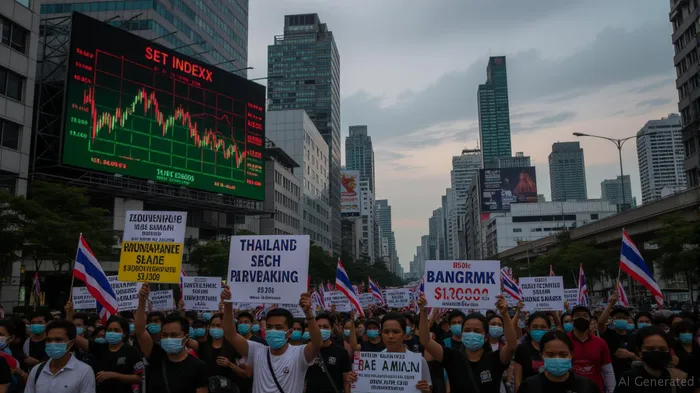
Thailand's political turmoil, fueled by the suspension of Prime Minister Paetongtarn Shinawatra and protests demanding her resignation, has triggered a $2.3 billion exodus of foreign capital from equities year-to-date. This outflow has sent the Stock Exchange of Thailand (SET) Index plunging nearly 24% year-to-date—its lowest in over three years. The crisis has stalled critical fiscal policies, including the 2026 budget, risking delays in infrastructure projects like the Eastern Economic Corridor (EEC).
The political paralysis has also intensified concerns over Thailand's $46 billion trade surplus with the U.S., which remains a focal point of U.S. trade negotiations. A weaker baht would worsen this imbalance, amplifying tariff risks.
U.S. Tariffs: The Sword of Damocles
The U.S. is poised to impose tariffs of up to 36% on Thai exports, targeting sectors like automotive parts, electronics, and agricultural goods. While Thailand has proposed reducing its trade surplus with the U.S. by 70% over five years—via increased LNG imports and BoeingBA-- aircraft purchases—the final tariff rate hinges on negotiations concluding by July 9. Analysts warn that even a 20% tariff could shave 0.5-1% off Thailand's GDP growth, which already faces headwinds from high household debt (170% of GDP) and sluggish domestic demand.
The automotive sector, which lacks a U.S. Free Trade Agreement (FTA), is particularly vulnerable. Competitors like Vietnam and Mexico—benefiting from lower tariffs—could capture market share, squeezing Thai automakers like Toyota MotorTM-- Thailand and PTT Global Chemical.
Currency Devaluation: The Tipping Point at 34.00 THB/USD
The baht's recent volatility is no anomaly. Historical context reveals that a sustained breach of 34.00 THB/USD would mirror the 2008 financial crisis, when the baht plummeted to 42.20 THB/USD. A weaker baht would:- Increase import costs: Fuel and machinery imports (22% of total imports) would become costlier, squeezing corporate margins.- Erode tourism revenue: Foreign tourists, already down 2.9% month-on-month in May, would face higher costs, further weakening the baht.- Undermine fiscal stability: A weaker currency would complicate debt servicing, given Thailand's $1.3 trillion external debt.
Hedging Strategies: Protecting Equity Portfolios
Investors must adopt a multi-pronged approach to mitigate currency risks:
1. Short the Baht via FXTH ETF
The ProShares UltraShort Thai Baht (FXTH) provides a 2x leveraged inverse exposure to the baht's performance against the U.S. dollar. With the baht's 12-month volatility at 6.2%, FXTH could deliver significant gains if the currency weakens past 34.00.
2. Sector-Specific Plays: Energy and Infrastructure
- Energy: Thai energy firms like PTT Pcl (PTT.BK) benefit from higher oil prices (a baht depreciation boosts dollar-denominated revenues). PTT's LNG import commitments under its U.S. trade proposal also align with tariff mitigation efforts.
- Infrastructure: Amata Corporation (AMATA.BK), a developer of industrial parks, stands to gain from fiscal stimulus once political stability returns. Its projects in Vietnam and Indonesia also offer diversification.
3. Diversification into ASEAN ETFs
Investors should consider the Market Vectors Indonesia ETF (IDX) or iShares MSCI Malaysia ETF (EWM), which offer exposure to politically stable ASEAN markets while hedging against baht-specific risks.
4. Short-Term Bonds and Inverse ETFs
- Thai Government Bonds (7-10Y): A 7.5% yield offers downside protection against equity volatility.
- Inverse ETFs: The iPath Inverse MSCI Thailand ETF (THN) provides short exposure to the SET Index, ideal for defensive positioning.
Investment Thesis and Urgency
The baht's proximity to 34.00 THB/USD demands immediate action. Equity investors should:1. Allocate 5-10% to FXTH to hedge against currency depreciation.2. Rotate into energy and infrastructure stocks (e.g., PTT, AMATA) for sector-specific resilience.3. Diversify into ASEAN ETFs to reduce baht exposure.
Failure to act could amplify losses if the baht breaches 34.00, triggering a feedback loop of capital flight and tariff impositions. The window to lock in hedging strategies is narrowing—investors must act before July 9's tariff deadline.
Conclusion
Thailand's political and trade risks are no longer theoretical. With the baht hovering near critical thresholds and tariffs looming, equity investors must prioritize hedging. By combining short-term currency hedges, sector-specific plays, and regional diversification, portfolios can withstand—and even profit from—the storm. The stakes are high, but so are the rewards for those prepared to navigate this volatile landscape.







Comentarios
Aún no hay comentarios