
Texas Instruments' Q3 2025 Earnings: A Strategic Inflection Point for Analog Dominance
Financial Resilience Amid Margin Compression
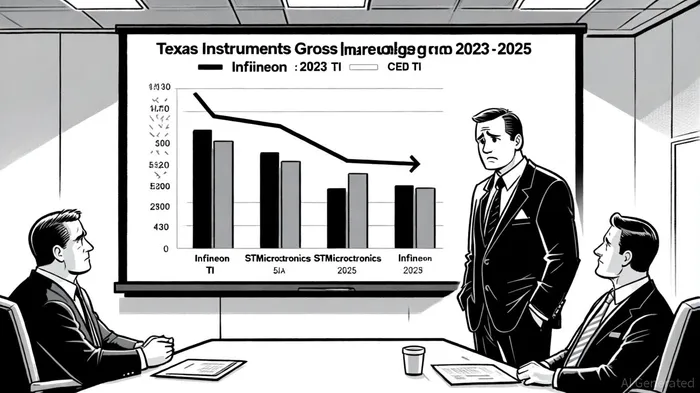
TI's Q3 net income of $1.36 billion yielded a 28.67% profit margin, a figure that, while impressive, masks underlying challenges. The company's gross margin contracted by 2.2 percentage points year-over-year, attributed to rising fixed costs from its 300mm wafer manufacturing strategy, according to a Panabee analysis. This margin compression reflects broader industry trends, as companies like Infineon Technologies and STMicroelectronics also grapple with cost inflation and commoditization. For instance, STMicroelectronics reported a 33.5% gross margin in Q2 2025, while Infineon's gross margin stood at 38.7% in an STMicro press release. TI's margin, though still robust, lags behind these peers, signaling a need for operational efficiency improvements.
The company's free cash flow, however, remains a standout. Trailing 12-month free cash flow hit $2.4 billion, a 65% year-over-year increase, enabling TI to return $6.6 billion to shareholders through dividends and buybacks, as noted in the TI press release. This financial flexibility positions TI to weather near-term headwinds, but its Q4 guidance-below analyst expectations of $4.51 billion-suggests demand volatility in key markets like industrial and automotive, an issue highlighted by MarketMinute.
Analog Dominance Under Threat
TI's Analog segment, which accounts for 79% of total revenue, remains a cornerstone of its strategy. The segment's 16% year-over-year growth in Q3 2025 outpaced the broader analog semiconductor market, which is projected to grow at a 7.4% CAGR through 2034, per a GM Insights forecast. However, TI's market share in the analog segment has dipped marginally, losing 2% over two years to low-cost competitors, particularly from China, according to an InvestorVector analysis. Infineon and STMicroelectronics, meanwhile, have maintained stronger positions: Infineon's automotive semiconductor revenue exceeded $8 billion in 2024, while STMicroelectronics holds a 19.1% market share in analog, per a ThisVsThat comparison.
The competitive landscape is further complicated by divergent R&D strategies. TI's R&D spending as a percentage of revenue stood at 11.4% for the trailing 12 months, slightly below Infineon's 13.27% in 2024, according to Macrotrends data. STMicroelectronics, despite a 1.1% decline in R&D spending in 2025, continues to prioritize automation and 300mm wafer expansion at its Agrate facility, aiming to double capacity by 2027, per an ST program announcement. These investments underscore the importance of innovation in maintaining analog leadership, a domain where TI's recent focus on volume-based manufacturing may leave it exposed.
Manufacturing Strategies: Efficiency vs. Scalability
TI's long-term strategy hinges on internal control of its supply chain, with plans to achieve 95% internal production by 2030 through 300mm wafer fabrication in Texas and Utah, as described in TI's manufacturing overview. This approach contrasts with Infineon's and STMicroelectronics' reliance on foundry partnerships and diversified manufacturing footprints. For example, Infineon's acquisition of Marvell's automotive Ethernet business for $2.5 billion in 2025 signals a strategic pivot toward software-defined vehicles, while STMicroelectronics is reconfiguring its Crolles and Catania facilities to focus on digital products and silicon carbide production, as reported in an EE Times roundup.
The trade-off between TI's vertical integration and its peers' scalable, flexible models remains a key differentiator. While TI's 300mm strategy enhances wafer efficiency, it also locks in significant fixed costs. In contrast, STMicroelectronics' shift to automation and modular production could enable faster adaptation to demand swings-a critical advantage in a post-pandemic market characterized by rapid cycles.
Strategic Inflection Point: Risks and Opportunities
TI's Q3 results highlight a strategic inflection point. The company's analog dominance is underpinned by strong cash flow and a resilient core business, but its margin pressures, tepid Q4 guidance, and R&D intensity relative to peers suggest vulnerabilities. The analog semiconductor market, valued at $87.5 billion in 2024, is expected to expand with automotive electrification and 5G adoption, according to the GM Insights forecast cited above. Yet, TI's ability to capitalize on these trends will depend on its capacity to balance cost discipline with innovation.
For investors, the key question is whether TI can sustain its analog leadership while addressing margin erosion and competitive threats. Its $3.9 billion trailing 12-month R&D and SG&A spending indicates a commitment to long-term growth, but the company must also navigate near-term challenges, including a 10-cent EPS miss in Q3 and a 2.2-point gross margin decline, as the TI press release showed.
In the broader semiconductor ecosystem, TI's trajectory will be closely watched as a bellwether for analog innovation. Its success-or failure-to adapt to a post-pandemic landscape defined by cost pressures and technological disruption will shape not only its own future but the competitive dynamics of an industry at a pivotal crossroads.





Comentarios
Aún no hay comentarios