
Tether's Strategic Moves and the Evolution of Bitcoin's Market Dynamics in 2025
The TetherUSDT-- Effect: Strategic Allocations and Market Sentiment
Tether's influence on Bitcoin's market dynamics in 2025 has been profound, driven by its dual role as a stablecoin issuer and a strategic BitcoinBTC-- accumulator. According to a Coin-Views report, Tether's transfers of 14,000 BTCBTC-- to Twenty One Capital (XXI) in June 2025 and an additional 5,800 BTC in July were explicitly framed as part of a long-term diversification strategy, not a sell-off. This clarification was critical in stabilizing investor sentiment, as rumors of a Tether Bitcoin divestment had initially triggered short-term volatility. By Q2 2025, Tether's Bitcoin holdings had grown to 83,274 BTC, with net gains of 4,624 BTC when accounting for the XXI transfers, according to the Coin-Views report.
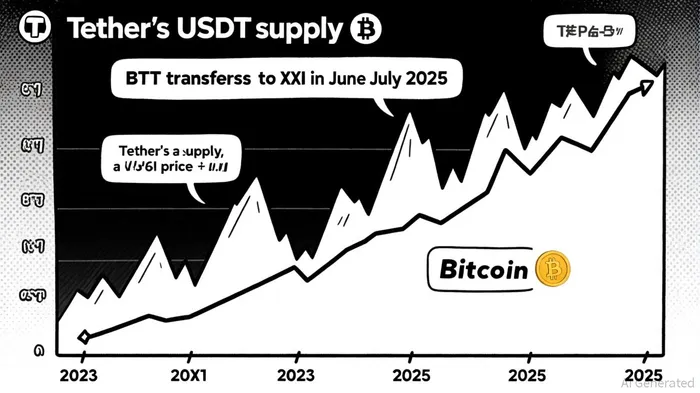
Tether's CEO, Paolo Ardoino, has emphasized the company's commitment to holding Bitcoin and gold as part of its risk-mitigation strategy, a point the Coin-Views coverage reiterated. This approach aligns with broader market trends: Tether's balance sheet in Q2 2025 revealed $162.5 billion in total assets, including $5.47 billion in excess reserves and $4.9 billion in profits. Such financial robustness has reinforced confidence in Tether's stablecoin, USDTUSDT--, which maintains a market cap of $111 billion and daily trading volume exceeding $90 billion, as noted in the Coin-Views analysis.
Corporate Crypto Donations: A Catalyst for Price Stability
The surge in corporate-driven crypto donations has further stabilized Bitcoin's price dynamics. In 2024, over $1 billion in cryptocurrency was donated to charities, with Bitcoin accounting for 64.3% of all crypto gifts, according to The Giving Block. By 2025, this trend accelerated, with 70% of Forbes' Top 100 Charities accepting crypto donations, and The Giving Block projects $2.5 billion in crypto donations for 2025, with Bitcoin remaining the dominant asset.
These donations have created a "strong hands" effect, reducing short-term volatility. For instance, Bitcoin's annualized volatility dropped to 35.5% in 2024, narrowing the gap with the S&P 500's 7.9%, as reported by BeInCrypto. During periods of traditional market stress, such as April 2025, Bitcoin's volatility briefly dipped below that of the S&P 500, signaling its maturation as a mainstream asset. Corporate Bitcoin holdings, now totaling 1.3 million BTC ($117 billion), have further deepened liquidity and reduced speculative trading pressure, according to Cointelegraph reporting.
ESG and Regulatory Frameworks: Balancing Sustainability and Growth
Environmental, social, and governance (ESG) considerations are reshaping the sustainability of corporate crypto donations. While Bitcoin's energy consumption remains a concern, initiatives to transition mining operations to renewable energy have gained traction-KPMG notes this transition and its implications. For example, KPMG notes that Bitcoin's role as an inflation hedge and store of value aligns with ESG goals, particularly in promoting financial inclusion and transparency.
Regulatory clarity has also bolstered confidence. The U.S. Financial Accounting Standards Board (FASB) now allows companies to report Bitcoin at fair value, enabling unrealized gains to be recognized as income, as described by Business Initiative. This change has incentivized corporate adoption, with public companies acquiring 157,000 BTC ($16.1 billion) in Q1 2025 alone, according to Ecoinimist. Meanwhile, California's SB 253 and SB 261 climate laws are pushing firms to disclose Scope 3 emissions, including those tied to crypto operations, as Coupa discusses. These regulations may force companies to adopt greener blockchain solutions, further aligning crypto donations with ESG standards.
The Road Ahead: Tether's Role in a Maturing Market
Tether's strategic Bitcoin allocations and the normalization of crypto philanthropy suggest a self-reinforcing cycle: as Tether accumulates more Bitcoin to back USDT, Bitcoin's price rises, enhancing the stablecoin's utility. Economist Saifedean Ammous highlights this dynamic, noting that Tether's actions could accelerate Bitcoin's transition from a speculative asset to a global reserve currency.
However, challenges remain. Regulatory divergence between U.S. states and international frameworks complicates ESG compliance for crypto donors, as KnowESG outlines. Additionally, Bitcoin's energy footprint must be addressed to fully align with ESG principles-a concern KPMG has raised. Despite these hurdles, the integration of Bitcoin into corporate treasuries and philanthropy is irreversible, with institutional demand outpacing mining supply by 7.4x, per Bitcoin Magazine.
Conclusion
Tether's strategic Bitcoin holdings and the surge in corporate crypto donations have transformed Bitcoin's market dynamics in 2025. By stabilizing investor sentiment, reducing volatility, and aligning with ESG goals, these trends are cementing Bitcoin's role as a legitimate asset class. As regulatory frameworks evolve and renewable energy adoption grows, the sustainability of corporate-driven crypto donations will likely continue to drive Bitcoin's long-term value.






Comentarios
Aún no hay comentarios