
Tether's Strategic Funding Round and Implications for Stablecoin Market Leadership
Tether's reported $20 billion funding round, which could value the company at $500 billion by selling just 3% of its equity, marks a seismic shift in the stablecoin landscape. This move, backed by institutional heavyweights like SoftBank and ARKARK-- Invest, underscores Tether's ambition to transcend its role as a stablecoin issuer and position itself as a cornerstone of global financial infrastructure[1]. The implications for market leadership are profound, as TetherUSDT-- leverages its dominance in the $250 billion stablecoin market—where USDTUSDT-- commands 56–70% of total value—to expand into AI, energy, and U.S. regulatory compliance[2].
Strategic Expansion: From Stablecoins to Systemic Influence
Tether's valuation target dwarfs its current $172 billion market cap, placing it in the same league as private tech giants like OpenAI and SpaceX[3]. The capital raised will fund ventures beyond stablecoins, including BitcoinBTC-- mining (with ambitions to become the world's largest miner by 2025) and AI development[4]. This diversification is notNOT-- merely speculative: Tether's Q2 2025 net income surged 277% year-over-year to $4.9 billion, demonstrating its financial resilience[5]. By allocating funds to energy and AI, Tether aims to integrate digital assets into real-world applications, a strategy that could redefine its value proposition beyond liquidity provision.
The U.S. regulatory front is equally critical. Tether's hiring of Bo Hines, a former White House crypto official, to lead its U.S. operations signals a calculated pivot toward compliance. The launch of USAT, a stablecoin designed to align with the proposed GENIUS Act, reflects Tether's intent to navigate the evolving regulatory landscape while challenging Circle's (USDC) institutional credibility[6]. This move could accelerate regulatory clarity for stablecoins, as lawmakers scrutinize their systemic risks—a double-edged sword that may either legitimize Tether's dominance or expose vulnerabilities in its reserve management.
Competitive Dynamics: USDC's Transparency vs. Tether's Scale
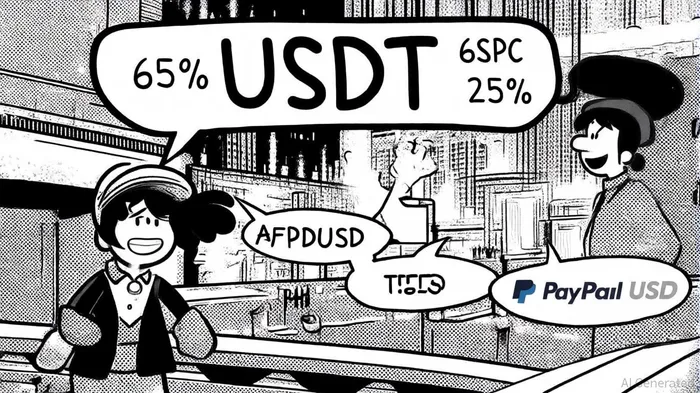
Circle's USDCUSDC--, Tether's closest competitor, has carved a niche by prioritizing transparency and regulatory compliance. With a market cap of $60–75 billion, USDC appeals to institutional investors and DeFi protocols through its audited reserves and low-fee trading pairs[7]. However, Tether's $500 billion valuation target sets an unprecedented benchmark, forcing competitors to innovate. For instance, FDUSDFDUSD-- and PayPal USD are gaining traction with zero-fee models, while USDC's expansion to layer-2 networks like Base and zkSyncZK-- highlights its focus on speed and cost efficiency[8].
Yet Tether's scale remains unmatched. Its dominance on TRON—where it mints $10 billion in USDT in 2025—underscores its ability to exploit low-cost blockchains, even as EthereumETH-- retains 70% of total stablecoin supply due to its DeFi infrastructure[9]. Tether's U.S. Treasury holdings ($120 billion as of Q1 2025) and $1 billion operating profit further cement its financial strength, creating a moat that rivals struggle to match[10].
Market Reactions and Systemic Risks
The funding round has triggered mixed reactions. Analysts warn that Tether's rapid expansion could exacerbate systemic risks, such as reduced central bank control over monetary policy. For example, stablecoins' role in cross-border transactions and savings in emerging markets—where traditional banking infrastructure is weak—poses challenges for regulators[11]. Meanwhile, institutional investors like SoftBank and ARK are drawn to Tether's potential to reshape financial infrastructure, with Cantor Fitzgerald's advisory role signaling confidence in its execution.
Regulatory scrutiny, however, remains a wildcard. Tether's quarterly attestation reports and U.S. Treasury reserves have improved transparency, but questions linger about its reserve composition and governance. The SEC's ongoing investigations into stablecoin practices could either validate Tether's compliance efforts or trigger stricter oversight, impacting its growth trajectory[12].
Conclusion: A New Era for Stablecoins
Tether's $500 billion valuation target is not just a financial milestone—it's a declaration of intent to dominate the stablecoin market while reshaping the broader crypto ecosystem. By securing institutional backing, expanding into AI and energy, and navigating U.S. regulatory frameworks, Tether is positioning itself as a bridge between traditional finance and Web3. However, its success hinges on balancing innovation with transparency, as competitors and regulators scrutinize its every move. For investors, the key question is whether Tether can sustain its dominance without triggering systemic risks—a challenge that will define the future of stablecoins.






Comentarios
Aún no hay comentarios