
Tether's Strategic Expansion into Commodity Lending: How USDT is Reshaping Global Trade Finance and Unlocking 2026 Investment Opportunities
The USDT Advantage: Speed, Efficiency, and Market Access
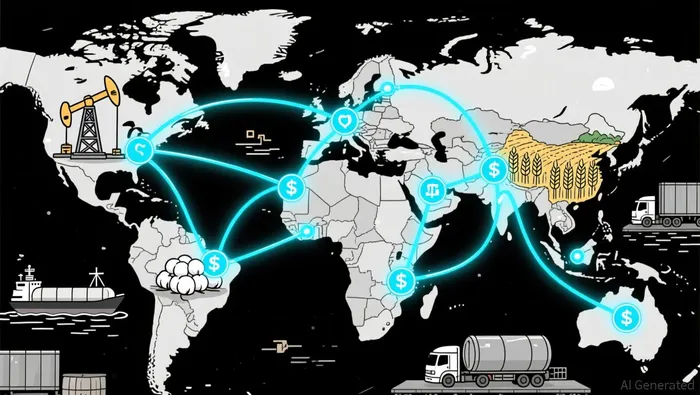
Tether's commodity lending model is uniquely positioned to capitalize on the volatility and liquidity challenges inherent in global trade. By using USDT, the stablecoin pegged to the U.S. dollar, Tether enables traders to secure financing within minutes, a stark contrast to traditional banks that often require weeks or months. This speed is critical in markets like oil and agricultural commodities, where timing can determine profitability. For instance, a crude oil transaction in November 2024 demonstrated the stablecoin's ability to reduce settlement delays and lower transaction costs, particularly in emerging markets where USDT adoption is already high.
According to a report by Bloomberg, Tether's CEO Paolo Ardoino emphasized that USDT's role in regions like Latin America-where 40% of global commodities are produced-has been pivotal. By providing liquidity in stablecoin form, Tether is not only democratizing access to financing for smaller traders but also creating a parallel financial infrastructure that operates independently of traditional banking systems.
Displacing Traditional Banks: A $15 Billion Bet on Reserves and Resilience
Tether's expansion is underpinned by its $200 billion in reserves, a financial buffer that allows it to outmaneuver traditional banks retreating from riskier markets. As noted in an industry analysis by Bitget, banks have scaled back commodity lending due to regulatory constraints and high-profile defaults, leaving a void Tether is eager to fill. The company's ability to offer faster approvals and lower overhead costs-thanks to blockchain-based automation-positions it as a formidable competitor.
Moreover, Tether's strategy extends beyond digital assets. The firm has been aggressively accumulating physical gold and hiring executives from institutions like HSBC to integrate with traditional precious metals markets. This hybrid approach-combining crypto liquidity with tangible assets-signals a long-term vision to tokenize real-world commodities, a trend analysts predict will gain momentumMMT-- in 2026.
Investment Opportunities: Tokenizing Trade and Capturing Market Share
For investors, Tether's expansion into commodity lending represents a dual opportunity: exposure to the growing stablecoin ecosystem and the tokenization of physical assets. Analysts at Crypto Economy highlight that Tether's projected $15 billion in 2025 profits-driven by its lending business-could fuel further innovation in 2026, including the development of gold-backed tokens or cross-border trade platforms.
The broader implications are equally compelling. By reducing reliance on traditional banking infrastructure, Tether is accelerating the adoption of blockchain in global trade. This shift could unlock new markets for investors, particularly in emerging economies where access to credit has historically been limited. As one industry report notes, "Tether's model is not just about lending-it's about redefining the rules of trade finance in a digital age".
Conclusion: A New Era of Trade Finance
Tether's strategic expansion into commodity lending is more than a financial play-it's a structural shift in how global trade operates. By leveraging USDT's speed and scalability, the company is addressing inefficiencies that have long plagued the sector while positioning itself as a bridge between crypto and traditional markets. For investors, the 2026 horizon offers a unique window to capitalize on this transformation, provided they align with the growing demand for decentralized, high-liquidity solutions.
As Tether continues to scale its gold reserves and expand its lending capacity, the question is no longer whether digital assets will reshape trade finance-but how quickly they will do so.






Comentarios
Aún no hay comentarios