
Tether's Strategic Credibility and Long-Term Value: A Deep Dive into Transparency and Investor Confidence
Stablecoins have become the backbone of the crypto ecosystem, serving as a bridge between traditional finance and decentralized markets. Among them, TetherUSDT-- (USD₮) dominates with its market share and utility. Yet, for investors, the critical question remains: Can Tether sustain its credibility amid regulatory scrutiny and market volatility? The answer lies in its financial transparency, strategic governance, and long-term vision—factors that directly influence investor confidence in stablecoins.
Financial Transparency: A Pillar of Trust
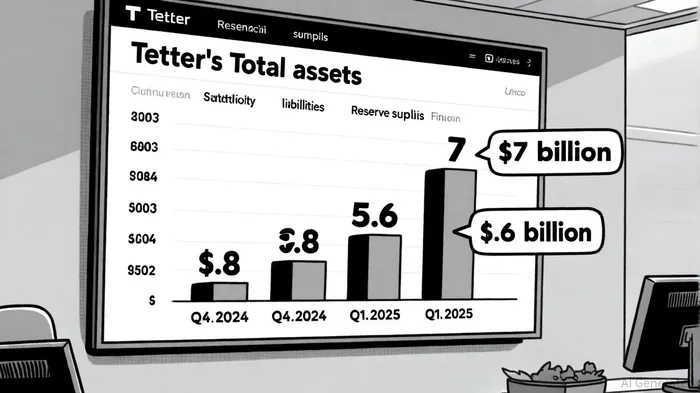
Tether's 2024 reserve audit, conducted by BDO, revealed a robust financial position. As of December 31, 2024, the company's consolidated total assets reached $157.6 billion, while liabilities stood at $137.6 billion, resulting in a reserve surplus of $7.09 billion [1]. This surplus, exceeding liabilities by 5%, underscores Tether's conservative reserve management. Notably, 90% of its reserves are held in cash and cash equivalents, with U.S. Treasury holdings hitting an all-time high of $113 billion [1].
In Q1 2025, Tether's financial strength was further validated. Total assets dipped slightly to $149.3 billion, but liabilities remained at $143.7 billion, leaving a $5.6 billion reserve buffer [2]. The company's exposure to U.S. Treasuries neared $120 billion, cementing its status as one of the largest holders of U.S. government debt globally [2]. These figures, verified by BDO, demonstrate Tether's commitment to liquidity and stability—a critical trait for a stablecoin.
Regulatory Compliance: A New Era of Governance
Tether's relocation to El Salvador and its acquisition of a stablecoin issuer license under the country's Digital Assets framework mark a pivotal shift toward regulatory compliance [2]. The Q1 2025 financial attestation, released under El Salvador's oversight, confirmed the company's adherence to transparent reporting standards. This move not only addresses past criticisms about opacity but also aligns Tether with evolving global regulatory expectations.
For investors, regulatory alignment is a double-edged sword. While it introduces compliance costs, it also reduces the risk of sudden legal disruptions—a key concern for stablecoin projects. Tether's proactive approach to licensing suggests a long-term strategy to operate within structured frameworks, which is essential for maintaining institutional trust.
Strategic Investments: Beyond the Balance Sheet
Tether's financial prowess extends beyond its stablecoin operations. In 2024, the company allocated over $5 billion to emerging sectors like renewable energy, BitcoinBTC-- mining, AI, and education [1]. While these investments are not part of the reserves backing USD₮, they signal a forward-looking strategy to diversify revenue streams and hedge against macroeconomic risks.
For example, Tether's Bitcoin and gold holdings generated unrealized gains during volatile market conditions, offsetting potential losses in its Treasury portfolio [1]. Such strategic diversification enhances resilience, ensuring that Tether's financial health isn't solely tied to the stability of its stablecoin.
Investor Confidence: The Transparency-Continuity Link
Investor confidence in stablecoins hinges on two pillars: transparency and project continuity. Tether's quarterly audits, verified by third-party firms like BDO, provide real-time visibility into its reserves, addressing historical skepticism. Meanwhile, its regulatory compliance in El Salvador and strategic investments in high-growth sectors reinforce the perception of a sustainable, adaptive business model.
The data supports this narrative. In Q1 2025, USD₮'s circulating supply grew by $7 billion, with 46 million new wallets created—a 13% increase from the prior quarter [2]. This adoption surge reflects growing trust in Tether's stability, even as the broader crypto market faces headwinds.
Conclusion: A Foundation for Long-Term Value
Tether's strategic credibility is built on a foundation of financial transparency, regulatory alignment, and diversified growth. While challenges remain—such as navigating global regulatory fragmentation—its current trajectory positions it as a leader in the stablecoin space. For investors, the key takeaway is clear: projects that prioritize transparency and adaptability are better equipped to sustain long-term value in an evolving market.
As the crypto ecosystem matures, Tether's ability to balance innovation with accountability will be a defining factor in its continued dominance.






Comentarios
Aún no hay comentarios