
Tether's Strategic Allocation of Bitcoin and Diversification into Gold and Land: A Blueprint for Institutional Resilience
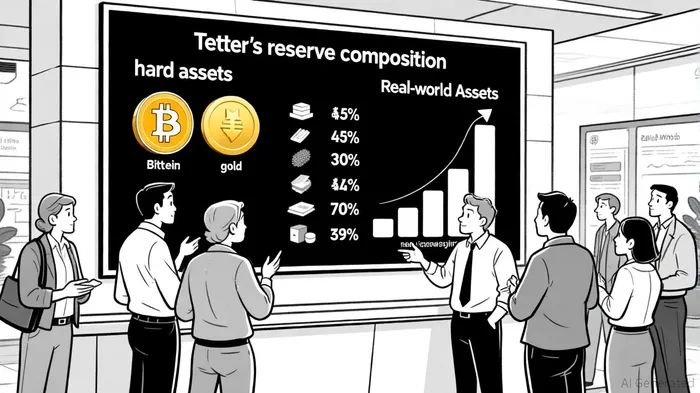
In the evolving landscape of digital finance, TetherUSDT-- (USDT) has emerged as a linchpin of institutional resilience, leveraging its position as the largest stablecoin to strategically allocate reserves across BitcoinBTC--, gold, and real-world assets (RWA). This diversification strategy, underscored by a blend of digital innovation and traditional safe-haven assets, signals long-term confidence in both the crypto ecosystem and macroeconomic stability.
Bitcoin: The Core of Tether's Digital Treasury
Tether's commitment to Bitcoin remains unwavering, with its holdings growing to over 100,521 BTC by September 2025, valued at approximately $11.17 billion[1]. Contrary to rumors of a sell-off, Tether CEO Paolo Ardoino clarified that the company reallocated 19,800 BTC to its investment arm, Twenty One Capital (XXI), in June and July 2025[2]. This move, rather than reducing Bitcoin exposure, reflects a strategic shift to fund Bitcoin-native initiatives, including infrastructure and financial products. By channeling profits into Bitcoin, Tether reinforces its role as a quasi-sovereign allocator, surpassing even major ETFs in Bitcoin accumulation[3].
Gold: Bridging the Digital and Physical
Tether's gold investments have expanded significantly, with $8.7 billion in physical gold bars stored in a Zurich vault[4]. The company also acquired a minority stake in Elemental Altus, a gold royaltyGROY-- company, for $100 million[5], signaling a deeper integration into the gold supply chain. CEO Ardoino's assertion that gold is “natural Bitcoin”[6] underscores a philosophical alignment between the two assets as stores of value. This dual allocation not only diversifies Tether's reserves but also positions it to capitalize on the growing convergence of digital and physical markets.
Land and Real-World Assets: A New Frontier
While Tether's land investments remain less quantified, its acquisition of Adecoagro—a South American agribusiness company—reveals a strategic pivot toward RWA[7]. By tendering for up to 70% of Adecoagro's shares, Tether is tapping into the tokenization trend, where real estate and commodities are digitized for fractional ownership and liquidity[8]. Additionally, Tether's exploration of gold mining ventures[9] aligns with its broader RWA strategy, leveraging its crypto profits to secure tangible assets. Though specific valuations for land holdings are undisclosed, the company's participation in this sector highlights its forward-looking approach to reserve diversification.
Institutional Resilience and Long-Term Confidence
Tether's reserve strategy—anchored in 84% cash and U.S. Treasuries, with incremental allocations to Bitcoin, gold, and RWA—demonstrates a calculated balance between stability and innovation[10]. This approach mitigates risks from macroeconomic volatility while positioning Tether to benefit from the tokenization boom, projected to exceed $10.9 trillion by 2030[11]. By diversifying into hard assets and RWA, Tether not only safeguards its stablecoin's credibility but also signals confidence in the long-term viability of both digital and traditional markets.
Conclusion
Tether's strategic allocation of reserves into Bitcoin, gold, and RWA exemplifies institutional resilience in an era of financial uncertainty. By treating Bitcoin as a core asset, embracing gold as a complementary store of value, and pioneering RWA integration, Tether is redefining the role of stablecoins in global finance. For investors, this strategy underscores the importance of diversification and adaptability in navigating the intersection of crypto and traditional markets.





Comentarios
Aún no hay comentarios