
Tether's Centralized Enforcement Power: A Double-Edged Sword for Stablecoin Investors
Tether's dominance in the stablecoin market has long been attributed to its centralized enforcement model, which enables rapid risk mitigation but simultaneously exposes it to regulatory vulnerabilities. As the crypto industry grapples with evolving compliance frameworks, investors must weigh the operational advantages of centralization against the growing threat of regulatory intervention. This analysis explores how Tether's centralized governance serves as both a shield and a sword, shaping its role in the global financial ecosystem.
Centralization as a Risk Mitigation Tool
Tether's centralized structure allows it to enforce strict reserve management and liquidity controls, which are critical for maintaining the USDTUSDT-- peg during periods of market stress. According to a report by Elliptic, Tether's reserve composition-including U.S. Treasuries and Bitcoin-has enabled it to sustain the $1 peg even during extreme volatility in late 2025, reinforcing its position as a critical liquidity layer for the crypto economy. This centralized control also facilitates rapid address freezes to combat illicit activity, a feature that has drawn both praise and criticism. For instance, the 2026 Crypto Crime Report highlighted how sanctioned entities, particularly those linked to Russia, increasingly leveraged stablecoins for sanctions evasion, with TetherUSDT-- and similar tokens at the center of these activities. While centralization enables Tether to act unilaterally against such threats, it also raises concerns about transparency and potential misuse of enforcement power.
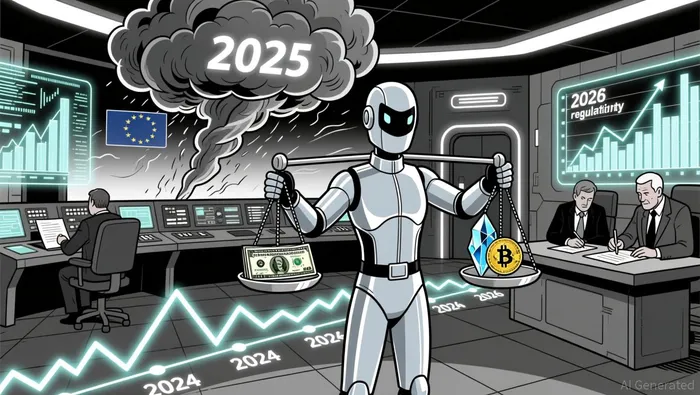
Regulatory Vulnerabilities in a Fragmented Landscape
The centralized nature of Tether's operations has made it a focal point for regulators seeking to impose stricter oversight on stablecoins. The EU's Markets in Crypto-Assets (MiCA) Phase 2 rules, enforced in early 2026, exemplify this trend. These regulations led to the delisting of non-compliant stablecoins like USDT from major platforms, triggering a $50 billion altcoin market wipeout as liquidity dried up. Similarly, the U.S. GENIUS Act mandated 1:1 reserve backing, monthly public attestations, and annual independent audits for stablecoin issuers. While Tether has not faced direct enforcement actions under the GENIUS Act as of late 2025, the law's requirement that only regulated entities can issue payment stablecoins has forced Tether to pivot toward compliance-driven strategies, such as launching USAT in partnership with Anchorage Digital Bank and Cantor Fitzgerald.
Tether's Strategic Balancing Act
Tether's response to regulatory pressures reflects a dual strategy: maintaining its offshore dominance while expanding into regulated markets. The launch of USAT under the GENIUS Act framework signals Tether's attempt to align with U.S. compliance standards, offering a regulated alternative to USDT with enhanced transparency and traceability. However, the company continues to rely on its centralized infrastructure-such as Stable, its Layer 1 blockchain-to serve emerging markets and preserve cross-chain ubiquity. This duality allows Tether to hedge against regulatory risks in developed markets while capitalizing on growth opportunities in less stringent jurisdictions.
Despite these efforts, Tether's compliance posture remains contentious. While it publishes quarterly attestations from BDO, critics argue that the absence of a Big Four audit undermines institutional confidence. This gap in transparency contrasts with Circle's USDCUSDC--, which has positioned itself as a fully audited alternative. For investors, this tension between profitability and compliance highlights the inherent risks of centralized governance in a rapidly evolving regulatory environment.
Implications for Stablecoin Investing
For investors, Tether's centralized enforcement power presents a paradox: it offers operational resilience and market dominance but at the cost of regulatory exposure. The 2026 Digital Asset Market Clarity Act and similar reforms have created a more predictable framework for stablecoin adoption, yet they also heighten the stakes for non-compliance. Tether's ability to navigate this landscape will depend on its capacity to balance innovation with transparency.
Investors should monitor key metrics, including Tether's reserve disclosures, audit practices, and regulatory interactions. The company's profitability-driven by diversified reserves and infrastructure expansion-suggests a strong foundation, but its centralized model remains a liability in jurisdictions prioritizing decentralization and open access. As the crypto industry matures, the long-term viability of Tether and similar stablecoins will hinge on their ability to adapt to a world where regulatory compliance and operational efficiency are no longer mutually exclusive.





Comentarios
Aún no hay comentarios