
Tether's $500 Billion Ambition: Strategic Implications for Stablecoin Dominance and Institutional Adoption
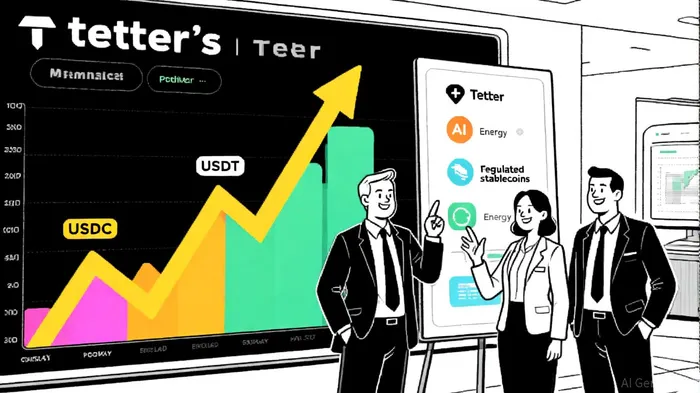
Tether, the issuer of the world's largest stablecoin (USDT), is embarking on an audacious strategy to cement its dominance in the digital asset ecosystem. By targeting a $500 billion valuation through a $20 billion private fundraising round, the company is positioning itself not just as a stablecoin leader but as a multifaceted financial infrastructure player. This move, if successful, could redefine the competitive landscape of stablecoins and accelerate institutional adoption of digital assets.
The Stablecoin Power Play
Tether's USDTUSDT-- has long held a dominant position in the stablecoin market, with a market capitalization that dwarfs its closest rival, Circle's USDCUSDC--. According to a report by the Financial Times, Tether's $500 billion valuation—if achieved—would represent a 10x multiple on its current revenue and assets, underscoring investors' belief in its network effects and first-mover advantage [1]. The private placement, which involves issuing new equity rather than selling existing shares, would provide TetherUSDT-- with a war chest to scale its operations and defend its market share against regulatory and competitive pressures.
A critical component of this strategy is the launch of USAT, a U.S.-compliant stablecoin regulated under the GENIUS Act. By appointing a dedicated CEO for this initiative, Tether is signaling its intent to navigate the increasingly complex regulatory environment in the U.S. [2]. This move could attract institutional investors wary of the legal uncertainties surrounding unregulated stablecoins, further entrenching Tether's dominance in both the crypto-native and traditional financial markets.
Institutional Adoption: A New Frontier
The $20 billion raise would also fund Tether's expansion into sectors beyond stablecoins, including artificial intelligence, commodity trading, and energy. CEO Paolo Ardoino has emphasized the company's ambition to become a “financial infrastructure provider,” leveraging its liquidity and user base to diversify into adjacent markets [3]. For institutions, this diversification could create new use cases for Tether's technology, such as tokenizing real-world assets or facilitating cross-border payments.
Institutional adoption hinges on trust, and Tether's history of transparency issues has been a barrier. However, the company's recent focus on regulatory compliance—particularly with USAT—addresses a key concern for institutional investors. As stated by CNBC, Tether's U.S. operations are now structured to meet federal requirements, a shift that could unlock partnerships with banks and asset managers [4]. This alignment with regulatory frameworks is critical for scaling institutional adoption, as it reduces counterparty risk and enhances credibility.
Strategic Risks and Rewards
While Tether's ambitions are bold, they are not without risks. A $500 billion valuation implies expectations of exponential growth, which may be difficult to sustain given the volatile nature of the crypto market. Additionally, regulatory scrutiny remains a wildcard. The U.S. Treasury and the SEC have shown increasing interest in stablecoin oversight, and any missteps in compliance could derail Tether's plans.
However, the potential rewards are equally significant. By securing a valuation rivaling OpenAI and SpaceX, Tether could attract capital from traditional investors seeking exposure to the next phase of financial innovation. The company's ability to integrate stablecoins with AI-driven financial services or energy trading platforms could create a flywheel effect, where liquidity and data reinforce each other.
Conclusion
Tether's $20 billion fundraising and $500 billion valuation target reflect a strategic pivot from a stablecoin issuer to a global financial infrastructure player. By addressing regulatory concerns, diversifying into high-growth sectors, and leveraging its dominant market position, Tether is positioning itself to capture a significant share of the institutional capital flowing into digital assets. For investors, the key question is whether Tether can execute its vision without compromising the stability and trust that underpin its core product.






Comentarios
Aún no hay comentarios