
Tether's $10 Billion Profit and Its Implications for Stablecoin Dominance and Adjacent Sectors
Tether's Financial Resilience and Reserve Composition
Tether's profitability is underpinned by its $174.45 billion in total assets, including $135 billion in U.S. Treasury bonds, $12.9 billion in gold, and $9.9 billion in BitcoinBTC--. These reserves, combined with $6.8 billion in excess liquidity, provide a buffer against volatility and enhance trust in its dollar-pegged stablecoin (USDT). The company's liabilities-primarily $174.357 billion in issued tokens-remain fully backed, with a positive equity position of $6.778 billion. This financial structure notNOT-- only supports Tether's operational stability but also positions it to capitalize on growing demand for stablecoins in DeFi protocols and global remittances.
However, Tether's reliance on traditional assets like Treasuries and gold contrasts with the crypto-native reserves of competitors like Circle's USDCUSDC--, which increasingly leverage Ethereum-based assets. This divergence highlights a strategic trade-off: Tether prioritizes regulatory compatibility and liquidity, while others chase on-chain innovation.
Market Share and Competitive Pressures
Despite Tether's dominance, the stablecoin market is intensifying. Circle's USDC and EURC have captured 35 million users and $75 billion in supply, reflecting a shift toward EthereumETH-- and LayerLAYER-- 2 networks like ArbitrumARB-- and Base. The Ethereum stablecoin market alone expanded to $184 billion in 2025, driven by DeFi applications and cross-border use cases. This growth is partly fueled by faster transaction speeds and lower fees on Layer 2 solutions, which are attracting developers and users away from Tether's legacy infrastructure.
Tether's market share remains under pressure as alternative blockchains (e.g., SolanaSOL--, Tron) capture over 30% of stablecoin supply. Yet, its $186 billion market cap for USDT-serving 6.25% of the global population-ensures it retains a commanding position, Tether projects $15 billion profit. For investors, this duality of dominance and disruption raises questions about Tether's ability to innovate while maintaining its reserve transparency and regulatory compliance.
Regulatory Risks and Strategic Adaptation
Regulatory developments in 2025 have intensified scrutiny on stablecoin reserves; broader policy shifts are visible in headlines such as Trump's 100% tariff threat. Meanwhile, the EU's MiCA framework is advancing harmonization, emphasizing investor protection and market integrity. Tether has proactively applied for an Investment Fund License in El Salvador and settled litigation with Celsius using proprietary capital, signaling a shift toward regulated operations.
Yet, risks persist. The SEC's focus on reserve transparency could force Tether to disclose more granular details about its asset composition, potentially impacting its flexibility. Conversely, the U.S. GENIUS Act's promotion of tokenized fiat currencies may benefit Tether by legitimizing blockchain-based dollar alternatives. Investors must weigh these regulatory headwinds and tailwinds, as compliance costs and policy shifts could alter profit margins.
Implications for DeFi and Cross-Border Payments
Tether's reserves directly influence DeFi protocols and cross-border payment systems. In November 2025, the BalancerBAL-- DeFi protocol suffered a Balancer $116M exploit, exposing vulnerabilities in smart contracts handling Tether and other stablecoins. Such incidents highlight the fragility of DeFi infrastructure, where Tether's liquidity is both a catalyst for growth and a potential risk multiplier. For cross-border payments, Tether's stability and low fees make it a preferred medium, but regulatory constraints-such as reserve requirements-could limit adoption in certain jurisdictions.
A 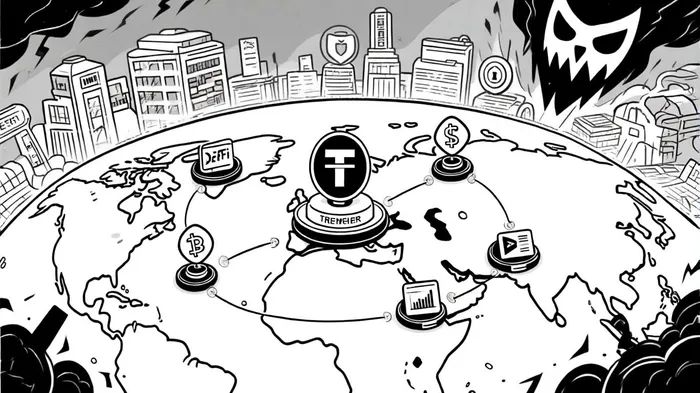 would visually encapsulate these dynamics.
Strategic Allocation Considerations
For institutional and retail investors, Tether's $10 billion profit and $6.8 billion in excess reserves suggest a resilient business model. However, strategic allocation must account for three factors:
1. Regulatory Uncertainty: A 50% probability of new reserve disclosure rules in 2026 could impact Tether's margins.
2. Competitive Erosion: USDC's growth on Ethereum and Layer 2 networks may dilute Tether's market share.
3. DeFi Volatility: Exploits like Balancer's $116 million loss underscore the risks of integrating Tether into unsecured protocols.
Investors should diversify exposure across stablecoins with varying reserve strategies (e.g., Tether's fiat-pegged model vs. USDC's crypto-native approach) while hedging against regulatory shocks.
Conclusion
Tether's $10 billion profit in 2025 reflects its dominance in a rapidly evolving stablecoin market. However, the interplay of regulatory pressures, competitive innovation, and DeFi vulnerabilities demands a nuanced approach to allocation. As the industry matures, Tether's ability to balance compliance, liquidity, and innovation will determine its long-term relevance-and its role in shaping the future of digital finance.






Comentarios
Aún no hay comentarios