
Tesla vs. Waymo: The Robotaxi Race and Who Will Win the Future of Mobility
The battle for dominance in the autonomous vehicle (AV) market has reached a critical inflection point. TeslaRACE-- and Waymo, two titans with divergent philosophies, are racing to redefine urban mobility. While Tesla's camera-only, data-driven approach promises disruptive scalability, Waymo's sensor-rich, map-driven model prioritizes safety and regulatory compliance. For investors, the question is not just which technology will prevail, but which strategyMSTR-- offers a more defensible path to profitability in a sector still grappling with technical, regulatory, and consumer adoption hurdles.
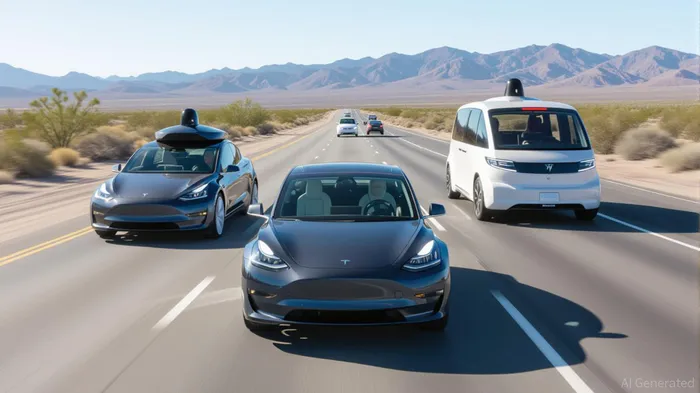
Tesla: The Disruptive Long Shot
Elon Musk's vision for Tesla's Full Self-Driving (FSD) v12 is audacious: leverage a fleet of over six million vehicles to train a camera-only AI system using real-world data equivalent to 100 years of driving. This “pure vision” approach eliminates the need for costly LiDAR hardware, slashing costs and enabling rapid deployment. Tesla's Austin Robotaxi pilot, charging $6.90 per ride, is a testbed for this model, though it still relies on human safety drivers. The company's projected $75 billion in robotaxi revenue by 2030 hinges on overcoming regulatory bottlenecks in Europe and China, where approval processes for autonomous systems are labyrinthine.
Strategic Risks:
- Regulatory Delays: Tesla's FSD Unsupervised mode, slated for late 2025, faces uncertainty in markets with strict safety standards. A single incident could derail approvals.
- Technical Limitations: Camera-only systems struggle in low-visibility scenarios. A recent red-light-running incident in San Francisco exposed gaps in real-time decision-making.
- Market Competition: Waymo's first-mover advantage and Alphabet's financial muscle could outpace Tesla's cost-driven model.
Financial Leverage: Tesla's R&D spending is projected to exceed $9 billion in 2025, fueled by $4.54 billion in 2024 investments. The company's vertical integration—combining hardware, software, and energy infrastructure—creates a defensible moat if FSD achieves mass adoption.
Waymo: The Proven Leader
Waymo's approach is methodical: a multi-sensor stack (LiDAR, radar, cameras) paired with high-resolution maps and conservative operational parameters. Its fifth-generation system has achieved 0.41 casualty accidents per million miles, a 6.8x improvement over human drivers. With 1,500 vehicles in service and 250,000 weekly paid rides, Waymo's robotaxi network is already profitable in Phoenix, San Francisco, and Austin. Alphabet's $5.6 billion funding round in October 2024 (valuing Waymo at $45 billion) underscores its commitment to scaling this model.
Strategic Advantages:
- Regulatory Readiness: Waymo's safety record and NHTSA approvals allow fully autonomous operation without safety drivers, a critical edge in markets prioritizing reliability.
- Technical Maturity: Redundant sensor systems and map-driven navigation provide a safety buffer, enabling operation in complex urban environments.
- Scalable Infrastructure: Alphabet's financial resources allow Waymo to build charging hubs and maintenance networks from scratch, avoiding Tesla's reliance on third-party infrastructure.
Market Risks:
- High Costs: At $100,000 per vehicle, Waymo's fleet is 3x more expensive than Tesla's projected $30,000 Cybercab. This limits rapid fleet expansion.
- Competition from Vertical Integration: Tesla's cost advantage could erode Waymo's margins if FSD achieves mass adoption.
The Defensible Path to Profitability
The core debate is between speed and safety. Tesla's camera-only model offers a cheaper, faster path to scalability but carries existential risks if technical or regulatory hurdles persist. Waymo's sensor-rich approach is slower and costlier but has already proven its viability in real-world operations. For investors, the choice hinges on risk tolerance:
- Tesla is a high-reward, high-risk bet. Success would redefine mobility, but delays or accidents could erode confidence.
- Waymo is a safer, more stable investment. Its established revenue streams, regulatory approvals, and safety record make it a near-term leader in a sector still in its infancy.
Investment Recommendation
For growth-oriented investors with a long-term horizon, Tesla's disruptive potential is compelling. However, its regulatory and technical uncertainties make it a speculative play. Waymo, by contrast, offers a more reliable path to profitability in the next 3–5 years. Its proven safety metrics, Alphabet's financial backing, and expanding market presence position it as the stronger near-term investment.
In the race to dominate robotaxi, Waymo's measured, safety-first strategy aligns with the cautious regulatory environment and consumer demand for reliability. Tesla's vision is bold, but until its camera-only system can match Waymo's safety record and navigate global regulatory labyrinths, the latter remains the more defensible bet for investors seeking stability and growth in the autonomous vehicle sector.





Comentarios
Aún no hay comentarios