
Tesla vs. Waymo in the Robotaxi Race: Scalability, Cost Efficiency, and FSD Progress as Key Investment Differentiators
The autonomous vehicle (AV) market is entering a pivotal phase in 2025, with TeslaTSLA-- and Waymo locked in a high-stakes race to dominate the robotaxi sector. Investors seeking exposure to this transformative industry must evaluate the two leaders through the lenses of scalability, cost efficiency, and Full Self-Driving (FSD) progress. These metrics not only define current competitive advantages but also shape long-term investment potential.
Scalability: Manufacturing Might vs. Geofenced Precision
Tesla's vertically integrated manufacturing model gives it a clear edge in rapid fleet deployment. As of late 2025, Waymo operates 2,500 robotaxes across five U.S. regions, including 1,000 in the San Francisco Bay Area and 700 in Los Angeles. Tesla, however, has demonstrated explosive scalability, doubling its Austin-based robotaxi service area in just 22 days and surpassing Waymo's operational footprint in the city. Elon Musk's stated goal of 1,000 Robotaxes in the Bay Area and 500 in Austin by year-end underscores Tesla's aggressive expansion plans.
This speed is enabled by Tesla's vision-only, end-to-end AI system, which generalizes autonomy faster than Waymo's lidar-heavy, geofenced approach. Meanwhile, Waymo's reliance on third-party automakers for vehicle production creates bottlenecks, though its partnerships with Uber and traditional automakers help offset some limitations. Tesla's Supercharger Network further enhances its scalability, with recent upgrades allowing non-Tesla EVs to access charging infrastructure-a critical enabler for large-scale deployments.
Cost Efficiency: Data Volume vs. Safety Margins
Cost efficiency remains a defining battleground. Tesla's camera-only FSD system is inherently cheaper to implement, with per-unit hardware costs significantly lower than Waymo's lidar-based sensors. According to a report by Forbes, Tesla's FSD system is trained on over 10 million real-world miles per day, dwarfing Waymo's 200,000 miles per day. This data advantage accelerates AI training and reduces long-term operational costs. 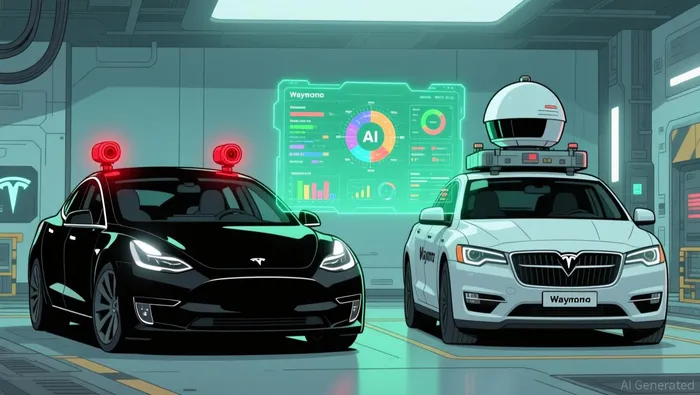
However, Waymo's safety record is unmatched. Its system has achieved 500,000 miles between collisions, a metric that investors increasingly prioritize as regulatory scrutiny intensifies. Waymo's commercial robotaxi service, already active in Phoenix, San Francisco, and Los Angeles, benefits from Alphabet's $1.5 trillion market cap, which allows long-term investment without immediate profit pressure. Tesla, despite its $800 billion valuation, faces higher short-term risks due to its reliance on rapid scaling and regulatory approvals.
FSD Progress: Regulatory Hurdles and Deployment Timelines
FSD progress is a mixed bag for both companies. Waymo's commercial robotaxi service is operational in multiple U.S. cities, with plans to expand to Austin. Tesla, by contrast, remains in a limited pilot phase in Austin, requiring human safety drivers for oversight. Regulatory approvals will be critical for Tesla's next phase. As stated by Elon Musk, Tesla expects full FSD approval in China by Q1 2026 and EU approval by February 2026. However, the Netherlands Vehicle Authority has cautioned that these timelines remain uncertain, emphasizing safety as the top priority.
Waymo's regulatory head start provides a buffer, but Tesla's AI-first approach could disrupt the market once approvals materialize. A report by Ark Invest notes that Tesla's FSD system, while not yet as safe as Waymo's, is rapidly closing the gap through its data-driven training model.
Investment Implications
For investors, the choice between Tesla and Waymo hinges on risk tolerance and time horizons. Tesla's scalability and cost efficiency position it as a high-growth bet, with potential for rapid market share gains if regulatory hurdles are cleared. However, its reliance on unproven regulatory timelines and safety metrics introduces volatility. Waymo, backed by Alphabet's financial might and a proven safety record, offers a more stable, albeit slower, path to profitability.
In the robotaxi race, Tesla's vision of a camera-only, AI-first future challenges Waymo's lidar-centric, safety-first model. Both strategies have merit, but 2025's data underscores that scalability and cost efficiency are becoming the dominant forces in shaping the AV landscape.





Comentarios
Aún no hay comentarios