
Tesla's Volatility and Visionary Valuation: A High-Risk, High-Reward Proposition in 2025
Tesla's stock performance over the past year has epitomized the paradox of high-risk, high-reward investing. Between November 2024 and November 2025, the electric vehicle (EV) giant's shares closed at $459.06, reflecting a 13.67% annualized return for 2025. Yet this modest gain masks a rollercoaster ride: the stock's 30-day historical volatility (0.4301) and implied volatility (48.9) underscore its extreme price swings, with a 52-week range spanning $214.25 to $488.54. For investors, Tesla's trajectory raises a critical question: How does a company with such volatility sustain a valuation that remains anchored to a long-term vision, even as fundamentals like delivery growth and profit margins falter?
Volatility as a Double-Edged Sword
Tesla's stock volatility is baked into its DNA. With a beta coefficient of 1.67, the stock is 67% more volatile than the S&P 500 amplifying both gains and losses during market swings. Over 2024, Tesla's annualized standard deviation of returns hit 62.52%, a stark contrast to its 13.65% return in 2025 according to financial data. This volatility is not merely statistical-it reflects investor sentiment torn between optimism over Tesla's technological edge and skepticism about its execution risks. For instance, the 7.6% gap between implied volatility and historical volatility suggests options markets are pricing in heightened uncertainty, likely tied to Elon Musk's erratic public statements and the company's competitive challenges.
Visionary Leadership: Fueling Valuation Amid Uncertainty
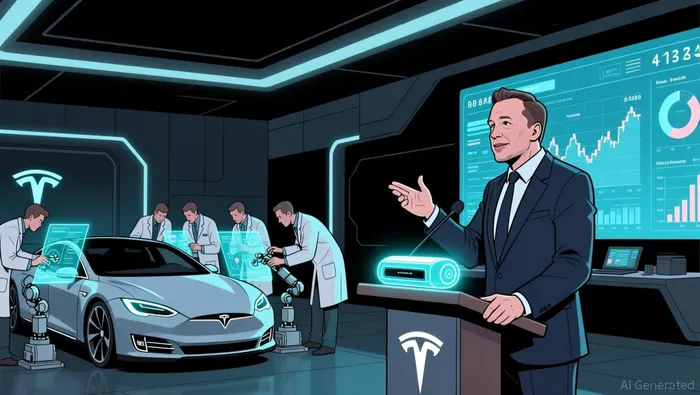
At the heart of Tesla's valuation lies its founder-CEO, Elon Musk, whose leadership style is as disruptive as it is polarizing. Musk's focus on moonshot innovations-such as full self-driving AI and energy storage solutions-has kept TeslaTSLA-- at the forefront of the EV revolution, even as rivals like BYD and traditional automakers close the gap according to Reddit analysis. According to a Forbes report, visionary leaders like Musk often prioritize long-term disruption over short-term profitability, creating a "speculative premium" in stock valuations. This dynamic is evident in Tesla's market capitalization, which accounted for 80% of the total value of 14 pure-play EV companies by late 2021, despite inconsistent financial performance.
However, this vision-driven narrative is not without cracks. By 2025, Tesla faced declining delivery growth (down 8% year-over-year) and shrinking profit margins, raising questions about whether its valuation is tethered to reality. Yet Musk's ability to generate hype-whether through high-profile product launches or controversial tweets-continues to stoke investor confidence. A pending $55 billion pay package for Musk, tied to ambitious stock price targets, further underscores how his personal brand remains a linchpin of Tesla's valuation.
Financial Models and the EV Sector's "Vision Premium"
The EV sector's financial models increasingly reflect a premium for visionary leadership. A 2022 IEA report noted that companies with clear long-term sustainability goals and disruptive technologies commanded higher valuations, even amid short-term losses. Tesla's vertical integration strategy-spanning battery production, Gigafactories, and AI R&D-exemplifies this approach. By reducing costs and securing supply chains, Tesla has positioned itself as a leader in both EVs and renewable energy, a dual narrative that justifies its premium valuation according to Forbes analysis.
Comparisons to other EV entrants highlight this trend. Visionary Holdings Inc., for example, announced a $4 billion sales target for its PEGASUS New Energy Vehicles brand in 2025, leveraging China's manufacturing scale and solid-state battery technology according to company news. While such ambitions are common in the sector, Tesla's first-mover advantage and Musk's global influence give it a unique edge.
Implications for High-Risk Investors
For investors, Tesla's story is a masterclass in balancing volatility with visionary potential. The stock's beta of 1.67 and 62.52% annualized standard deviation in 2024 suggest it is unsuitable for risk-averse portfolios. Yet for those with a long-term horizon, Tesla's valuation remains anchored to its role as a catalyst for the EV and AI revolutions. As one Reddit analysis noted, Tesla's stock is "a bet on Musk's ability to execute on moonshots," with outcomes that could swing wildly but reward patience.
However, investors must also grapple with the risks of overreliance on a single individual. Musk's recent acquisition of Twitter and his public stances on AI and geopolitics have added layers of unpredictability to Tesla's stock. This volatility is unlikely to abate, given the company's exposure to regulatory shifts, supply chain bottlenecks, and intensifying competition.
Conclusion
Tesla's one-year performance encapsulates the essence of high-risk, high-reward investing: a stock that dances between euphoria and despair, driven by a leader whose vision is as much a liability as it is an asset. For those willing to stomach the volatility, Tesla offers a unique opportunity to bet on the future of mobility and energy. But as the company's fundamentals evolve, investors must ask whether the "vision premium" is justified-or if the market is merely chasing a mirage.







Comentarios
Aún no hay comentarios