
Tesla's Texas Gamble: Robotaxis by June?
Generado por agente de IAWesley Park
lunes, 10 de febrero de 2025, 6:14 am ET2 min de lectura
TSLA--
As the electric vehicle (EV) revolution gains momentum, one name stands out as a trailblazer: Tesla. The company, led by the enigmatic Elon Musk, has consistently pushed the boundaries of innovation and technology. Now, Tesla is set to revolutionize the ride-sharing industry with its robotaxi service, aiming to launch as early as June 2025. But to make this happen, Tesla is turning to Texas, a state known for its lenient regulations. Let's dive into the details and explore the potential implications of this strategic move.
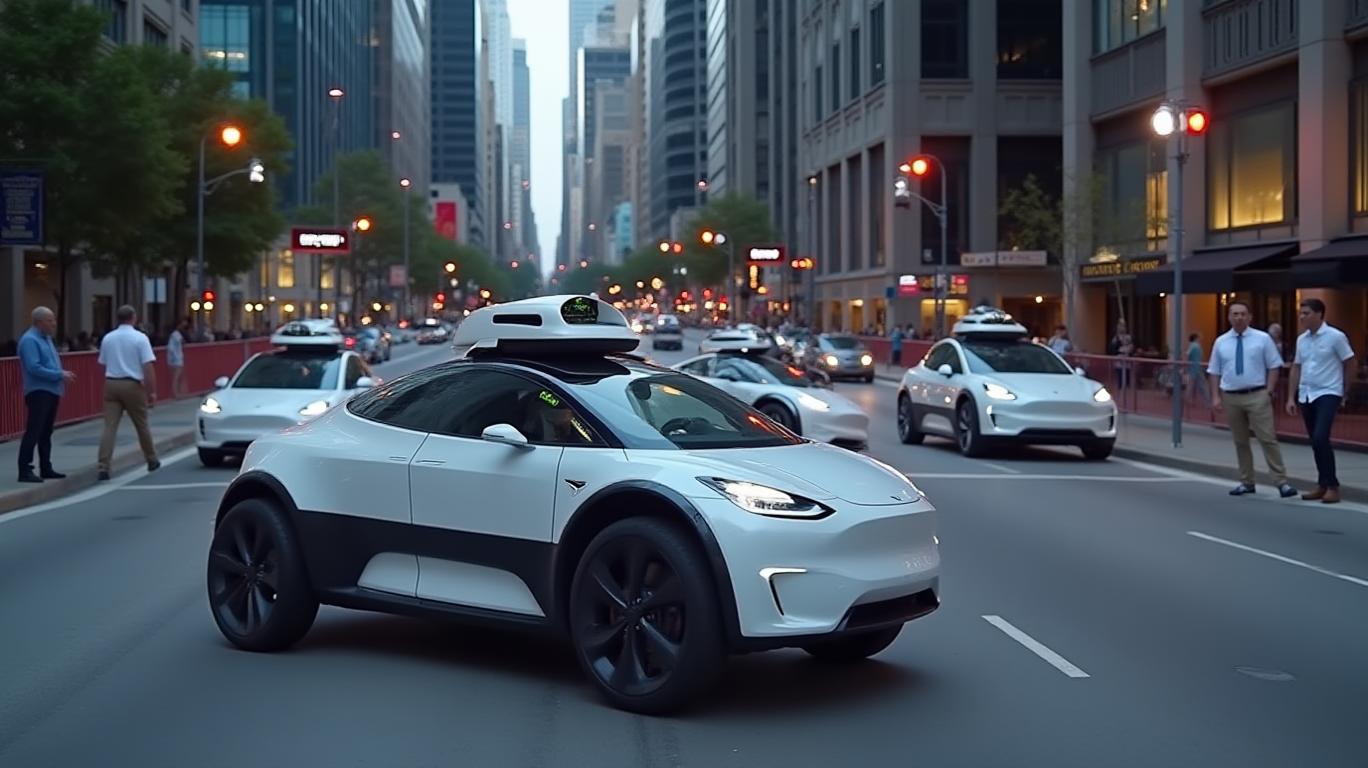
Tesla's robotaxi service, initially announced in October 2023, is set to debut in Austin, Texas, before expanding to other U.S. regions and eventually going global. The service will rely on a fleet of Model 3 and Model Y vehicles equipped with an unsupervised version of Tesla's Full Self-Driving (FSD) software. This software, currently in testing at Tesla's Fremont factory, has already proven its reliability in real-world conditions, with thousands of Teslas using it daily.
By leveraging Texas' more lenient regulations, Tesla aims to accelerate the deployment of its robotaxi service. Texas has fewer restrictions on autonomous vehicle testing and deployment compared to states like California, which has stricter regulations. This could enable Tesla to launch its robotaxi service more quickly and at a lower cost than in other states.
However, this strategic move also presents potential challenges and concerns. First, Texas' less stringent labor laws might result in lower-quality manufacturing processes, which could affect the overall reliability and durability of the robotaxis. Additionally, Texas' extreme heat and humidity could pose additional challenges to the robotaxis' performance and longevity. Lastly, the shift in production to Texas could potentially impact the safety and reliability of the robotaxis, as less rigorous testing and validation might be conducted before deployment on public roads.
Despite these concerns, Tesla's robotaxi service has the potential to disrupt the ride-sharing industry and create new opportunities for the company. By offering fully autonomous rides on demand, Tesla can tap into a growing market for convenient, eco-friendly transportation. Moreover, the robotaxi service could generate additional revenue streams for Tesla, further solidifying its position as a leader in the EV industry.
In conclusion, Tesla's robotaxi service, set to launch in Austin, Texas, by June 2025, represents a significant step forward in the company's quest to revolutionize the transportation industry. By leveraging Texas' lenient regulations, Tesla aims to accelerate the deployment of its robotaxi service, potentially disrupting the ride-sharing market and creating new revenue streams. However, the shift in production to Texas also presents potential challenges and concerns that Tesla must address to ensure the safety and reliability of its robotaxis. As Tesla continues to push the boundaries of innovation and technology, investors and consumers alike will be watching closely to see how this bold move unfolds.
As the electric vehicle (EV) revolution gains momentum, one name stands out as a trailblazer: Tesla. The company, led by the enigmatic Elon Musk, has consistently pushed the boundaries of innovation and technology. Now, Tesla is set to revolutionize the ride-sharing industry with its robotaxi service, aiming to launch as early as June 2025. But to make this happen, Tesla is turning to Texas, a state known for its lenient regulations. Let's dive into the details and explore the potential implications of this strategic move.
Tesla's robotaxi service, initially announced in October 2023, is set to debut in Austin, Texas, before expanding to other U.S. regions and eventually going global. The service will rely on a fleet of Model 3 and Model Y vehicles equipped with an unsupervised version of Tesla's Full Self-Driving (FSD) software. This software, currently in testing at Tesla's Fremont factory, has already proven its reliability in real-world conditions, with thousands of Teslas using it daily.
By leveraging Texas' more lenient regulations, Tesla aims to accelerate the deployment of its robotaxi service. Texas has fewer restrictions on autonomous vehicle testing and deployment compared to states like California, which has stricter regulations. This could enable Tesla to launch its robotaxi service more quickly and at a lower cost than in other states.
However, this strategic move also presents potential challenges and concerns. First, Texas' less stringent labor laws might result in lower-quality manufacturing processes, which could affect the overall reliability and durability of the robotaxis. Additionally, Texas' extreme heat and humidity could pose additional challenges to the robotaxis' performance and longevity. Lastly, the shift in production to Texas could potentially impact the safety and reliability of the robotaxis, as less rigorous testing and validation might be conducted before deployment on public roads.
Despite these concerns, Tesla's robotaxi service has the potential to disrupt the ride-sharing industry and create new opportunities for the company. By offering fully autonomous rides on demand, Tesla can tap into a growing market for convenient, eco-friendly transportation. Moreover, the robotaxi service could generate additional revenue streams for Tesla, further solidifying its position as a leader in the EV industry.
In conclusion, Tesla's robotaxi service, set to launch in Austin, Texas, by June 2025, represents a significant step forward in the company's quest to revolutionize the transportation industry. By leveraging Texas' lenient regulations, Tesla aims to accelerate the deployment of its robotaxi service, potentially disrupting the ride-sharing market and creating new revenue streams. However, the shift in production to Texas also presents potential challenges and concerns that Tesla must address to ensure the safety and reliability of its robotaxis. As Tesla continues to push the boundaries of innovation and technology, investors and consumers alike will be watching closely to see how this bold move unfolds.

Divulgación editorial y transparencia de la IA: Ainvest News utiliza tecnología avanzada de Modelos de Lenguaje Largo (LLM) para sintetizar y analizar datos de mercado en tiempo real. Para garantizar los más altos estándares de integridad, cada artículo se somete a un riguroso proceso de verificación con participación humana.
Mientras la IA asiste en el procesamiento de datos y la redacción inicial, un miembro editorial profesional de Ainvest revisa, verifica y aprueba de forma independiente todo el contenido para garantizar su precisión y cumplimiento con los estándares editoriales de Ainvest Fintech Inc. Esta supervisión humana está diseñada para mitigar las alucinaciones de la IA y garantizar el contexto financiero.
Advertencia sobre inversiones: Este contenido se proporciona únicamente con fines informativos y no constituye asesoramiento profesional de inversión, legal o financiero. Los mercados conllevan riesgos inherentes. Se recomienda a los usuarios que realicen una investigación independiente o consulten a un asesor financiero certificado antes de tomar cualquier decisión. Ainvest Fintech Inc. se exime de toda responsabilidad por las acciones tomadas con base en esta información. ¿Encontró un error? Reportar un problema




Comentarios
Aún no hay comentarios