
Tesla's Strategic Viability: Assessing Long-Term Investment Potential Amid Valuation Volatility and Market Dynamics
The investment case for TeslaTSLA--, Inc. (TSLA) remains a subject of intense debate, particularly as the company navigates a complex interplay of financial metrics, competitive pressures, and macroeconomic headwinds. With a trailing P/E ratio of 330.02 as of November 2025-far exceeding the industry average of 12.64-Tesla's valuation reflects a market that is betting heavily on its future growth potential. However, this optimism must be weighed against a backdrop of declining revenue growth, margin pressures, and regulatory uncertainties. This analysis evaluates the strategic viability of Tesla as a long-term investment, drawing on its financial health, competitive advantages, and exposure to broader market dynamics.
Financial Metrics: A Tale of High Expectations and Marginal Pressures
Tesla's financial performance in 2025 underscores the tension between its market dominance and operational challenges. While its $1.6 trillion market capitalization cements its status as a global automotive leader, the company's trailing twelve months (TTM) revenue growth is negative at -1.56%, lagging behind the industry average of 2.85%. This divergence highlights a critical risk: Tesla's valuation is decoupled from its near-term revenue performance.
Gross margins have also deteriorated, with Q3 2025 reporting a 17.0% margin, down from previous levels, driven by aggressive price cuts and rising production costs. Meanwhile, the non-automotive segments-Energy Generation & Storage and Services-are emerging as key growth drivers, contributing $3.4 billion in revenue and $1.1 billion in gross profit during the same period. These segments offer higher-margin opportunities but remain smaller in scale compared to Tesla's core automotive business.
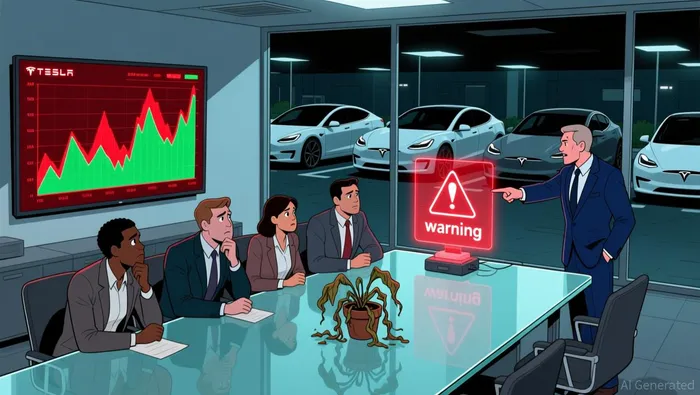 Despite these challenges, Tesla's balance sheet remains robust, with $41.65 billion in cash reserves and a debt-to-equity ratio of 9.2%. This financial flexibility provides a buffer against short-term volatility but does not mitigate the risks of declining profitability if margin pressures persist.
Competitive Advantages: Innovation and Strategic Expansion
Tesla's ability to sustain its market leadership hinges on its capacity to innovate and scale. The company's R&D investments are focused on battery technology, Full Self-Driving (FSD) capabilities, and affordable EV models. The release of FSD v13, which aims to surpass human safety performance by 2025, represents a pivotal milestone in autonomous driving. Additionally, Tesla's energy division is projected to grow by 50% in 2025, driven by demand for Powerwall and Megapack systems.
Strategic expansion into robotics and autonomous ride-hailing services-such as the pilot launch of Robotaxi in Texas-positions Tesla at the forefront of physical AI and mobility innovation. These initiatives align with broader trends in electrification and automation, offering long-term growth catalysts. However, the company's declining U.S. market share-from 60% in 2020 to 38% in 2024-underscores the intensifying competition from traditional automakers and new entrants.
Tesla's foray into the Indian market, supported by government incentives, could provide a new revenue stream. Yet, success will depend on navigating regulatory complexities and adapting to local consumer preferences. Similarly, the company's dual-market supply chain strategy-reshoring production in the U.S. and scaling domestic battery capacity-aims to mitigate geopolitical risks but requires significant capital expenditures.
Analyst Projections: Growth vs. Profitability
Analysts project Tesla's 2025 revenue to reach $97.1 billion, with net profit expected at $5.4 billion. While this represents a 16.89% revenue growth rate, the net profit margin of 10.25% is a decline from previous years, reflecting margin compression. The projected revenue growth is driven by the Energy and Services segments, which are expanding at a faster pace than the automotive division.
However, the bearish outlook centers on Tesla's ability to maintain profitability amid rising R&D costs, capital expenditures, and regulatory scrutiny. The company's trailing P/E ratio of 175.15x remains elevated, suggesting that the market is pricing in aggressive growth assumptions that may not materialize. Analysts are divided: bullish perspectives emphasize AI and robotics advancements, while bearish views highlight execution risks and overvaluation concerns.
Long-Term Risks: Regulatory and Macroeconomic Headwinds
Beyond operational challenges, Tesla faces significant regulatory and macroeconomic risks. The U.S. EV market, a critical growth driver, is subject to policy uncertainty, including potential rollbacks of the Inflation Reduction Act incentives. In Europe, Tesla's Q2 2025 vehicle deliveries fell short of expectations, with European sales declining by nearly 50% in April 2025. These trends highlight the vulnerability of Tesla's international operations to regulatory shifts and shifting consumer preferences.
Legal risks are also mounting, particularly around FSD technology. Regulatory scrutiny from the NHTSA and investor lawsuits over alleged securities fraud could disrupt Tesla's product roadmap and erode investor confidence. Additionally, the company's bylaw amendments, which impose a 3% minimum shareholding threshold for initiating derivative lawsuits, have raised concerns about corporate governance and shareholder rights.
Globally, trade tensions and supply chain constraints are prompting automakers to regionalize production. Tesla's strategy to phase out dependencies on problematic suppliers within one to two years is ambitious but will require navigating complex geopolitical dynamics.
Strategic Viability: A Balancing Act
Tesla's strategic viability as a long-term investment depends on its ability to balance innovation with execution. The company's strengths-leadership in EV technology, robust cash reserves, and a first-mover advantage in autonomous driving-remain compelling. However, these must be weighed against the risks of margin compression, regulatory headwinds, and intensifying competition.
For investors, the key question is whether Tesla's current valuation is justified by its growth potential. While the company's P/E ratio is significantly higher than industry peers, its projected revenue growth and expansion into high-margin segments like energy storage and robotics could justify the premium. Conversely, any missteps in scaling these initiatives or navigating regulatory challenges could lead to a re-rating of the stock.
Conclusion
Tesla occupies a unique position at the intersection of technological innovation and market volatility. Its long-term investment appeal lies in its potential to redefine mobility and energy systems, but this potential is tempered by financial and regulatory risks. Investors considering Tesla at current valuations must assess their risk tolerance for a company that is both a growth engine and a speculative bet. As the EV market evolves and regulatory landscapes shift, Tesla's ability to adapt will determine whether it remains a cornerstone of the clean energy revolution or becomes a cautionary tale of overvaluation.







Comentarios
Aún no hay comentarios