
Tesla's Strategic Position in the Trump-Era AI and Robotics Revolution
The intersection of artificial intelligence (AI), robotics, and geopolitics has never been more consequential for corporate strategy. TeslaTSLA--, under Elon Musk's leadership, is uniquely positioned to capitalize on the Trump administration's aggressive AI and robotics agenda, which prioritizes deregulation, ideological neutrality, and global technological dominance. This alignment of policy, innovation, and geopolitical ambition creates a compelling case for Tesla's long-term value creation, even as execution risks persist.
Geopolitical Alignment: AI as a Strategic Weapon
The Trump administration's AI Action Plan, unveiled in July 2025, underscores a clear objective: to cement U.S. leadership in AI and robotics while countering global rivals, particularly China. By emphasizing "America-first AI," the administration has positioned AI as a cornerstone of national security and economic competitiveness. Tesla's advancements in autonomous driving and humanoid robotics align seamlessly with this vision. For instance, the Pentagon's partnership with xAI-a Musk-led venture-to integrate Grok AI into military operations according to GenAI.mil highlights how Tesla's ecosystem of AI-driven technologies could bolster U.S. strategic interests.
Moreover, the administration's focus on "sustainable abundance" through AI mirrors Tesla's Master Plan Part 4, which envisions a future where robotics and AI eliminate labor and energy constraints. This ideological congruence is not coincidental. Musk's influence within the Trump administration, including his role as head of the Department of Government Efficiency (DOGE), has amplified his ability to shape policies that accelerate Tesla's autonomous vehicle (AV) and robotaxi initiatives according to Nasdaq. The administration's pledge to streamline federal AV regulations, for example, directly addresses a key bottleneck for Tesla's FSD technology rollout.
Regulatory Tailwinds: Deregulation as a Catalyst
The Trump administration's regulatory approach has been as transformative as its strategic vision. The AI Preemption Executive Order (EO), signed in December 2025, aims to preempt state-level AI regulations deemed "onerous" or innovation-hindering. This move creates a favorable environment for Tesla, which has long criticized fragmented state regulations as a barrier to scaling AV and robotics technologies. By centralizing oversight and reducing bureaucratic friction, the administration is effectively lowering the cost of compliance for companies like Tesla, which rely on rapid iteration and deployment.
 Additionally, the administration's directive to streamline data center permitting-a critical infrastructure for AI training- aligns with Tesla's need for robust computational resources. The AI Litigation Task Force, tasked with challenging restrictive state laws, further insulates Tesla from regulatory uncertainty, allowing it to focus on execution rather than legal battles. These tailwinds are not merely theoretical: Tesla's stock has rebounded in response to the administration's pro-innovation stance, signaling investor confidence in the company's strategic alignment with policy trends.
Long-Term Value Creation: From EVs to AI-Driven Abundance
Tesla's pivot from electric vehicles (EVs) to AI and robotics represents a fundamental reimagining of its value proposition. According to a report by Carbon Credits, Musk has asserted that humanoid robots-specifically the Optimus line-could account for up to 80% of Tesla's long-term value. This is not hyperbole. The Optimus robot, designed for tasks ranging from factory automation to home assistance, is projected to disrupt labor markets with a price point of $20,000–$30,000 per unit, potentially offsetting $50,000–$100,000 in annual human labor costs according to Carbon Credits.
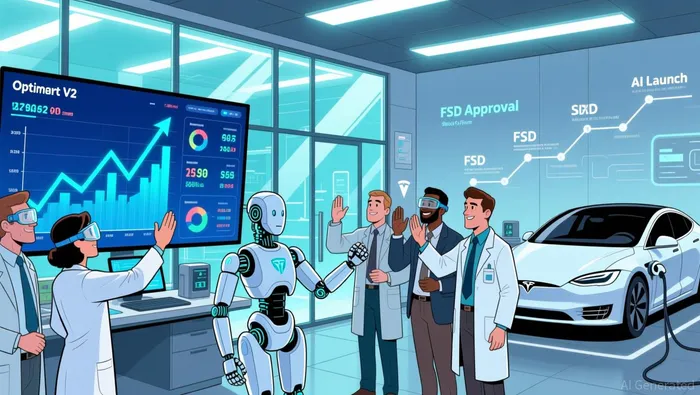
Technical progress in Q4 2025 has been encouraging. Tesla demonstrated Optimus performing a light jog and refining its dexterous hand for precision tasks like threading a needle. Production plans, including Version 2 (V2) launches in mid-2025 and a target of 100,000 units per month by 2026, suggest the company is on track to scale rapidly. Crucially, Tesla's AI infrastructure-shared across autonomous vehicles and robots-creates a flywheel effect. Real-world data from Tesla's 500,000+ AVs could accelerate Optimus's learning curve, while the robot's operational insights could, in turn, enhance AV performance according to MotorWatt.
However, skeptics remain. Production challenges have forced Tesla to pause early Optimus production for redesigns. Execution risks are real, but the potential rewards are unprecedented. If Tesla succeeds, it could redefine industries from manufacturing to logistics, generating revenue streams that dwarf its current EV business.
Conclusion: A High-Stakes Bet on the Future
Tesla's strategic position in the Trump-era AI and robotics revolution is underpinned by three pillars: geopolitical alignment with U.S. leadership goals, regulatory tailwinds that reduce innovation barriers, and a long-term value proposition rooted in AI-driven abundance. While execution risks persist, the administration's policy framework and Musk's influence create a unique environment for Tesla to scale its ambitions. For investors, the question is not whether Tesla can succeed, but whether it can execute on its vision before competitors or regulatory shifts disrupt the trajectory. In a world where AI and robotics are reshaping economies and geopolitics, Tesla's bets are as bold as they are consequential.







Comentarios
Aún no hay comentarios