
Tesla's Strategic Pivots in Europe: Model Y L Expansion and the Retreat of Model S/X
Tesla's strategic recalibration in Europe-marked-by the aggressive expansion of its lower-cost Model Y and the relative retreat of its premium Model S/X-offers a critical lens through which to assess the company's broader adaptation to the global electric vehicle (EV) market. As European sales falter and competition intensifies, Tesla's product strategy reveals both its resilience and vulnerabilities, with implications for investors navigating the EV sector's evolving landscape.
The Model Y's Price War and Market Rebound
Tesla's decision to launch a stripped-down "Standard" variant of the Model Y in key European markets in October 2025 underscores its pivot toward price competitiveness. Priced at €39,990 in Germany, NOK 421,996 in Norway, and SEK 499,990 in Sweden, the Model Y Standard sacrifices features like Autosteer to undercut the Model Y Long Range RWD by nearly €10,000. This move aims to counter declining market share, which fell to 1.2% in May 2025 from 1.8% a year earlier, as Chinese EVs like BYD's Dolphin Surf (priced at €23,000) gained traction.
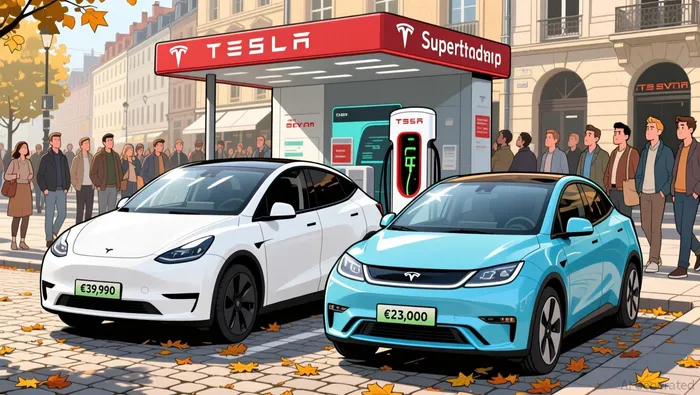 Despite these cuts, the Model Y Standard retains access to Tesla's Supercharger network and over-the-air updates, preserving brand equity while targeting budget-conscious buyers. Localized production at Giga Berlin further enhances cost efficiency, with the factory producing 375,000 vehicles annually and leveraging EU sustainability incentives. However, analysts argue the pricing remains too high for true mass-market appeal, highlighting Tesla's struggle to balance affordability with profitability.
The Model Y's performance in 2025 has been volatile. While it briefly reclaimed the title of Europe's best-selling car in September 2025 with 25,000 units sold, overall sales fell 48.5% year-over-year in October 2025. A Q3 rebound, driven by the refreshed "Project Juniper" Model Y, saw a 67% quarter-over-quarter growth, but this resurgence has yet to translate into sustained market share gains according to analysis.
The Retreat of Model S/X and Premium Brand Challenges
The Model S/X, Tesla's premium offerings, have consistently underperformed in Europe. In 2024, only 85,133 units of these models were delivered, compared to 1.7 million for the Model 3/Y. This disparity reflects shifting consumer preferences toward affordability and practicality, particularly in price-sensitive markets like Germany and France. The Model S/X's niche appeal is further constrained by its higher price point and limited differentiation from competitors like the Mercedes EQS or BMW i7, which offer comparable luxury at lower costs.
Tesla's premium brand image, once a key differentiator, is also eroding. Consumer sentiment studies indicate that one-third of buyers now view TeslaTSLA-- as mainstream rather than premium, with nearly 40% believing its novelty has worn off. This shift is exacerbated by Elon Musk's public persona and regulatory scrutiny, which have dented the company's aspirational appeal according to analysis.
Strategic Implications for the Global EV Market
Tesla's European strategy mirrors broader trends in the global EV market. The rise of Chinese EVs-eight of which now dominate the world's top ten best-selling models-has forced Tesla to adopt a more aggressive pricing approach. BYD's 34.1% market share in China and its vertical integration model highlight the challenges Tesla faces in maintaining its cost leadership. Meanwhile, European automakers like Volkswagen and Renault are developing smaller, cheaper EVs to compete with both Chinese brands and Tesla according to industry reports.
Localization remains a double-edged sword. While Giga Berlin's production of 4680 battery cells and localized supply chains reduce costs and environmental impact, regulatory hurdles and environmental concerns (e.g., water usage) persist. Tesla's ability to navigate these challenges will determine its long-term competitiveness in Europe, a market critical to its global growth ambitions.
Investor Considerations: A Mixed Outlook
For investors, Tesla's European strategy presents both opportunities and risks. On the positive side, the Model Y Standard's launch and Giga Berlin's expansion demonstrate Tesla's agility in adapting to market dynamics. The company's robust Supercharger network and technological leadership also provide a moat against rivals. However, the sharp decline in European sales-down 52% in Q1 2025 and 48.5% in October-raises concerns about its ability to sustain growth in a fragmented market.
Cross-regional comparisons further complicate the outlook. While Tesla dominates the U.S. EV market (43% of sales in Q2 2025), its European struggles highlight regional disparities in regulatory support, consumer preferences, and competitive intensity. Investors must weigh these factors against Tesla's broader financial health, including its vertical integration and energy diversification efforts, which offer long-term resilience according to strategic analysis.
Conclusion
Tesla's strategic pivots in Europe-expanding the Model Y's affordability while retreating from premium segments-reflect a broader recalibration to a maturing EV market. While these moves signal adaptability, they also underscore the company's vulnerabilities in the face of rising competition and regulatory uncertainty. For investors, the key question is whether Tesla can sustain its innovation edge and cost advantages while scaling in price-sensitive markets. The answer will shape not only Tesla's fortunes but also the trajectory of the global EV industry.





Comentarios
Aún no hay comentarios