
Tesla's Strategic Move into 2nm Chip Manufacturing: A Deep Dive into Vertical Integration's Long-Term Investment Implications
Tesla's recent foray into 2nm chip manufacturing represents a bold redefinition of its technological ambitions, positioning the automaker at the intersection of AI innovation and semiconductor production. By announcing plans to develop a 2nm fabrication process in-house while partnering with Samsung for large-scale production, TeslaTSLA-- is leveraging vertical integration to secure a competitive edge in AI-driven hardware. This move raises critical questions for investors: How does vertical integration in semiconductor manufacturing align with Tesla's long-term strategy? What are the financial and operational risks and rewards? And how does this strategy compare to traditional models in an industry dominated by giants like Intel and TSMC?
Tesla's 2nm Initiative: A Hybrid Approach to Vertical Integration
Tesla's strategy combines in-house R&D with strategic outsourcing. CEO Elon Musk has emphasized the company's plan to build a clean room with wafer-isolation capabilities, a move designed to reduce contamination risks and enhance flexibility in chip production. Simultaneously, Tesla has inked a $16.5 billion, multiyear agreement with Samsung to manufacture its AI6 chips using the 2nm process at Samsung's Taylor, Texas facility. This partnership, which spans through 2033, allows Tesla to benefit from Samsung's advanced nanosheet transistor technology while retaining control over chip design.
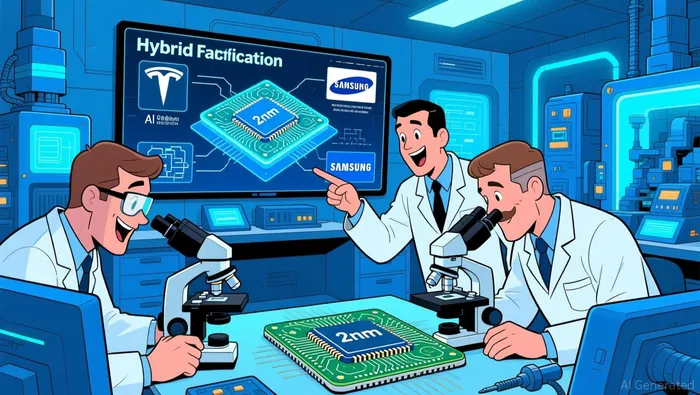 This hybrid model diverges from traditional vertical integration, where companies like Intel control both design and fabrication entirely in-house. Instead, Tesla appears to be adopting a "semi-vertical" approach, outsourcing manufacturing to a partner while maintaining tight oversight of design and process innovation. Such a strategy could mitigate the astronomical capital expenditures associated with building a full 2nm fab- TSMC's Fab 20 and Fab 22, for instance, cost over $20 billion to construct.
Vertical Integration in Semiconductors: A Double-Edged Sword
The semiconductor industry has long grappled with the trade-offs of vertical integration. Intel's historical dominance relied on full vertical integration, which allowed it to optimize performance and avoid supply chain bottlenecks. However, this model has become increasingly untenable as process node development costs soar and timelines stretch. Intel's recent struggles-falling behind fabless rivals like AMD and NVIDIA-highlight the risks of shouldering both design and fabrication costs alone.
In contrast, fabless companies such as NVIDIA and AMD outsource manufacturing to foundries like TSMCTSM--, enabling them to focus on R&D while avoiding the financial burden of fabrication plants. This model offers scalability and flexibility, as seen in Qualcomm's recent decision to use Samsung's 2nm process for its next-generation mobile chips. Tesla's partnership with Samsung seems to blend the best of both worlds: it secures access to cutting-edge manufacturing while retaining design control, a critical factor in AI applications where customization is paramount.
Competitive Landscape and Financial Implications
Tesla's 2nm push places it in direct competition with TSMC, which has already begun mass production of its N2 technology. TSMC's leadership in density and energy efficiency underscores the technical hurdles Tesla must overcome to achieve parity. However, the company's focus on AI-specific hardware-such as the AI6 chip-could differentiate its offerings. AI chips require specialized architectures optimized for parallel processing, a domain where Tesla's in-house expertise in autonomous driving and neural networks may provide an edge.
Financially, the $16.5 billion Samsung deal is a significant investment, but it pales in comparison to the costs of building a full 2nm fab. For context, TSMC's Fab 20 alone required an estimated $20 billion in capital expenditures. By outsourcing production, Tesla avoids tying up capital in infrastructure while still securing long-term manufacturing capacity. This approach aligns with broader industry trends: AI/ML applications are increasingly deployed across semiconductor manufacturing, contributing to EBIT growth and unlocking new value streams.
Long-Term Investment Implications
For investors, Tesla's 2nm strategy hinges on three key factors: cost efficiency, innovation control, and market timing.
- Cost Efficiency: By outsourcing fabrication to Samsung, Tesla reduces CAPEX risks while leveraging Samsung's economies of scale. However, long-term costs could rise if Samsung demands higher margins or if Tesla seeks to transition to full in-house production.
- Innovation Control: Tesla's in-house design capabilities, combined with Samsung's manufacturing expertise, position the company to iterate rapidly on AI-specific hardware. This is critical in an industry where performance gains are often tied to proprietary architectures.
- Market Timing: The 2nm node is pivotal for AI, where energy efficiency and computational density are non-negotiable. TSMC's early lead means Tesla must accelerate its timeline to capture market share, a challenge compounded by the technical complexity of nanosheet transistors.
A potential wildcard is the emergence of disruptive technologies, such as vertical gallium nitride (GaN) transistors developed by MIT spinout Vertical Semiconductor. These devices promise to reduce energy loss in AI data centers, a critical consideration for companies like Tesla that rely on high-power computing. While Tesla has not yet incorporated such innovations, the company's vertical integration strategy could enable it to adopt new technologies more swiftly than fabless competitors.
Conclusion: A Calculated Bet on AI's Future
Tesla's 2nm initiative is a high-stakes bet on the future of AI-driven mobility. By adopting a semi-vertical integration model, the company balances the need for design control with the financial realities of advanced semiconductor manufacturing. While risks-such as technical delays or rising production costs-remain, the strategic alignment with Samsung and Tesla's AI expertise position the automaker to disrupt traditional supply chains. For investors, the key will be monitoring how this strategy translates into tangible performance gains for Tesla's vehicles and AI systems, as well as how it stacks up against the relentless innovation of TSMC and Intel. In an industry where Moore's Law is slowing and vertical integration is both a shield and a sword, Tesla's approach could redefine what it means to be a vertically integrated tech company.







Comentarios
Aún no hay comentarios