
Tesla's Stock Valuation: Is the AI and Autonomous Future Already Priced In?
The debate over Tesla's stock valuation has reached a fever pitch in 2025, as the company's market capitalization of $1.37 trillion sits at odds with its mixed financial performance and speculative growth narratives. With a trailing price-to-earnings (P/E) ratio of 252.65 and a forward P/E of 172.41, investors are clearly pricing in a future where Tesla's AI-driven autonomous driving and robotics ventures dominate global markets. But is this optimism justified, or is the stock already overvalued by the very innovations it promises?
The Case for Optimism: AI and Energy as Growth Catalysts
Tesla's long-term value proposition hinges on its ability to transition from an automotive company to a diversified tech platform. The energy division, now accounting for 12.1% of total revenue in Q3 2025, has grown 44% year-over-year, driven by demand for Megapack battery systems and renewable energy solutions. Analysts project this segment could generate $27–30 billion by 2027, offering a critical buffer against automotive headwinds.
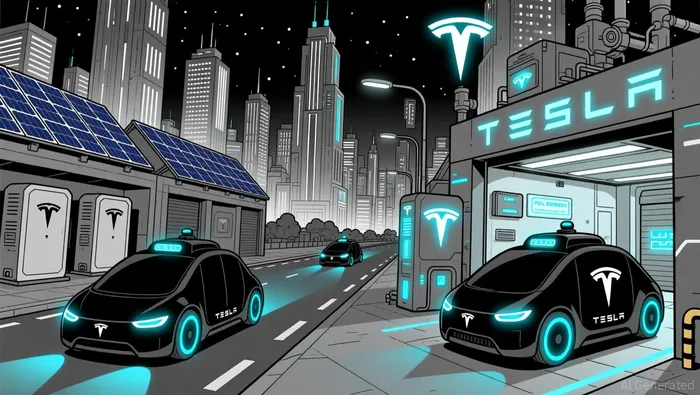
Meanwhile, the autonomous driving segment remains the most speculative but potentially transformative. The Cybercab, slated for mass production in Q2 2026, could yield net profits of up to $94,000 per vehicle by its fifth year, assuming optimal utilization rates. Tesla's Full Self-Driving (FSD) software is also expanding globally, with plans for a robotaxi service that could disrupt traditional ride-hailing markets. These initiatives are priced into the stock, with forward-looking models suggesting valuations as high as $3,000 per share.
The Reality Check: Automotive Struggles and Margin Compression
Despite these bullish narratives, Tesla's core automotive business is under pressure. Margins have compressed from over 25% in 2023 to 16–18% in 2025, while U.S. EV sales declined 30% year-over-year following the expiration of federal tax credits. Q1 2025 deliveries fell 32% compared to Q4 2024, highlighting vulnerability to regulatory and economic shifts.
Competitive threats further complicate the outlook. BYD overtook Tesla as the global leader in battery electric vehicle (BEV) sales in Q3 2025, capturing 15.4% of the market versus Tesla's 13.4%. While TeslaTSLA-- maintains higher profitability ($1.4 billion net income in Q3 2025 versus BYD's $1.1 billion), its valuation multiples-289x P/E versus BYD's 25x-reflect a stark disconnect between speculative expectations and current fundamentals.
Regulatory and Execution Risks: The Unseen Hurdles
Tesla's autonomous driving ambitions face significant regulatory hurdles. Delays in FSD deployment in Europe and the UK, coupled with safety concerns around its AI systems, could stall timelines for revenue-generating services like robotaxi. Additionally, the company's reliance on unproven technologies-such as the Cybercab's mass-market viability-introduces execution risks that traditional valuation models struggle to quantify.
Valuation Divergence: DCF vs. Scenario Analysis
The valuation debate is split between two camps. Discounted cash flow (DCF) models, which rely on historical financial data, suggest Tesla's fair value is between $69 and $138 per share. Conversely, scenario analysis-factoring in the potential of AI, robotics, and energy-projects valuations as high as $3,000 per share. This divergence underscores the stock's high-risk, high-reward profile, with outcomes hinging on the success of Tesla's moonshot bets.
Risk-Reward Analysis: A High-Stakes Bet
For investors, Tesla's stock embodies the classic high-growth tech stock dilemma: a company with transformative potential but uncertain execution. The energy division and AI initiatives offer compelling long-term upside, but the automotive segment's struggles and regulatory risks create near-term volatility. Morgan Stanley's downgrade to Equal Weight in 2025, despite a $425 price target, reflects this tension.
In conclusion, Tesla's valuation appears to partially price in its AI and autonomous driving future, but the extent to which this potential materializes remains uncertain. Investors must weigh the allure of disruptive innovation against the realities of margin compression, regulatory delays, and competitive pressures. For those with a high-risk tolerance and a long-term horizon, Tesla could still deliver outsized returns. For others, the current valuation may signal a cautionary tale of speculative excess.





Comentarios
Aún no hay comentarios