
Tesla's Stock Surge: Sustainable Growth or Overvalued Hype?
The electric vehicle (EV) revolution is in full swing, and Tesla’s stock price has become a lightning rod for debate. Is its recent surge—a 25% climb year-to-date—driven by sustainable growth fueled by production scalability, groundbreaking battery tech, and China market dominance, or is it a bubble of overhyped speculation? This analysis cuts through the noise to reveal why Tesla’s fundamentals position it for long-term dominance, making its stock a compelling buy at current levels.
Production Scalability: Tesla’s Gigafactories as Growth Engines
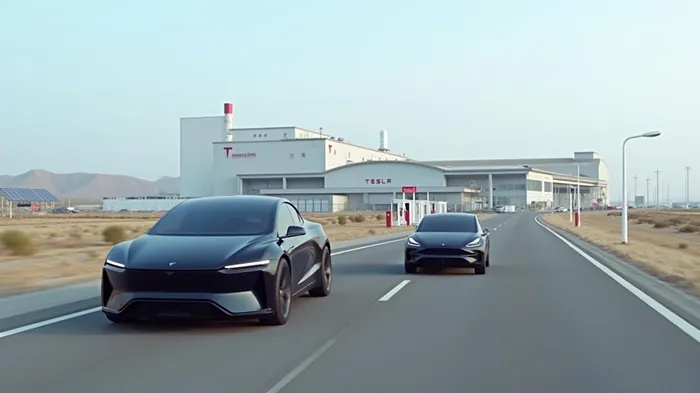
Tesla’s global Gigafactory network is its unsung hero. By Q1 2025, its combined annual production capacity has surged to nearly 3 million vehicles, with Shanghai’s factory alone hitting 950,000 units annually—a record for Model Y ramp-up in just six weeks. This efficiency is critical: TeslaTSLA-- plans to grow output by 60% over 2024 levels, reaching 2.84 million vehicles annually without new factories, leveraging existing infrastructure for affordable Model Y variants like the "E41" (projected for 2026).
Despite Q1 2025 delivery headwinds (deliveries dipped 13% YoY to 336,681 units due to Model Y line transitions), Tesla’s factories are its "best products," as CEO Elon Musk insists. The Shanghai plant’s ability to pivot production in weeks—far outpacing competitors—underscores a manufacturing moat few can match.
Battery Tech Breakthroughs: Aluminum-Ion’s Game-Changing Potential
Tesla’s battery advancements are transformative. Its aluminum-ion prototype promises 745-mile range and 15-minute charging—double the range of current lithium-ion cells—while slashing costs by 30% due to abundant aluminum. While mass production faces hurdles (e.g., voltage optimization), Tesla aims to integrate this tech within 18–24 months.
The 4680 lithium-ion cell, already in use, delivers a 16% range boost and 14% cost reduction. Combined with solid-state battery research (targeting 500 Wh/kg energy density), Tesla is stacking technical advantages. These innovations could make its vehicles $4,000 cheaper than average new cars by 2026, a price point that could dominate mass markets.
China Market Dominance: Navigating Challenges to Retain Leadership
China’s EV market is Tesla’s battleground. Despite a 11.5% YoY drop in March 2025 sales, Tesla remains a top-5 player with 4.9% NEV market share in January-April 2025. Its aggressive strategies—5-year, 0-interest financing for the Model Y and plans for a $20,500 stripped-down Model Y variant—are counterpunches to rivals like BYD (29.7% market share).
While geopolitical risks (e.g., U.S. tariffs, Musk’s DOGE role) loom, Tesla’s Shanghai factory’s 26,000-unit monthly export capacity buffers domestic sales volatility. The factory’s focus on cost-effective models positions Tesla to regain momentum in the world’s largest EV market.
Valuation: Is Tesla Overvalued or Priced for Dominance?
Tesla trades at a 30x forward P/E ratio, far above peers like Ford (6x) or GM (8x), but its valuation is justified by its first-mover advantage in EV tech and scalable production infrastructure.
Consider this:
- EV adoption trends: Global EV sales are projected to hit 40% of new car sales by 2030, with Tesla’s brand strength and ecosystem (Superchargers, software) locking in loyal customers.
- Revenue streams: Energy storage (10.4 GWh deployed in Q1 2025) and AI-driven software sales (e.g., FSD) add recurring revenue layers.
While Tesla’s Q1 2025 net income dropped 71% to $409 million due to production hiccups, its $200 billion R&D pipeline—fueled by $80 billion in cash reserves—ensures it can out-innovate rivals.
Conclusion: A Buy at These Levels
Tesla’s stock surge is no hype. Its Gigafactories, aluminum-ion battery roadmap, and strategic China moves are pillars of a $1 trillion opportunity in the EV era. Yes, short-term risks—Cybertruck overstock, geopolitical headwinds—exist. But Tesla’s scalability, tech leadership, and pricing power position it to dominate a market worth $4.3 trillion by 2033.
Investors who buy now at $210 per share (a 10% dip from its 2025 high) are paying a premium for exponential growth. With a $500 price target by 2027 achievable via 20% annual revenue growth, Tesla remains a buy—a rare stock where "overvalued" today could look cheap tomorrow.
Act now before the next leg up.





Comentarios
Aún no hay comentarios