
Tesla's Stock Resilience Amidst Sales Downturns: A Contrarian Case for 2026 Growth
Tesla's third-quarter 2025 performance painted a mixed picture: record deliveries of 497,099 vehicles and a 29.6% surge in U.S. sales, yet operating profit plummeted 40% year-over-year to $1.6 billion according to financial reports. While near-term profitability challenges persist, a closer look at Tesla's strategic catalysts-Full Self-Driving (FSD) advancements, robotaxi readiness, energy segment expansion, and technical momentum-reveals a compelling contrarian case for 2026 growth.
Strategic Catalysts: From Hardware to Software-Driven Value
Tesla's ability to transform challenges into opportunities has long defined its trajectory. The recent Q3 sales surge, driven by the expiring U.S. EV tax credit, underscores demand for its vehicles. However, the decline in operating margins-falling to 5.8%-reflects pressures from tariffs and reduced regulatory credit income. The solution lies in Tesla's pivot toward software monetization.
FSD Version 14, now operational in key markets, introduces advanced reasoning features for parking, lane changes, and turns. 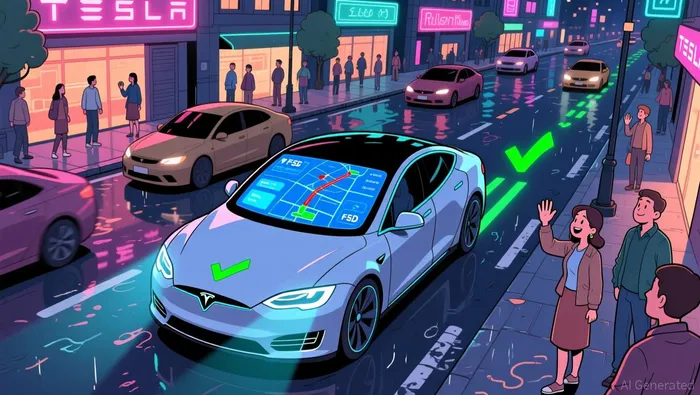 Analyst Stephen Gengaro of Stifel argues this progress justifies a $508 price target, up from $483, as FSD's commercialization could unlock recurring revenue streams. Similarly, robotaxi testing in Austin, slated for 2026, signals a shift from vehicle-centric to mobility-as-a-service models. By expanding autonomous ride-hailing to half the U.S. population by year-end 2025 according to market analysis, TeslaTSLA-- could replicate the scalability of its EV business while diversifying income.
The energy segment further bolsters this narrative. Record Powerwall deployments and Megapack expansions position Tesla to capitalize on the global energy transition. With energy storage demand projected to grow exponentially, this segment could offset automotive margin pressures and stabilize cash flows.
Technical Momentum: A Breakout Above $460?
Tesla's stock price has oscillated between optimism and skepticism in Q4 2025. After closing at $434.22 on October 14 according to market data, intraday highs reached $479.86 indicating potential breakout momentum, hinting at a potential breakout above $460. Analysts at Piper Sandler and Baird have raised price targets to $500 and $548, respectively, citing AI and robotaxi advancements.
Critics, including UBS, remain cautious, citing delivery volumes and margin risks. Yet Tesla's recent $1 billion stock repurchase by Elon Musk signals strong confidence and its AI-driven innovations-such as the Optimus humanoid robot-suggest a long-term bullish thesis. Technical indicators, including a narrowing trading range and increasing volume above key resistance levels, further support the case for a sustained breakout.
Contrarian Case: Turning Short-Term Pain Into Long-Term Gain
Tesla's history of overcoming adversity-whether supply chain bottlenecks or regulatory hurdles-positions it to navigate current challenges. The Q3 2025 earnings report, while showing $22.5 billion in revenue (slightly below expectations), highlighted resilience in a competitive EV landscape. Chinese manufacturers and traditional automakers may erode market share temporarily, but Tesla's first-mover advantage in FSD and robotaxi technology creates a durable moat.
For investors, the key is timing. While near-term volatility is likely, the alignment of strategic catalysts-software monetization, energy growth, and autonomous mobility-points to a 2026 inflection point. As one analyst noted, "Tesla is not just selling cars anymore; it's building a platform for the future of transportation and energy."
Conclusion
Tesla's stock resilience amid sales downturns reflects its capacity to reinvent itself. By leveraging FSD, robotaxi, and energy innovations, the company is poised to transition from a hardware-centric business to a software-driven ecosystem. For contrarian investors, the current valuation offers an opportunity to bet on a future where Tesla's recurring revenue streams and technological leadership drive exponential growth.





Comentarios
Aún no hay comentarios