
Tesla's Stock Crash: A Harbinger of Tech Sector Valuation Risks
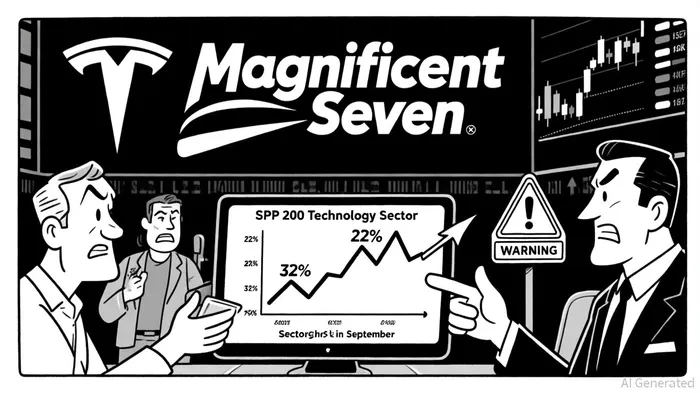
The recent turbulence in Tesla's stock price-plummeting 22% by August 2025 before surging 32% in September-has become a focal point for investors grappling with broader questions about the sustainability of tech-driven growth stocks. While Tesla's challenges are multifaceted, from declining European sales to geopolitical headwinds, its struggles reflect systemic vulnerabilities in a sector increasingly dominated by speculative valuations and concentrated market power. As the "Magnificent Seven" (Mag 7) tech giants account for 14% of global stock market capitalization, the TeslaTSLA-- saga underscores a critical warning: the tech sector's current trajectory may be teetering on the edge of a correction, according to a LinkedIn analysis.
Tesla's Unique Struggles and Broader Sector Parallels
Tesla's Q3 2025 delivery numbers-497,099 vehicles-exceeded expectations, driven by the Model 3 and Y platforms, according to a Tesla Accessories analysis. Yet, this success masked deeper issues: a 4.8% year-over-year decline in production, rising competition from Chinese EVs like BYD, and reputational risks tied to Elon Musk's political affiliations, as reported by Analytics Insight. These challenges mirror broader trends in the tech sector, where overvaluation and earnings shortfalls are becoming increasingly evident. For instance, Palantir Technologies (PLTR) saw its stock plummet in October 2025, as noted in a MarketMinute report. Similarly, Vistra (VST) and United Airlines (UAL) trade at multiples that outstrip their earnings growth prospects, signaling speculative excess, according to a Motley Fool list.
The root of the problem lies in the sector's reliance on speculative narratives. Tesla's forward P/E of 83.1x is justified by its bets on AI, robotics, and energy storage, but these initiatives carry execution risks, as noted in a Forbes piece. The same logic applies to the Mag 7, whose valuations are inflated by expectations of AI-driven growth rather than current earnings. As Stifel's Barry Bannister notes, large-cap U.S. indices are in their fifth "mania" in over a century, with the Mag 7 accounting for 30% of the S&P 500's market cap and 21% of its forward earnings, as Morningstar reports. This concentration creates fragility: a downturn in one of these firms could trigger cascading effects across the market.
Systemic Risks and the Great Rebalancing
The tech sector's vulnerabilities are compounded by macroeconomic headwinds. Rising U.S.-China trade tensions, sticky inflation, and potential stagflation scenarios threaten to erode margins and investor confidence, according to a Morgan Stanley report. Meanwhile, the sector's capital spending is heavily skewed toward a few hyperscalers. The four major cloud providers-Amazon, Microsoft, Alphabet, and Meta-are investing over $300 billion annually, representing 20% of the S&P 500's total capex, as discussed in The Great Rebalancing. Such concentrated spending raises concerns about overcapacity and diminishing returns, reminiscent of the 2000s shale boom.
Investors are already rotating capital toward defensive sectors. In October 2025, the Nasdaq Composite and S&P 500 Technology Sector experienced sharp declines as money flowed into utilities, healthcare, and consumer staples, according to a Yahoo Finance report. This "Great Rebalancing" reflects a shift in risk appetite, with markets prioritizing tangible profitability over speculative growth. For Tesla, this means its energy storage division-deploying 12.5 GWh in Q3 2025-may become a critical profit anchor, but its automotive and AI ambitions remain exposed to sector-wide volatility, as The Cooldown reports.
Implications for Investors
The Tesla crash and broader tech correction highlight the need for disciplined investing. While the Mag 7 and AI-driven narratives have fueled gains, they also expose portfolios to concentrated risk. For example, a 17% single-day drop in Nvidia's stock in October 2025 underscored the fragility of high-growth valuations, as a MarketMinute report noted. Investors must now weigh the potential of long-term innovation against near-term execution risks and macroeconomic pressures.
Conclusion
Tesla's stock volatility is not an isolated event but a symptom of deeper imbalances in the tech sector. As valuations stretch and earnings growth falters, the market is recalibrating its expectations. For investors, the lesson is clear: diversification, caution, and a focus on fundamentals will be critical in navigating the next phase of this cycle. The road ahead for Tesla-and the tech sector as a whole-depends not just on innovation, but on the ability to deliver sustainable value in an increasingly skeptical market.





Comentarios
Aún no hay comentarios