
Is Tesla Stock a Bubble Waiting to Burst?
The debate over Tesla's stock valuation has reached a fever pitch as the electric vehicle (EV) giant trades at a forward price-to-earnings (P/E) ratio of 204, far exceeding the industry average of 17.47 according to analysis. With former fund manager George Noble estimating Tesla's fair value at $80 per share-a price tag implying the stock is at least five times overpriced-and investor icon Michael Burry calling it "ridiculously overvalued," the question of whether TeslaTSLA-- is a speculative bubble looms large as reported. This analysis examines the disconnect between Tesla's fundamentals and its market capitalization, evaluates recent sales trends, and weighs the risks and opportunities for investors.
Valuation Disconnect: A House of Cards?
Tesla's current valuation of $1.53 trillion-a figure that dwarfs its closest automotive peers-has long been a point of contention. George Noble, a former fund manager known for his contrarian views, argues that the stock's price is "fundamentally disconnected from reality" according to his analysis. His $80 fair value estimate, derived from traditional automotive valuation metrics, suggests that Tesla's market capitalization is built on speculative optimism rather than sustainable financial performance. This skepticism is echoed by Michael Burry, the "Big Short" investor, who has criticized Tesla for diluting shareholders by 3.6% annually without offsetting buybacks, a practice he views as a red flag for long-term value erosion.
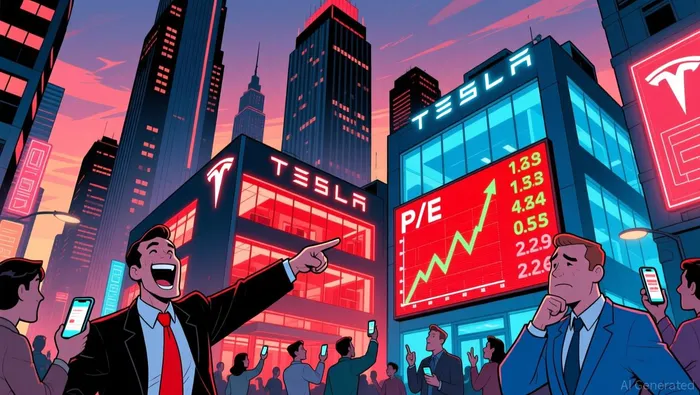 The forward P/E ratio of 204 further underscores the valuation gap. While high-growth companies often command premium multiples, Tesla's earnings trajectory has not justified such a lofty figure. For context, the S&P 500's forward P/E typically hovers around 18–20, and even high-flying tech stocks rarely exceed 50 according to market data. Tesla's multiple implies that investors are betting on a future where the company dominates global EV markets, energy storage, and robotaxi services-a scenario that remains unproven.
Sales Decline: A Harbinger of Trouble?
Tesla's recent quarterly results have added fuel to the bearish narrative. In Q4 2025, the company delivered 418,227 vehicles, a 15% drop from the 495,570 units delivered in the same period in 2024 and below the Wall Street forecast of 423,000 units according to Q4 results. This marked the second consecutive annual sales decline, with full-year 2025 deliveries totaling 1.64 million units-8% fewer than in 2024 according to investor reports. The slowdown reflects intensifying competition from traditional automakers and EV startups, as well as macroeconomic headwinds like rising interest rates and stagnant demand in key markets.
Michael Burry highlighted these sales trends as a critical warning sign. "If a company can't grow its core business, its valuation becomes a house of cards," he stated, noting that Tesla's revenue growth has outpaced delivery growth, largely due to price increases rather than volume. This dynamic raises questions about the sustainability of Tesla's profit margins, particularly as rivals like BYD and Rivian gain market share.
Market Euphoria vs. Fundamentals
Despite the bearish arguments, Tesla's stock remains a darling of speculative investors. The company's dominance in energy storage-14.2 GWh deployed in Q4 2025-and its ambitious robotaxi roadmap have fueled optimism. Additionally, Tesla's brand strength, vertical integration, and software ecosystem provide defensible moats. Proponents argue that the forward P/E ratio is justified by the company's potential to monetize autonomous driving and expand into new markets like Europe and Southeast Asia.
However, this optimism often overlooks key risks. Tesla's reliance on price hikes to maintain margins, its lack of consistent profitability in international markets, and the regulatory challenges facing its robotaxi ambitions all pose significant hurdles. Moreover, the company's capital-intensive expansion plans-such as the Texas Gigafactory and the Berlin plant-require sustained cash flow, which could be jeopardized by a prolonged sales slump.
Risks and Opportunities for Investors
For investors, Tesla presents a high-stakes proposition. On one hand, the stock's volatility offers the potential for outsized gains if the company executes on its long-term vision. On the other, a correction in the forward P/E multiple-triggered by a missed delivery target, regulatory setbacks, or macroeconomic deterioration-could lead to a sharp selloff. The risk is amplified by Tesla's lack of buybacks and its history of shareholder dilution, which Burry has likened to a "slow bleed" on value.
Conversely, Tesla's innovation pipeline and first-mover advantage in EVs and energy storage could create new revenue streams. The success of its robotaxi service, in particular, could redefine the company's business model, shifting it from a vehicle seller to a mobility-as-a-service provider. Investors willing to tolerate short-term volatility may find value in Tesla's long-term potential, provided they can stomach the risks.
Conclusion
Tesla's stock valuation remains a contentious topic, straddling the line between justified optimism and speculative excess. While the company's technological prowess and market leadership are undeniable, its current valuation appears to hinge on unproven future outcomes. George Noble's $80 fair value estimate and Michael Burry's warnings serve as cautionary reminders that fundamentals must anchor long-term investment decisions. For now, Tesla's stock is a high-risk, high-reward bet-a bubble waiting to burst for some, and a golden opportunity for others.





Comentarios
Aún no hay comentarios