
Tesla's Starlink Integration and Its Implications for the Future of Connected Mobility
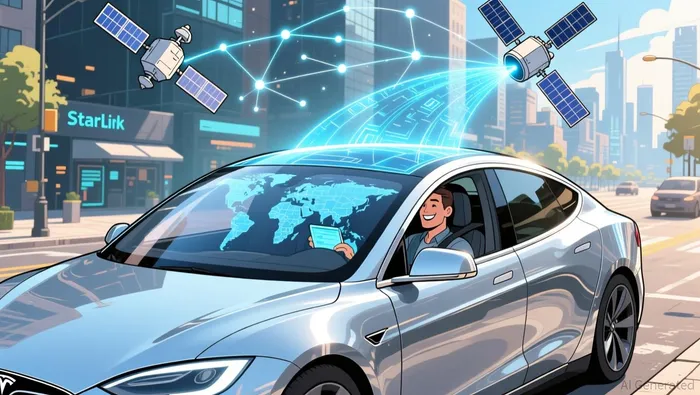
The integration of SpaceX's Starlink satellite internet into TeslaTSLA-- vehicles represents a pivotal shift in the convergence of infrastructure, mobility, and digital ecosystems. This development, underscored by Tesla's recent patent filings and strategic alignment with Elon Musk's broader ventures, signals a redefinition of electric vehicle (EV) ownership and autonomous systems. By embedding Starlink connectivity into its vehicles, Tesla is not merely enhancing in-car functionality but reimagining the role of the automobile in a hyperconnected, AI-driven future.
Strategic Infrastructure Convergence: A New Paradigm
Tesla's patent for a "Vehicle Roof Assembly with Radio Frequency Transparent Material" exemplifies a strategic move to bridge terrestrial and satellite-based infrastructure. The use of polycarbonate and acrylonitrile styrene acrylate (ASA) materials in the roof allows satellite signals to pass through unimpeded, enabling seamless connectivity between 5G and Starlink networks as demonstrated in a recent report. This innovation addresses a critical limitation of traditional vehicle designs, where metal or glass roofs block satellite signals, and positions Tesla as a pioneer in overcoming the "last-mile" connectivity challenge for autonomous systems.
The integration of Starlink into Tesla's ecosystem aligns with Musk's vision of a unified infrastructure network. By leveraging SpaceX's satellite constellation, Tesla can ensure uninterrupted data transmission for its Full Self-Driving (FSD) systems, robotaxi fleets, and even its Optimus humanoid robot according to Musk's recent interview. This synergy between space-based and ground-based technologies creates a feedback loop: autonomous vehicles generate vast amounts of real-time data, which Starlink transmits to centralized AI systems, according to an industry analysis. Such convergence not only enhances operational efficiency but also reduces reliance on terrestrial networks, which remain inconsistent in remote or disaster-affected regions as reported by industry analysts.
Redefining EV Ownership: From Transportation to Mobility Platforms
The implications for EV ownership are profound. Tesla vehicles equipped with Starlink could transform into mobile offices, base camps, or emergency response units, offering uninterrupted internet access even in off-grid locations according to a transportation analysis. This capability aligns with the growing demand for "always-on" connectivity, particularly as remote work and digital nomadism become mainstream. For instance, the Cybertruck's power export features, combined with Starlink integration, could enable users to power tools, appliances, or even small businesses from a single vehicle as noted in a recent article.
Moreover, the integration strengthens Tesla's value proposition in the software-as-a-service (SaaS) model. By enabling seamless over-the-air updates and real-time fleet management, Tesla can monetize connectivity features, such as premium bandwidth or emergency communication services according to market research. This shift from hardware-centric to software-driven revenue streams mirrors broader industry trends, where data and digital services account for an increasing share of automotive profits as reported in a strategic analysis.
Autonomous Systems: A Leap Toward Full Self-Driving
The convergence of Starlink and autonomous systems is particularly transformative for Tesla's robotaxi ambitions. The ability to switch between 5G and satellite networks ensures that autonomous vehicles remain operational in areas with poor cellular coverage, a critical factor for global scalability as highlighted in a recent article. Furthermore, Starlink's low-latency, high-bandwidth connectivity facilitates real-time data sharing across fleets, enabling collaborative decision-making and dynamic route optimization according to industry experts.
Critically, this integration addresses a key regulatory and technical hurdle: the need for redundant communication systems in autonomous vehicles. By embedding Starlink antennas directly into vehicle roofs, Tesla mitigates the risk of signal loss, a concern that has historically slowed the deployment of self-driving technologies as noted in a patent analysis. As noted by industry analysts, this innovation could accelerate the adoption of robotaxis in rural and underserved markets, where traditional infrastructure is lacking according to a market report.
Competitive Dynamics and Industry-Wide Implications
Tesla's Starlink integration establishes a formidable competitive moat. While traditional automakers and even EV rivals like BYD and Rivian focus on cellular-based connectivity, Tesla's satellite-first approach offers a unique value proposition: global, uninterrupted coverage as stated in a market analysis. This advantage is amplified by Musk's control over both the vehicle (Tesla) and the satellite network (Starlink), creating a vertically integrated ecosystem that is difficult to replicate according to industry experts.
However, challenges remain. The cost of integrating satellite hardware into vehicles could increase production expenses, potentially affecting Tesla's affordability strategy for mass-market models like the $25,000 Model 2 according to a financial report. Additionally, regulatory scrutiny around data privacy and cybersecurity-particularly for autonomous systems reliant on satellite networks-may emerge as a barrier to widespread adoption as reported in industry insights.
Conclusion: A Connected Future, Redefined
Tesla's Starlink integration is more than a technological feat; it is a strategic masterstroke that redefines the boundaries of EV ownership and autonomous mobility. By converging space-based and ground-based infrastructure, Tesla is positioning itself as a leader in the next phase of transportation: one where vehicles are not just modes of transport but nodes in a global, AI-driven network. For investors, this development underscores Tesla's ability to innovate beyond its core automotive business, leveraging synergies across Musk's ventures to create a durable competitive edge. As the automotive industry grapples with the challenges of electrification and autonomy, Tesla's Starlink-enabled vehicles may well set the new standard for connected mobility.





Comentarios
Aún no hay comentarios