
Tesla's Robotaxi Trial: A Cautionary Tale of Ambition and Hurdles
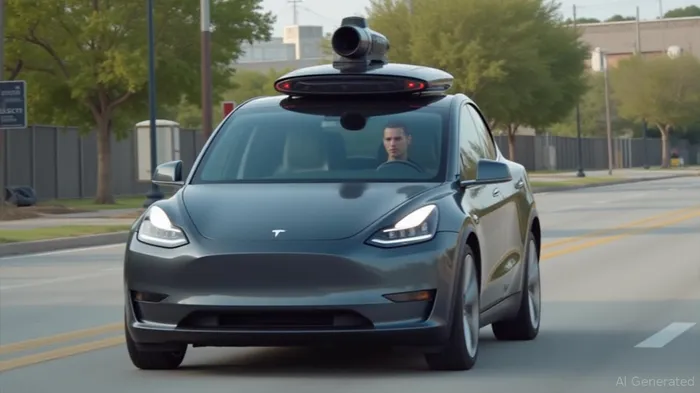
Tesla's June 2025 Robotaxi trial in Austin, Texas, marks a pivotal—but fraught—step toward its vision of autonomous mobility. While the launch underscores the company's technological aspirations, its reliance on front-seat safety monitors and geofenced operational limits reveals critical challenges in achieving truly scalable, profitable autonomy. For investors, this “supervised” rollout raises red flags about regulatory risks, capital efficiency, and the competitive landscape. Below, we dissect the strategic implications and argue that caution remains warranted until TeslaTSLA-- proves it can move beyond incremental pilot programs.
Market Positioning: Lagging Behind Competitors in the Autonomy Race
Tesla's Robotaxi trial contrasts sharply with rivals like Waymo, which already operates in Austin without human safety drivers. Waymo's autonomous fleet, now in its seventh year of commercial service, has built a lead in both technological maturity and regulatory trust. In contrast, Tesla's reliance on human monitors signals unresolved technical limitations, particularly in handling unpredictable urban environments.
This conservative approach may delay Tesla's ability to monetize its autonomy stack at scale. Waymo's model—where no human intervention is required—offers higher operational efficiency and lower labor costs. Tesla's trial, by contrast, is a “proof-of-concept” exercise rather than a commercially viable service.
Investors should note that Tesla's stock has underperformed Alphabet in recent years, reflecting skepticism about its autonomous timeline.
Regulatory Risks: Navigating a Shifting Policy Landscape
While Texas's lax autonomous vehicle regulations have allowed Tesla to proceed without stringent oversight, this advantage may prove fleeting. A pending Texas bill could soon require companies to seek state authorization and allow regulators to revoke permits if safety concerns arise. Meanwhile, the National Highway Traffic Safety Administration (NHTSA) has already flagged concerns about Tesla's autonomy systems, demanding detailed safety protocols and emergency preparedness plans.
The stakes are high: If Tesla's trial results in safety incidents—or if regulators tighten rules—the costs could be severe. A misstep could delay deployment in other states, where requirements are stricter. In California, for instance, autonomous vehicle testing mandates rigorous reporting and public disclosure of disengagement events—a standard Tesla may struggle to meet.
Scalability Concerns: The Cost of Human Oversight
Tesla's trial involves 10–20 unmodified Model Ys, with safety monitors present in every vehicle. This model is economically unsustainable at scale. Waymo's fleet, by contrast, operates with no onboard humans, reducing labor costs and enabling broader deployment.
The financial burden of maintaining safety monitors—alongside the fixed costs of geofencing software updates and regulatory compliance—could squeeze margins. Tesla's capital expenditure (CapEx) in autonomous tech has already risen sharply, yet the company has yet to demonstrate a clear path to profitability in this sector.
Tesla's investments in autonomy are rising, but returns remain elusive.
Investment Thesis: Proceed with Caution
Tesla's Robotaxi trial is a milestone, but it is far from a victory lap. Key risks include:
1. Competitive disadvantage: Waymo's head start in unsupervised autonomy could cement its dominance.
2. Regulatory backlash: NHTSA and state agencies may impose stricter rules, increasing costs.
3. Scalability limits: Geofencing and human monitors restrict growth potential.
Recommendation: Investors should avoid overvaluing Tesla's autonomy ambitions until the company:
- Eliminates the need for onboard safety monitors.
- Expands beyond geofenced zones without operational failures.
- Secures regulatory approvals in key markets like California.
Until then, Tesla's autonomous play remains a high-risk, long-term bet. While the trial provides incremental validation, the path to profitability is clouded by execution risks and formidable competition.
Tesla's valuation assumes autonomy success, but peers with clearer paths may offer better risk-adjusted returns.
Conclusion
Tesla's Robotaxi launch is a strategic move, but it's also a reminder of the company's challenges in delivering on its autonomous vision. The inclusion of safety monitors and geofenced restrictions highlights unresolved technical and regulatory hurdles. For investors, patience is critical. Success in this trial is just the first step; the true test lies in moving beyond supervision and scaling nationwide. Until that happens, Tesla's autonomous ambitions remain a work in progress—and a risky investment thesis.





Comentarios
Aún no hay comentarios