
Tesla's Robotaxi Service: A Game-Changer for the Company and a Threat to Uber and Lyft
PorAinvest
sábado, 13 de septiembre de 2025, 3:03 pm ET2 min de lectura
LYFT--
The rally extends a positive momentum that began earlier in the month, with shares gaining over 6% in a single session amid heavy trading volume. According to data from CNBC, Tesla’s stock closed at $370.44 on Thursday, reflecting a 6.5% daily increase. This performance has propelled the company toward break-even for the year, erasing earlier losses and positioning it as a standout in the tech-heavy Nasdaq index [1].
Analysts point to Tesla’s progress in full self-driving (FSD) software and robotics as key drivers. Recent updates suggest the company is on track for a robotaxi rollout, with projections of up to 1,000 units deployed by year-end, albeit conservatively estimated in some investor analyses shared on X. This comes alongside bullish forecasts for 2025 vehicle deliveries, potentially reaching 2.2 million units—a 23% increase from 2024—coupled with expanding energy storage deployments that surged 125% in recent quarters [1].
Financial health underpins this optimism. Tesla reported $25.2 billion in revenue for its latest quarter, with operating cash flow hitting $7.9 billion and automotive margins holding steady at 18.1%, as detailed in updates from Yahoo Finance. The energy business achieved record profit margins, while cost of goods sold reached historic lows, signaling operational efficiency amid scaling production at facilities like Mega Shanghai [1].
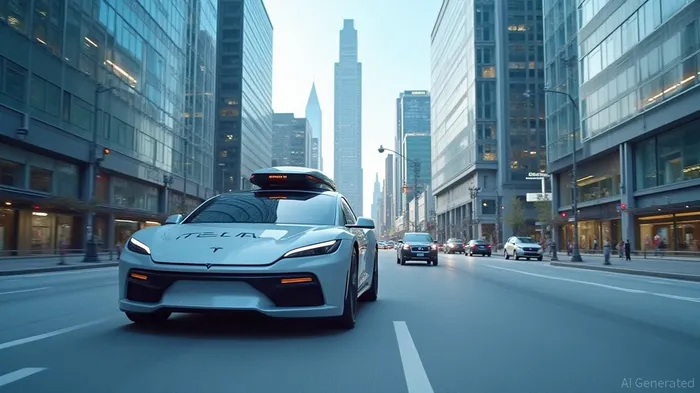
Tesla’s robotaxi service could be a game-changer, transforming the company from an EV pioneer to a sophisticated AI platform. This could put pressure on Uber and Lyft, which currently rely on human drivers. Tesla's progress in autonomous driving and recurring revenue streams make it a formidable competitor.
Market sentiment and external factors are also playing a role. Posts on X from industry watchers highlight a wave of positive sentiment, with users noting Tesla’s record cash reserves and over 130,000 orders backlog as indicators of sustained demand. This aligns with broader market trends, where anticipated Fed rate cuts—potentially by 100 basis points by year-end—could lower borrowing costs and boost consumer spending on big-ticket items like EVs [1].
However, not all signals are unequivocally positive. While U.S. EV market share has dipped slightly to 49% amid competition from Hyundai and Kia, Tesla’s innovation pipeline, including new affordable models slated for the first half of 2025, is expected to counter this. A summary from Forbes earlier this year noted tariff reductions between the U.S. and China as a tailwind, reducing trade frictions that previously hampered growth [1].
Looking forward, price predictions vary but skew optimistic. A forecast from 24/7 Wall St. sees strong upside through 2030, driven by diversification into AI and energy. Analyst Dan Ives, in posts on X, described Tesla’s recent guidance as “Aaron Judge-like,” projecting 20%-30% delivery growth for 2025. Yet, risks remain, including regulatory hurdles for autonomy and potential slowdowns in global EV adoption [1].
The stock’s technicals also warrant attention. After soaring seven straight sessions as reported by Yahoo Finance, traders are watching key resistance at $355.87, with support around $344.68. Breaking these levels could signal further gains or a pullback, especially as Q3 earnings loom [1].
Tesla’s leadership in electric vehicles and beyond positions it uniquely. With Cortex Supercluster coming online and FSD version 13 advancements, the company is not just selling cars but building an ecosystem around sustainable energy and AI. Investor Gary Black’s summaries on X emphasize factors like higher FSD take rates and potential licensing deals, which could multiply profits [1].
Critically, Tesla’s cash position—sitting at record levels—provides a buffer against economic headwinds. As the company eyes a $1 trillion valuation, per some X discussions, its trajectory hinges on executing on promises like the compact model launch and energy profits potentially 10x by 2030 [1].
In summary, this surge reflects renewed faith in Elon Musk’s vision, but sustained performance will depend on delivering tangible results in a competitive arena. For industry insiders, the real story lies in how Tesla navigates innovation amid macroeconomic shifts, potentially redefining mobility for decades.
TSLA--
UBER--
Tesla's robotaxi service could be a game-changer, transforming the company from an EV pioneer to a sophisticated AI platform. This could put pressure on Uber and Lyft, which currently rely on human drivers. Tesla's progress in autonomous driving and recurring revenue streams make it a formidable competitor.
Tesla Inc.'s shares have surged, climbing over 10% in the past week and reaching around $370 as of September 12, 2025. This significant rebound is driven by a combination of advancements in autonomous driving technology and broader market optimism, particularly regarding potential Federal Reserve interest rate cuts. Investors are betting on Tesla’s future, particularly its robotaxi ambitions and AI integrations, which have rekindled enthusiasm after a period of volatility [1].The rally extends a positive momentum that began earlier in the month, with shares gaining over 6% in a single session amid heavy trading volume. According to data from CNBC, Tesla’s stock closed at $370.44 on Thursday, reflecting a 6.5% daily increase. This performance has propelled the company toward break-even for the year, erasing earlier losses and positioning it as a standout in the tech-heavy Nasdaq index [1].
Analysts point to Tesla’s progress in full self-driving (FSD) software and robotics as key drivers. Recent updates suggest the company is on track for a robotaxi rollout, with projections of up to 1,000 units deployed by year-end, albeit conservatively estimated in some investor analyses shared on X. This comes alongside bullish forecasts for 2025 vehicle deliveries, potentially reaching 2.2 million units—a 23% increase from 2024—coupled with expanding energy storage deployments that surged 125% in recent quarters [1].
Financial health underpins this optimism. Tesla reported $25.2 billion in revenue for its latest quarter, with operating cash flow hitting $7.9 billion and automotive margins holding steady at 18.1%, as detailed in updates from Yahoo Finance. The energy business achieved record profit margins, while cost of goods sold reached historic lows, signaling operational efficiency amid scaling production at facilities like Mega Shanghai [1].
Tesla’s robotaxi service could be a game-changer, transforming the company from an EV pioneer to a sophisticated AI platform. This could put pressure on Uber and Lyft, which currently rely on human drivers. Tesla's progress in autonomous driving and recurring revenue streams make it a formidable competitor.
Market sentiment and external factors are also playing a role. Posts on X from industry watchers highlight a wave of positive sentiment, with users noting Tesla’s record cash reserves and over 130,000 orders backlog as indicators of sustained demand. This aligns with broader market trends, where anticipated Fed rate cuts—potentially by 100 basis points by year-end—could lower borrowing costs and boost consumer spending on big-ticket items like EVs [1].
However, not all signals are unequivocally positive. While U.S. EV market share has dipped slightly to 49% amid competition from Hyundai and Kia, Tesla’s innovation pipeline, including new affordable models slated for the first half of 2025, is expected to counter this. A summary from Forbes earlier this year noted tariff reductions between the U.S. and China as a tailwind, reducing trade frictions that previously hampered growth [1].
Looking forward, price predictions vary but skew optimistic. A forecast from 24/7 Wall St. sees strong upside through 2030, driven by diversification into AI and energy. Analyst Dan Ives, in posts on X, described Tesla’s recent guidance as “Aaron Judge-like,” projecting 20%-30% delivery growth for 2025. Yet, risks remain, including regulatory hurdles for autonomy and potential slowdowns in global EV adoption [1].
The stock’s technicals also warrant attention. After soaring seven straight sessions as reported by Yahoo Finance, traders are watching key resistance at $355.87, with support around $344.68. Breaking these levels could signal further gains or a pullback, especially as Q3 earnings loom [1].
Tesla’s leadership in electric vehicles and beyond positions it uniquely. With Cortex Supercluster coming online and FSD version 13 advancements, the company is not just selling cars but building an ecosystem around sustainable energy and AI. Investor Gary Black’s summaries on X emphasize factors like higher FSD take rates and potential licensing deals, which could multiply profits [1].
Critically, Tesla’s cash position—sitting at record levels—provides a buffer against economic headwinds. As the company eyes a $1 trillion valuation, per some X discussions, its trajectory hinges on executing on promises like the compact model launch and energy profits potentially 10x by 2030 [1].
In summary, this surge reflects renewed faith in Elon Musk’s vision, but sustained performance will depend on delivering tangible results in a competitive arena. For industry insiders, the real story lies in how Tesla navigates innovation amid macroeconomic shifts, potentially redefining mobility for decades.


Divulgación editorial y transparencia de la IA: Ainvest News utiliza tecnología avanzada de Modelos de Lenguaje Largo (LLM) para sintetizar y analizar datos de mercado en tiempo real. Para garantizar los más altos estándares de integridad, cada artículo se somete a un riguroso proceso de verificación con participación humana.
Mientras la IA asiste en el procesamiento de datos y la redacción inicial, un miembro editorial profesional de Ainvest revisa, verifica y aprueba de forma independiente todo el contenido para garantizar su precisión y cumplimiento con los estándares editoriales de Ainvest Fintech Inc. Esta supervisión humana está diseñada para mitigar las alucinaciones de la IA y garantizar el contexto financiero.
Advertencia sobre inversiones: Este contenido se proporciona únicamente con fines informativos y no constituye asesoramiento profesional de inversión, legal o financiero. Los mercados conllevan riesgos inherentes. Se recomienda a los usuarios que realicen una investigación independiente o consulten a un asesor financiero certificado antes de tomar cualquier decisión. Ainvest Fintech Inc. se exime de toda responsabilidad por las acciones tomadas con base en esta información. ¿Encontró un error? Reportar un problema


SOBRE NOSOTROS
Nuestra historiaAutores de noticiasBase de conocimientosPolítica de privacidadTérmino de usoDescargo de responsabilidad de corretaje de tercerosTérminos de uso de AIMEDivulgaciones de riesgos de AInvest AICarrerasCONTÁCTENOS
Email: support@ainvest.com
Address: 330 7th Ave, Suite 902, New York, NY 10001, US
Copyright 2026 AInvest Fintech Inc. All rights reserved.


Comentarios
Aún no hay comentarios