
Tesla's Robotaxi Gamble: $200 Billion Prize or Overvalued Mirage?
The race to dominate autonomous mobility is on, and TeslaTSLA-- is betting its future on a $200 billion robotaxi market by 2040. But can Elon Musk's vision survive the pitfalls of execution? Let's dive into the data, risks, and why this is a “high-risk, high-reward” play for investors.
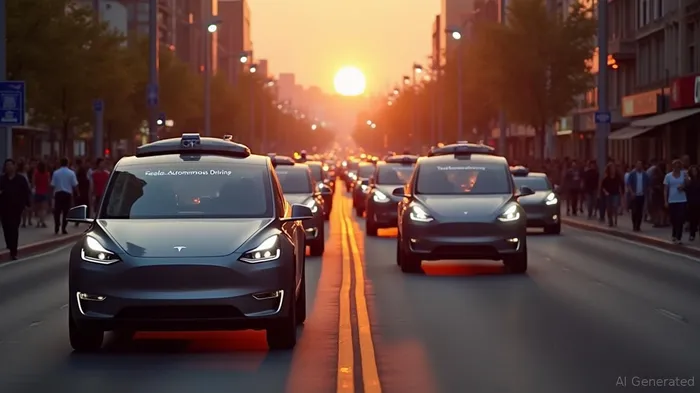
The Data Moat: Tesla's Secret Weapon
Tesla's existing fleet of over 3 million vehicles, each equipped with its Full Self-Driving (FSD) system, creates a data advantage no competitor can match. Waymo and Cruise may have billions in venture funding, but Tesla's real-world driving data—from over 100 billion miles—is a moat against rivals. This data fuels AI training, enabling Tesla's camera-only vision system (no costly LiDAR) to improve faster than sensor-heavy alternatives.
Unit Economics: Can Tesla Win on Price?
The math here matters. Waymo's robotaxis currently cost $1.34 per mile, while Tesla aims to slash that to $0.40 per mile by 2040. With its vertically integrated model—manufacturing, software, and charging infrastructure—Tesla's labor and capital costs are structurally lower. If achieved, this could make Tesla's robotaxis 40% cheaper than Uber rides by 2035, a game-changer for urban mobility.
But here's the catch: unit economics depend on scale. UBS estimates Tesla needs 2.3 million robotaxis by 2040 to hit $203 billion in annual revenue. Yet its Austin pilot—a paltry 10–20 cars—has already faced regulatory scrutiny over safety incidents. Musk's “hundreds of thousands by 2026” timeline? Analysts like Goldman SachsGS-- call it “overly optimistic.”
Regulatory Hurdles: The Elephant in the Room
The U.S. market, Tesla's testing ground, is a regulatory maze. California's rejection of self-driving truck mandates (Sept. 2023) and NHTSA's probe into Tesla's Austin trial show regulators aren't rubber-stamping innovation. Meanwhile, Waymo and Cruise already have 10,000+ robotaxis on the road, with partnerships like Uber-Waymo smoothing adoption. Tesla's slow rollout could cede market share to rivals before it even gains speed.
Valuation: Already Priced for Success?
Tesla's stock (TSLA) has surged +14.6% in 2025 on robotaxi hype, pushing its P/E ratio to 185x—a multiple usually reserved for startups, not a $900 billion company. The math here assumes Tesla captures 40% of the $200B robotaxi market by 2040. But what if it only claims 10%? That slashes the “fair value” by 75%, creating a steep drop for overleveraged bulls.
Investment Strategy: Play the Odds with Options
The verdict? Tesla's robotaxi vision is not a “buy” today—its stock is already too pricey for casual investors. But here's the play:
- Buy long-dated calls (e.g., 2026 expiration) at strike prices $300–$400, betting on a $500+ target by 2030 if Tesla scales.
- Set stop-losses at $150, cushioning against a “disaster scenario” (e.g., regulatory bans, cost overruns).
The 2025–2030 period is Tesla's make-or-break window. Success in Austin, partnerships with cities for geofenced zones, and cost reductions will validate the dream. Miss any of these, and the $200B market becomes a distant mirage.
Final Take
Tesla's robotaxi gamble is a “Moonshot” investment—high risk but with asymmetric upside. The data moat and scalability potential are real, but execution is a cliffhanger. For investors willing to bet on Musk's track record and take a 5–10 year view, options are the way to play it. If you're all-in today, you're not speculating—you're gambling.
Action Plan: Use 1–2% of your portfolio on Tesla calls with 3–5-year expiration. Let the data—and Musk's next move—do the talking.
Data as of June 2025. Past performance ≠ future results. Consult your financial advisor before acting on this analysis.





Comentarios
Aún no hay comentarios