
Tesla's Robotaxi Breakthrough and the Case for Strategic Investment in Autonomous Mobility
The investment narrative surrounding TeslaTSLA-- has undergone a seismic shift in 2025. Once dominated by metrics like vehicle deliveries and production rates, the company's valuation is now increasingly tied to its progress in artificial intelligence, robotics, and autonomous driving. As Tesla tests driverless robotaxis in Austin without safety monitors and accelerates its Full Self-Driving (FSD) software rollout, the market is recalibrating its expectations. This transformation raises a critical question: Can Tesla's autonomous mobility ambitions justify its premium valuation, or is the stock overextended in its bet on the future?
The Technological Edge: Data, Cost, and Scalability
Tesla's approach to autonomous driving-reliant on camera-based systems rather than expensive lidar technology-has positioned it as a disruptor in the race for self-driving dominance. According to a Forbes report, this strategy leverages the company's 5 million global vehicles as a data trove, enabling rapid AI training and deployment. By contrast, competitors like Waymo face higher hardware costs, with each autonomous vehicle reportedly requiring $100,000 in custom equipment. This cost advantage, combined with Tesla's ability to scale its software across its existing fleet, has drawn bullish projections from analysts. Dan Ives of Wedbush, for instance, argues that Tesla's AI and robotics segments could contribute $1 trillion in value by 2026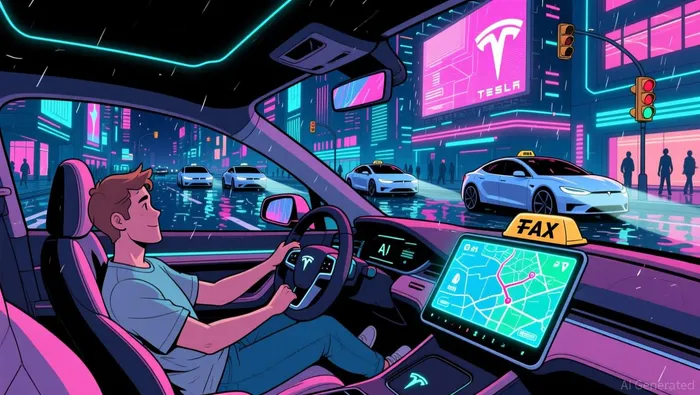 , potentially propelling the stock to a $2 trillion market cap.
Financial Projections: From EV Sales to Autonomous Revenue Streams
While Tesla's traditional vehicle sales face headwinds, its autonomous services are emerging as a speculative growth engine. Q1 2025 financial results underscored the challenges: automotive revenue fell 20% year-over-year to $13.97 billion, partly due to the expiration of the $7,500 U.S. federal EV tax credit. However, the company's FSD software, priced at $99 per month or $8,000 outright, is gaining traction. Morgan Stanley estimates that Tesla's robotaxi fleet could expand from 50–150 vehicles today to 1,000 by 2026, with a long-term target of one million units by 2035. If achieved, this would generate revenue through per-mile fees and external fleet commissions, potentially contributing up to 50% of Tesla's total revenue by 2030.
The energy storage segment further diversifies Tesla's revenue base. Shipments reached 32.5 GWh in the first three quarters of 2025, generating $8.9 billion in sales. With gross margins in this division outpacing the automotive segment (which now sits at 16–18%), Tesla's pivot toward energy and AI could mitigate near-term automotive pressures.
Challenges: Regulation, Competition, and Execution Risks
Despite the optimism, Tesla's autonomous ambitions face significant hurdles. In October 2025, the U.S. NHTSA opened an investigation into 2.9 million Tesla vehicles linked to crashes involving FSD. Regulatory scrutiny, coupled with technical challenges in achieving Level 4/5 autonomy, could delay widespread deployment. Additionally, Tesla's market share in the EV sector has declined to 7.5% in the first half of 2025, as rivals like BYD and Chinese startups gain ground through product diversification and pricing strategies.
Morgan Stanley's recent downgrade of Tesla to "Equal-weight" highlights these risks, citing execution uncertainties and slowing automotive growth. The firm's caution underscores the tension between Tesla's long-term vision and its near-term financial performance.
### The Investment Case: Balancing Hype and Potential
For investors, the key lies in assessing whether Tesla's autonomous mobility initiatives can deliver on their promise. Analysts like Cathie Wood of Ark Invest argue that 90% of Tesla's enterprise value could derive from AI and robotics by 2029, while Stephen Gengaro of Stifel projects a 25% stock surge if the company meets its AV goals. These projections hinge on successful scaling of robotaxis, regulatory approvals, and the Cybercab's 2026 launch.
However, Tesla's current valuation-trading at a P/E ratio of 260x estimated 2025 earnings-reflects aggressive expectations. A misstep in execution, such as delays in unsupervised FSD deployment or regulatory setbacks, could trigger a re-rating. Conversely, a breakthrough in autonomous scale could validate the market's optimism, particularly as the global robotaxi market is projected to exceed $118 billion by 2031.
Conclusion: A High-Stakes Bet on the Future
Tesla's transformation from automaker to AI-driven mobility platform is reshaping its valuation narrative. While traditional vehicle sales face near-term pressures, the company's autonomous and energy segments offer a compelling long-term story. For strategic investors, the challenge is to weigh the risks of regulatory and technical delays against the potential rewards of leading the autonomous revolution. As Tesla tests the boundaries of what's possible in Austin, the market will continue to bet on its ability to turn vision into reality.





Comentarios
Aún no hay comentarios