
Tesla's Robotaxi: Assessing Its Position on the Autonomous Driving S-Curve
Tesla's Robotaxi service is now live, but it's a supervised step on the autonomous driving S-curve. The company launched an invite-only ride-hailing service in the San Francisco Bay Area last July, using Model Ys equipped with its Full Self-Driving (Supervised) software. The service currently operates with a safety driver to meet California regulations, a requirement that underscores the gap between today's reality and the fully driverless promise. This launch is a necessary first step for data collection and regulatory engagement, but it arrives against a stark backdrop of competition.
The key point is timing. While TeslaTSLA-- is testing with a human in the loop, its primary rival, Waymo, has already achieved scale. In 2025, San Francisco became Waymo City, with a fleet of 1,000 vehicles completing millions of rides each month. Waymo's dominance is not just a matter of head start; it's a demonstration of the operational and regulatory infrastructure required to move from prototype to public service. Tesla's current setup-launched just days after California regulators confirmed it lacks the proper autonomous vehicle permits-highlights the regulatory and technical hurdles the company must still clear.
Viewed through the lens of the adoption curve, Tesla's launch is a classic early mover's test. It's gathering data and building a user base, but it's doing so from a position of significant lag. The supervised nature of the service reflects both current legal constraints and the technological maturity gap. For all the hype, the real S-curve acceleration for Tesla begins not with this launch, but with its ability to demonstrate a safety record that meets regulators' standards and to secure the permits needed to remove the safety driver. Until then, the company is riding the first, slow part of the curve while a competitor is already scaling the steep middle phase.
The Competitor Gap: Exponential Adoption vs. Camera-Only Tech
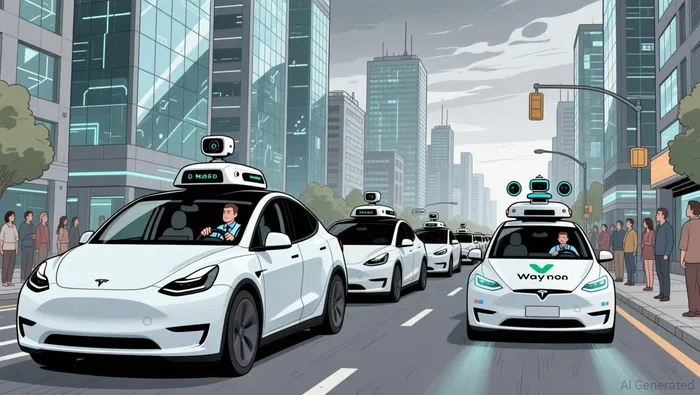
The technological gap between Tesla and its leading competitors is not a minor detail; it's a fundamental divergence in the architecture of the future. While Tesla's camera-only approach is a deliberate, cost-focused bet, its rivals have built a proven multi-sensor foundation. Waymo's fleet of 1,000 vehicles in San Francisco operates on a system that combines cameras, radar, and lidar, creating a safety redundancy that Tesla's vision-only stack lacks. Gerber praised Nvidia's use of vision and radar for safety redundancy, implicitly contrasting it with Tesla's setup. This isn't just about hardware-it's about the adoption curve. Competitors are already scaling a technology stack that regulators and consumers may ultimately demand, while Tesla's path requires proving its camera-centric system can achieve the same safety standard at scale.
The market is also shifting toward a new paradigm in autonomy, one that moves beyond simple perception to reasoning. Nvidia's recent launch of its 'Alpamayo' open AI models is a clear signal that the next frontier is about machines that can understand and reason about their environment, not just react to it. This is where the competitive landscape could widen further. If reasoning-based AI becomes the benchmark for true autonomy, Tesla's current software stack, trained on its camera data, may need significant adaptation to keep pace. The risk is that Tesla gets locked into a technological lane that the industry is moving away from.
This year is the critical inflection point. As early Tesla backer Ross Gerber frames it, 2026 is the "come-to-Jesus" year where promises must become reality. For the Robotaxi narrative to hold, Tesla must demonstrate exponential deployment and a safety record that surpasses its competitors' early lead. The company is racing against a dual timeline: the intensifying EV competition that erodes its core market share, and the policy changes that will phase out tax credits. If Tesla cannot show rapid, safe scaling of its Robotaxi service this year, the entire growth story-built on the promise of autonomous networks and licensing revenue-faces a severe credibility test. The gap isn't just technological; it's a race against time.
Financial and Strategic Implications
The Robotaxi push is less a revolutionary pivot and more a reaction to mounting market pressure. As early Tesla backer Ross Gerber frames it, the company is pivoting to robots when nobody will buy your car. This stark assessment points to a core vulnerability: Tesla's brand momentum in its core electric vehicle market is eroding. The Robotaxi narrative, therefore, becomes a defensive bet to re-ignite growth and investor enthusiasm, rather than a pure offensive play on a new S-curve.
This defensive posture is magnified by the company's valuation. With a 214x forward P/E ratio, Tesla's stock leaves absolutely no room for error. The market is pricing in perfection, betting that autonomous networks and licensing revenue will materialize at scale. Any stumble in the Robotaxi timeline-whether due to technical hurdles, regulatory delays, or safety incidents-would be punished severely. The high multiple turns a slow ramp into a crisis of confidence.
The strategic risk is that a failure to deliver on autonomy could unravel the entire growth story. As Gerber notes, 2026 is the "come-to-Jesus" year where promises must become reality. If Tesla cannot demonstrate exponential deployment of Robotaxis, the narrative that supports its premium valuation begins to collapse. This is especially dangerous as the company faces headwinds on its core business: intensifying EV competition is eroding market share, and the expiration of tax credits will remove a key demand driver. The Robotaxi service was meant to be the next paradigm shift, but if it fails to gain traction, the company could be left with a high-priced stock and a shrinking core market, with no clear path to justify its current price. The financial and strategic implications are clear: Tesla is betting its future on a single, high-stakes technology leap, with its valuation offering no margin for doubt.
Catalysts and What to Watch
The coming months will separate Tesla's Robotaxi from a mere concept. The company's ability to close the adoption gap hinges on a series of near-term milestones and the pace of its competitors. The first and most critical test is regulatory. Tesla's launch arrived with a stark warning: the state told the company it lacks the proper permits to operate and charge for autonomous rides. The company must now clear the "very involved" permitting process in California to move beyond the supervised, invite-only service. As experts note, the key question is whether Tesla can demonstrate a better safety record than human driving. Any delay in securing permits to operate without a safety driver would cement its lag and likely trigger more regulatory scrutiny.
At the same time, Tesla must prove it can still move vehicles. The company's desperate incentives, mocked by early backer Ross Gerber, are a sign of a weakening core market. The pace of vehicle sales and the effectiveness of these promotions will determine if the company has the cash and brand momentum to fund its robotaxi bet. A continued sales slump would leave Tesla with fewer resources to invest in the technology and could accelerate the defensive pivot into autonomy.
Finally, the competitive landscape is accelerating. While Tesla tests in a few cities, its rivals are scaling. In 2025, San Francisco became Waymo City, with a fleet of 1,000 vehicles completing millions of rides each month. Waymo is now expanding its service area to over 260 miles, a move that sets a new benchmark for operational scale. The industry is also shifting toward a new paradigm. Nvidia's recent launch of its 'Alpamayo' AI models aimed at enabling reasoning-based autonomous development signals where the technological S-curve is headed. If Tesla's camera-only, vision-centric stack cannot adapt to this new standard, its entire autonomy narrative risks becoming obsolete.
The bottom line is that 2026 is the year of truth. Tesla must secure permits, maintain sales, and demonstrate its technology can keep pace with rivals who are already building the infrastructure of the future. The adoption gap will either close or become structural based on how well the company navigates these concurrent catalysts.





Comentarios
Aún no hay comentarios