
Tesla's Q2 Earnings Disappointment and AI Ambitions: Is This the Setup for a Rebound?
Tesla's Q2 2025 earnings report painted a mixed picture: a 12% year-over-year revenue decline to $22.496 billion, a 14% drop in vehicle deliveries to 384,000 units, and a 42% plunge in operating income to $900 million. Yet, beneath the short-term volatility lies a strategic pivot that could redefine the company's trajectory. For value investors, the question is whether Tesla's current valuation—bolstered by a P/E ratio of 182.89 and a P/S ratio of 6.305—justifies its moonshot bets on AI, robotics, and mobility-as-a-service.
The Short-Term Pain: Earnings Misses and Market Sentiment
Tesla's Q2 results reflected near-term headwinds. Automotive revenue fell to $16.7 billion, a direct result of waning demand in key markets like China and the U.S., where Trump-era tariffs and expiring EV tax credits have dampened sales. The company's regulatory credit revenue also halved, further straining its bottom line. Investors reacted swiftly, sending shares down 4% in after-hours trading and extending the stock's year-to-date decline to 18%.
This volatility is emblematic of Tesla's dual identity: a high-growth tech company burdened by the cyclical pressures of the automotive industry. While traditional value metrics like P/B (8.905) suggest reasonable pricing relative to book value, the sky-high P/E ratio underscores a stock trading on future expectations rather than current earnings. For value investors, this raises a critical question: Is Tesla's AI-driven transformation a credible catalyst to justify its premium valuation, or is the market overestimating its potential?
The Long-Term Play: AI and Robotics as Growth Catalysts
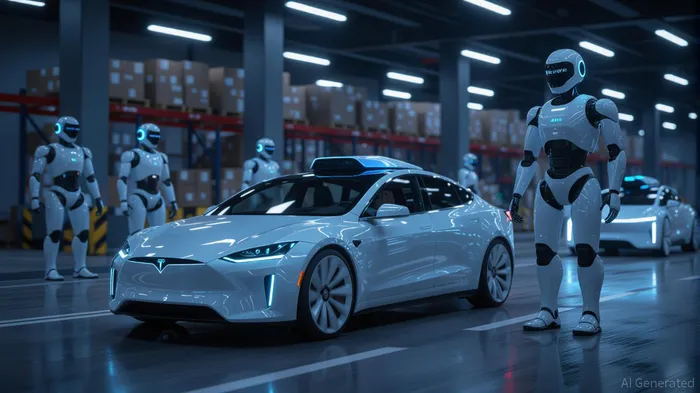
Elon Musk's vision for TeslaRACE-- has always extended beyond electric vehicles. The Q2 earnings call emphasized progress on two flagship initiatives: Robotaxi (Cybercab) and Optimus Gen 3, both of which could unlock vast revenue streams.
- Robotaxi: Tesla's fully autonomous ride-hailing service, launched in Austin, Texas, is priced at $6.90 per ride and aims to expand to 50% of the U.S. population by year-end. Analysts project this service could generate $1 billion in 2026 and scale to $75 billion by 2030. The business model—combining internal ridesharing and external fleet partnerships (with a 25% commission per mile)—offers high-margin, recurring revenue.
- Optimus Gen 3: The humanoid robot, with 28+ degrees of freedom and multimodal sensor fusion, targets the $25 trillion global automation market. At 1% market share, it could generate $250 billion annually by 2030, disrupting logistics, healthcare, and manufacturing.
Tesla's AI infrastructure, including the Dojo supercomputer and 16,000 H200 GPUs, positions it to lead in training large-scale AI models for these applications. With $36.8 billion in cash and $9+ billion in projected 2025 capex, the company has the financial firepower to sustain its R&D bets.
Valuation vs. Potential: A Value Investor's Dilemma
For value investors, Tesla's current metrics are a paradox. The P/E ratio of 182.89 dwarfs traditional automakers (Ford: 8, GM: 9), while the P/S ratio of 6.305 suggests a reasonable multiple for a company with $22.5 billion in revenue. However, the P/B ratio of 8.905—while in line with industry averages—reflects a market capitalization ($559.85 billion) far exceeding its tangible assets.
The key to unlocking value lies in whether Tesla can monetize its AI and robotics initiatives. If Robotaxi scales to 100,000 units annually by 2026 and Optimus achieves mass production by 2027, the company's revenue base could expand exponentially. This would re-rate Tesla from a premium EV maker to a high-growth tech company, potentially justifying a P/E closer to software firms (e.g., Microsoft's 35x).
Risks and Realities
Despite its ambitions, Tesla faces significant hurdles:
- Regulatory Delays: Unsupervised FSD deployment remains stalled in key markets like California and Europe.
- Technical Challenges: Optimus's commercial viability depends on achieving Level 4 autonomy and cost-effective mass production.
- Competition: Waymo, Cruise, and Chinese EV startups are advancing their own AI/robotic solutions.
Moreover, near-term profitability is under pressure. Tesla's operating margin of 4.1% in Q2 2025 is a far cry from its historical 20%+ margins, and the loss of federal EV incentives could further erode margins.
Investment Thesis: A High-Risk, High-Reward Bet
For value investors willing to tolerate short-term volatility, Tesla presents a unique opportunity. The company's balance sheet is robust, its AI infrastructure is cutting-edge, and its long-term revenue potential is staggering. However, success hinges on executing its AI/robotics roadmap—a path littered with technical and regulatory risks.
A disciplined approach might involve:
1. Position Sizing: Allocating a small portion of a portfolio to Tesla, given its high volatility and concentrated risk.
2. Milestone Monitoring: Closely tracking Q3–Q4 2025 updates on Robotaxi expansion and Optimus production timelines.
3. Valuation Guardrails: Selling if the P/E ratio climbs above 250x or if AI/robotics revenue fails to materialize by 2026.
In conclusion, Tesla's Q2 earnings disappointment is a symptom of near-term challenges, not a death knell for its long-term vision. For investors with a 5–10 year horizon and a tolerance for disruption, the company's AI ambitions could indeed set the stage for a rebound—but patience and prudence will be essential.





Comentarios
Aún no hay comentarios