
Tesla's Push for FSD and Legal Risks: A Strategic Crossroads for Autonomous Tech Investment
The autonomous vehicle (AV) industry is at a pivotal moment, with Tesla's Full Self-Driving (FSD) system representing both a technological leap and a regulatory minefield. As of 2025, Tesla's FSD v14.2.1 has introduced features like context-aware texting permissions, a move that has sparked legal and public safety debates. While the company touts its FSD Beta as a safer alternative to human drivers-claiming 2.9 million miles between major collisions-regulators like the National Highway Traffic Safety Administration (NHTSA) have raised alarms over incidents involving traffic light violations and lane-crossing errors according to reports. This tension between innovation and compliance underscores a critical question for investors: Can Tesla's aggressive FSD rollout navigate the legal and regulatory hurdles that threaten to derail its vision?
The Legal Tightrope: Innovation vs. Compliance
Tesla's FSD system, currently classified as Level 2 automation, requires active driver engagement. Yet, the company's recent updates blur this line. Elon Musk's announcement that FSD could permit texting under certain conditions has clashed with U.S. state laws, which universally prohibit texting while driving. Legal experts argue that Tesla's approach risks normalizing distracted behavior, even if the system's sensors monitor driver attentiveness. Meanwhile, the California Department of Motor Vehicles (DMV) is suing TeslaTSLA-- for allegedly misleading customers by implying the system can drive itself. A court ruling on this case, expected before year-end, could set a precedent for how regulators define the boundaries of AV capabilities.
NHTSA's investigations further complicate Tesla's position. Despite Tesla's safety data showing fewer collisions per mile compared to human drivers according to reports, the agency has documented 18 traffic light violations and 24 lane-crossing incidents involving FSD vehicles according to reports. These findings highlight a disconnect between Tesla's internal metrics and real-world performance, raising questions about the reliability of its camera-based AI. For investors, this duality-promising data versus regulatory skepticism-creates a high-stakes scenario where technical progress may not translate to market acceptance.
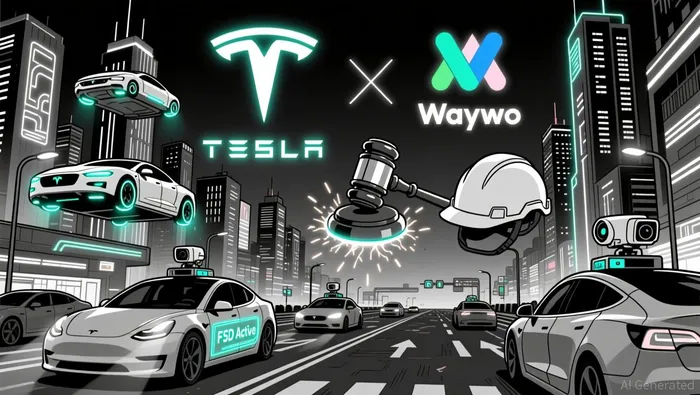
Competitor Strategies: A Tale of Two Approaches
Tesla's camera-only, vision-based approach contrasts sharply with competitors like Waymo and General Motors (GM). Waymo, for instance, relies on advanced sensor suites (29 cameras, 6 RADARs, 5 LIDARs) and has logged 20 million real-world miles and a billion simulation miles. This data-driven, sensor-rich model aligns with regulatory expectations for safety redundancy, particularly in adverse conditions like fog or heavy rain according to reports. Waymo's vehicles, already operating at Level 4 autonomy, have a disengagement rate lower than Tesla's, indicating greater operational reliability according to reports.
GM's Cruise, meanwhile, has pivoted from robotaxis to integrating autonomy into its broader vehicle lineup, a move that reduces direct investment but slows long-term returns according to reports. Waymo, backed by Alphabet's $1.5 trillion market cap, has a clearer path to profitability through ride-hailing services, with a valuation of $45 billion in 2024 according to reports. In contrast, Tesla's scalability-enabled by its 4 million-vehicle fleet-offers a lower-cost path to data collection but faces higher regulatory uncertainty.
Regulatory Fragmentation and Financial Implications
The U.S. AV regulatory landscape remains fragmented, with federal legislation like the Autonomous Vehicle Acceleration Act of 2025 aiming to standardize safety reporting according to reports. However, state-level disparities persist. California's strict safety reports and black-box recorder requirements contrast with Arizona's streamlined permitting, creating operational challenges for companies seeking nationwide deployment according to reports. For Tesla, this patchwork of rules complicates its FSD rollout, particularly as it seeks to expand robotaxi services to 50% of the U.S. population by year-end according to reports.
Financially, Waymo's $175,000 per-vehicle cost and 30–40% higher pricing than Uber/Lyft highlight the high operational costs of sensor-rich AVs according to reports. Tesla's cheaper robotaxi model ($0.12/Km vs. Waymo's $8.75/Km) could disrupt the market if regulatory hurdles are overcome according to reports. However, Tesla's recent $10 billion operating losses and NHTSA investigations underscore the risks of prioritizing speed over compliance.
Strategic Crossroads for Investors
For investors, Tesla's FSD strategy embodies a high-risk, high-reward proposition. The company's vertical integration and fleet scalability could enable rapid deployment if regulatory approvals align with its aggressive timeline. However, the California DMV lawsuit and NHTSA investigations signal that regulators are unlikely to tolerate overpromising. Competitors like Waymo, with their sensor-rich, simulation-driven models, offer a more conservative path with clearer regulatory alignment but slower scalability.
The broader AV industry's future hinges on resolving the tension between innovation and compliance. As the U.S. moves toward federal standards and global players like China and Japan advance their own frameworks according to reports, companies must balance technical ambition with legal prudence. For Tesla, the coming months will test whether its FSD vision can navigate the regulatory crossroads-or if it will be forced to recalibrate its approach.







Comentarios
Aún no hay comentarios