
The Tesla of Politics: How Musk's America Party Could Reshape Markets and Fiscal Policy
The rise of Elon Musk's proposed “America Party” marks a pivotal moment in U.S. political and economic history. Born out of Musk's vehement opposition to Donald Trump's “Big Beautiful Bill,” which slashed electric vehicle (EV) tax credits and expanded deficits, the party's fiscal agenda could redefine subsidies, corporate incentives, and sector-specific investment risks. Musk's vision—fiscal austerity paired with support for innovation—pits him against both major parties, creating a high-stakes game for investors in EVs, space tech, and renewables.
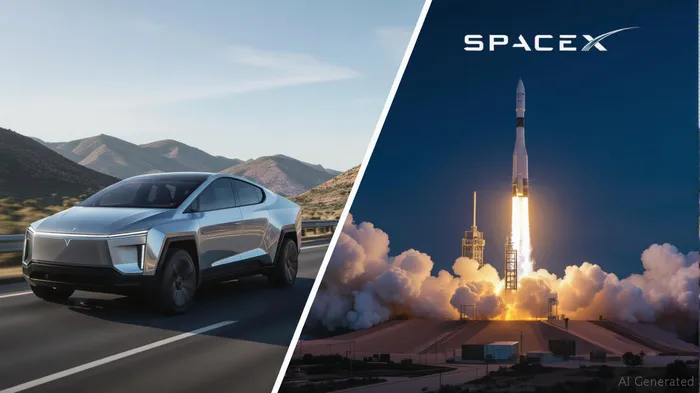
The Political Feasibility of a Third-Way Disruption
Musk's America Party faces steep structural barriers. Ballot access requirements, campaign finance constraints, and voter loyalty to the Democratic and Republican duopoly all loom large. Historically, third parties like Ross Perot's Reform Party have influenced discourse but failed to sustain power. Yet Musk's financial clout and social media reach offer unique advantages. By threatening primary challenges against Republican lawmakers who back Trump's deficit-increasing policies, Musk could splinter GOP unity—a tactic that resonates with fiscal conservatives.
However, Musk's personal brand is a double-edged sword. His controversial rhetoric, including past Nazi-salute gaffes, and his alignment with progressive policies like high-skilled immigration may alienate Trump's base and moderate Democrats alike. Polls suggest only 20–30% of U.S. voters would support a third-party candidate, even under Musk's leadership.
Fiscal Policy: A Tightrope Between Austerity and Innovation
The America Party's core tenet—reducing the national debt—aligns with Musk's critique of Trump's $3.4 trillion deficit-expanding bill. Yet Musk's policy prescriptions are nuanced:
- Cut corporate subsidies for traditional industries, like fossil fuels, which received $17 billion in federal grants in 2023.
- Maintain or expand subsidies for Musk's sectors: EVs, space tech, and renewables. For example, Tesla's 2024 revenue included $2.8 billion from regulatory credits, while SpaceX secured $3.8 billion in NASA contracts last year.
- Phase out EV tax credits “sensibly”, avoiding abrupt cuts that could destabilize markets.
This creates a paradox: fiscal hawkishness toward sectors Musk doesn't control, paired with targeted subsidies for his own industries. The result is a policy landscape where sectors aligned with Musk's priorities (e.g., space tech, battery storage) could thrive, while traditional energy and auto manufacturers face headwinds.
Sector-Specific Risks and Opportunities
Electric Vehicles (EVs): Navigating the Subsidy Cliff
The Big Beautiful Bill's termination of EV tax credits by 2025 poses a threat to TeslaTSLA-- and competitors. Musk argues that abrupt cuts could cost Tesla $1.2 billion annually, but his party's “sensible wind-down” proposal offers a lifeline. Investors should monitor Tesla's stock (TSLA) for volatility tied to political developments.
Meanwhile, Musk's push for battery innovation (e.g., Tesla's 4680 cell) could position EVs as a long-term growth sector, even without federal subsidies. Companies like CATL (300750.SZ) and Plug PowerPLUG-- (PLUG) may benefit from Musk's focus on energy storage.
Space Tech: A New Frontier of Federal Funding
SpaceX's dominance in government contracts—$12 billion from NASA since 2012—could grow under an America Party. The party's emphasis on “space as a priority” aligns with Musk's vision of Mars colonization and satellite broadband (Starlink). Investors should watch aerospace suppliers like Lockheed MartinLMT-- (LMT) and Maxar Technologies (MAXR), which benefit from NASA partnerships.
Renewables: A Bipartisan Cause, for Now
Despite Musk's advocacy, renewables face an uncertain future. The Big Beautiful Bill's phaseout of solar/wind tax credits by 2027 could reverse under an America Party, but fiscal austerity complicates this. Companies like NextEra EnergyNEE-- (NEE) and Vestas (VWS.CO) remain exposed to subsidy risks.
Fiscal Austerity's Winners and Losers
- Winners: Sectors tied to debt reduction, like healthcare (reduced Medicaid spending could boost for-profit hospitals like HCA HealthcareHCA-- (HCA)), and tech stocks insulated from subsidies (e.g., AlphabetGOOGL-- (GOOGL)).
- Losers: Firms reliant on federal largesse, such as coal companies (Peabody Energy (BTU)) and automakers without EV competitiveness (e.g., Ford (F)).
Investment Strategy: Playing Both Sides of the Political Divide
- Short-term plays:
- Short Tesla (TSLA) if the America Party's “sensible wind-down” of subsidies fails to materialize, or if Musk's political project collapses.
Long aerospace stocks (LMT, MAXR) as space tech gains bipartisan appeal.
Long-term bets:
- EV infrastructure: Companies like ChargePointCHPT-- (CHPT) and Tesla's Supercharger network could benefit from Musk's push for EV adoption, even without federal credits.
Debt-sensitive sectors: Financials (JPMorgan (JPM)) and utilities (Dominion Energy (D)) may outperform in a lower-deficit environment.
Hedge against political risk:
- Gold (GLD) or inflation-protected bonds (TIP) as a buffer against fiscal uncertainty.
- Dividend stocks in stable sectors (e.g., Coca-ColaKO-- (KO)) to mitigate volatility.
Final Analysis: Musk's Gambit Could Redraw the Economic Map
The America Party's success hinges on Musk's ability to leverage his wealth and influence to disrupt bipartisan spending trends. Even if the party falters, its ideas—fiscal discipline and innovation subsidies—could seep into policy debates, reshaping corporate incentives. For investors, the key is to position in sectors that benefit from Musk's priorities while hedging against political instability. As the EV tax credit sunset approaches, the next chapter of U.S. fiscal policy is anything but boring.
Recommendation: Overweight aerospace and EV infrastructure stocks, underweight traditional energy, and maintain a diversified defensive portfolio. The Tesla of politics is here—and markets must adapt.





Comentarios
Aún no hay comentarios