
Tesla's Political Crossroads: Assessing Long-Term Investment Risks Amid Elon Musk's Political Entanglements
Elon Musk's political ambitions have become a double-edged sword for TeslaTSLA--, intertwining the company's fortunes with the volatile landscape of U.S. and global politics. From co-founding the Department of Government Efficiency (DOGE) to launching the America Party, Musk's high-profile political moves in 2025 have triggered significant market turbulence, brand alienation, and investor skepticism. This analysis evaluates the long-term investment implications of these developments, balancing Tesla's technological strengths against the reputational and regulatory risks posed by Musk's political entanglements.
Market Reactions: Volatility as the New Normal
Tesla's stock price has become a barometer of Musk's political activities. The most striking example came on July 5, 2025, when Musk announced the America Party via a poll on X, leading to a 6.8% single-day drop in Tesla's share price, closing at $293.94 [1]. This followed a 22% decline earlier in the year after Musk's role in DOGEDOGE--, which he co-led under President Trump's administration [4]. Analysts like Wedbush's Dan Ives argue that Musk's political distractions are eroding focus on Tesla's core business, exacerbating investor fatigue [1].
The stock's year-to-date plunge of over 30% in 2025 underscores the market's unease [1]. While Tesla's Q3 2024 financials showed resilience—with a 17.3% year-over-year profit increase and $2.17 billion in net income [5]—the company's forward guidance has been clouded by political uncertainty.
Brand Erosion and Sales Slumps
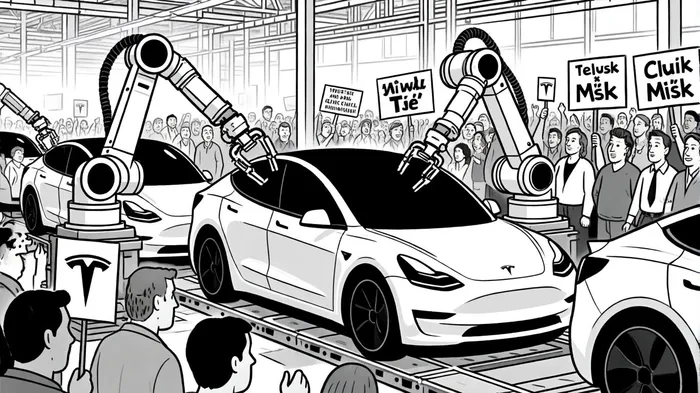
Musk's political alignment has directly impacted Tesla's brand equity. In California, Tesla's largest U.S. market, vehicle registrations declined for seven consecutive quarters through mid-2025, while hybrid registrations surged [2]. Similar trends emerged in Europe, where Germany and France saw nearly 50% drops in Tesla sales in April 2025 [3]. Protests against Musk's ties to Trump and DOGE have escalated, with vandalism of Tesla vehicles and a rise in “I bought this before Elon went off the rails” bumper stickers [1].
The #TeslaTakedown movement, which gained global traction, has further strained the company's sustainability image. Critics argue that Musk's support for Trump's policies—such as the U.S. withdrawal from the Paris Agreement—contradicts Tesla's environmental mission [4]. Celebrities and consumers have distanced themselves, with some selling Tesla vehicles to avoid “political baggage” [2].
Investor Pushback and Governance Tensions
Shareholders are increasingly vocal about the risks of Musk's political activism. In September 2025, investor Jay Butera proposed a Tesla board policy enforcing political neutrality, citing concerns over regulatory scrutiny and customer alienation [2]. The board rejected the proposal, arguing it would “chill free speech” and be impractical to enforce [2]. This standoff highlights the tension between Musk's personal ambitions and corporate governance, raising questions about Tesla's long-term strategic coherence.
Competitive Pressures: BYD's Rise and Regulatory Hurdles
Tesla's challenges extend beyond politics. Rival BYD overtook Tesla in global battery electric vehicle (BEV) sales in late 2024 and maintained its lead in 2025, leveraging affordable pricing, vertical integration, and Chinese government support [5]. BYD's Blade Battery technology and ultra-fast charging systems have undercut Tesla's premium positioning, particularly in price-sensitive markets [3].
Regulatory headwinds further complicate Tesla's outlook. The EU's 45% tariffs on Chinese EVs and proposed Foreign Subsidies Regulation threaten to erode Tesla's competitive edge in Europe [5]. Meanwhile, U.S. political shifts—such as potential repeal of the Inflation Reduction Act's EV incentives under a Trump administration—add uncertainty to Tesla's domestic growth strategy [1].
Long-Term Outlook: Innovation vs. Political Drag
Despite these challenges, Tesla's technological pipeline remains a key differentiator. The company's Full Self-Driving (FSD) system, now at version 12.5, continues to outpace competitors, with Musk claiming it is “closer to Level 4 autonomy” [5]. Upcoming affordable models priced under $30,000 and cost reductions in manufacturing could reinvigorate sales [5].
However, analysts caution that Musk's political baggage may persist as a liability. If Tesla becomes synonymous with partisan agendas, it risks regulatory scrutiny, international market friction, and a fractured customer base [6]. The America Party's focus on “technological governance” could yield favorable policies, but its polarizing nature may alienate moderates and regulators [6].
Conclusion: A High-Stakes Balancing Act
Investors must weigh Tesla's innovation-driven potential against the reputational and regulatory risks tied to Musk's political persona. While the company's leadership in EV technology and autonomous driving offers long-term upside, the entanglement with Musk's political ventures introduces volatility that may not align with traditional investment horizons. For Tesla to reclaim its trajectory, it must navigate a delicate balance: leveraging Musk's vision for technological progress while mitigating the fallout from his political overreach.





Comentarios
Aún no hay comentarios