
Tesla's Pivotal Crossroads: Can Non-Automotive Innovation Offset Eroding Core EV Growth?
The electric vehicle (EV) revolution, once a tailwind for Tesla's meteoric rise, is now a double-edged sword. While the company's core automotive business faces mounting headwinds-declining margins, shrinking market share, and aggressive price competition-Tesla is pivoting toward a future defined by energy storage, artificial intelligence (AI), and robotics. This strategic shift raises a critical question for investors: Can these nascent ventures offset the erosion of Tesla's traditional EV dominance and sustain long-term value creation?
The Erosion of Core EV Growth
Tesla's automotive business, once a paragon of innovation and scale, is under siege. By Q1 2025, the company's U.S. market share had dipped to 43.5%, while its global production ranked second to BYD's 4.0 million units. In Europe, Tesla's market share plummeted to 7.2% by May 2025, with German sales collapsing by 62.2% year-on-year according to market analysis. These declines reflect a broader trend: the expiration of U.S. federal EV tax credits in late 2025 triggered a 41% contraction in the EV market in November 2025, though Tesla's U.S. share temporarily surged to 56.7% as rivals faltered.
Financially, Tesla's automotive revenue dropped 20% in Q1 2025, with total revenue falling 9% year-on-year to $19.3 billion. Projections for Q4 2025 suggest a 50% decline in automotive sales and a 17.2% gross margin, down from 23.3% in 2023. These figures underscore a stark reality: Tesla's core EV business is no longer a growth engine but a liability in a market increasingly saturated by Chinese rivals like BYD and Xiaomi, which have leveraged aggressive pricing and localized ecosystems to capture market share.
Strategic Capital Allocation: Energy Storage, AI, and Robotics
Tesla's response to these challenges is a bold reimagining of its identity. The company is allocating capital to three non-automotive pillars: energy storage, AI, and robotics.
Energy Storage: A Resilient Growth Engine
Tesla's energy generation and storage segment has emerged as a bright spot. In Q1 2025, revenue surged 67% year-on-year to $2.73 billion, driven by a 154% increase in storage deployments to 10.4 GWh. The Shanghai and Lathrop, California, Megafactories are now operating at full capacity, with plans to expand to support 100 GWh of annual deployment by 2027. This segment is projected to grow by at least 50% in 2025, fueled by demand for Powerwalls and Megapacks in residential and commercial markets.
AI and Autonomy: High-Margin Opportunities
Tesla's Full Self-Driving (FSD) software is advancing rapidly. By October 2025, FSD adoption had reached 12% of the installed fleet, with v14.2.2.2 nearing "Unsupervised" capabilities. The company is also integrating xAI's Grok 4 models to maintain a technological edge. FSD licensing is emerging as a high-margin revenue stream, with automakers reportedly in talks to adopt the software. Meanwhile, Tesla's Cybercab (Robotaxi) is in pilot testing in Texas, with mass production slated for April 2026.
Robotics: A Future Value Driver
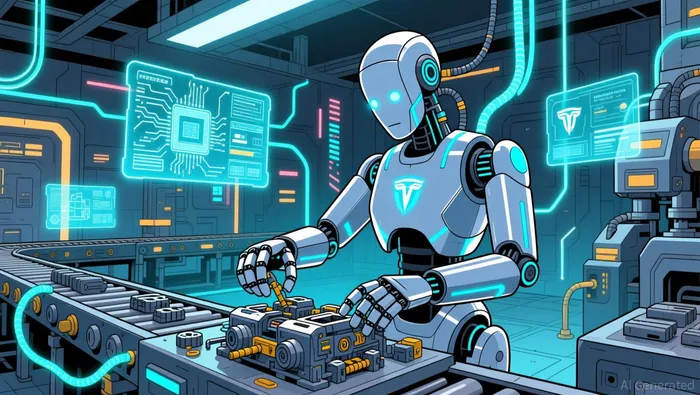
Tesla's Optimus humanoid robot, now performing repetitive tasks in its Fremont factory, is being scaled to 1,000 units per month by 2025. Elon Musk has suggested that robotics could account for 80% of Tesla's future value, a claim that, while ambitious, reflects the company's long-term vision. The Optimus Gen 2.5 iteration is already validating the market for industrial robotics, potentially benefiting competitors like Agility Robotics and Figure AI.
Capital Expenditures and Long-Term Projections
Tesla's 2024–2025 capital expenditures totaled $9 billion, with $6.1 billion spent in the first three quarters of 2025 according to financial reports. This funding is directed toward scaling AI initiatives, expanding energy storage capacity, and ramping up Optimus production. While 2026 capex is expected to rise as TeslaTSLA-- prepares for the next phase of expansion, the company's focus on automation and AI route optimization has already reduced transport emissions and improved manufacturing efficiency.
Long-term growth targets include achieving 3 million annual vehicle production within two years, expanding energy storage deployments to 100 GWh by 2027, and transitioning to 100% renewable manufacturing energy by 2026. These goals hinge on successful execution in AI, robotics, and energy storage-sectors where Tesla's first-mover advantage and vertical integration could provide a durable edge.
The Crossroads: Can Innovation Compensate for Erosion?
Tesla's strategic pivot is both visionary and risky. Energy storage and AI offer high-margin, recurring revenue streams that could buffer automotive volatility. However, these segments are still nascent: energy storage revenue remains a fraction of automotive sales, and FSD licensing is unproven at scale. Robotics, while promising, faces skepticism about commercial viability and regulatory hurdles.
For investors, the key question is whether Tesla's capital allocation aligns with its long-term value proposition. The company's ability to monetize AI and robotics will depend on factors beyond its control, such as regulatory approval for autonomous vehicles and global demand for industrial automation. Meanwhile, the core EV business remains vulnerable to price wars and shifting consumer preferences.
Conclusion
Tesla stands at a pivotal crossroads. Its non-automotive innovations-energy storage, AI, and robotics-have the potential to redefine its value proposition, but they must be viewed through the lens of strategic patience. While these ventures offer compelling long-term upside, they cannot yet offset the erosion of Tesla's core EV growth. Investors must weigh the company's technological ambition against the realities of market saturation, regulatory uncertainty, and the relentless pace of competition. In this high-stakes environment, Tesla's success will hinge not just on innovation, but on its ability to execute with discipline and foresight.







Comentarios
Aún no hay comentarios